After five years of championing grassroots change, the PAX Strengthening Civil Courage or Power of Voices project officially concluded on Tuesday, leaving a legacy of empowered youth leaders, newly appointed female chiefs, and a expansion of the national record of those killed during conflict.
At a closing ceremony held at the South Sudan Council of Churches on September 30, 2025, partner organizations gathered to showcase the project’s remarkable achievements.
Funded by the Dutch Ministry of Foreign Affairs, the initiative ran from 2021 to 2025, strengthening civil courage and amplifying local voices in the nation’s journey toward peace.
Speaking at the event, Martin Kwori, Executive Director of the Agency on Humanitarian Assistance and Development (AHD) an organzation working on amplifying voices of youth on issues of governance and constitution making,
“We want to build a constructive peace in South Sudan through empowering youth,” he said.
He credited the project with enabling the training of over 50 youth leaders in transformational leadership, noting that some have since been elected to executive positions in the East African Youth Parliament.
Mr Kwori added that through the support from PAX, AHD also conducted advocacy work related to the country’s constitution-making process.
Julia Aker, Executive Director of Concern Citizen Network for peace (CCNP) which works on research and advocacy on governance, thanked PAX stating that through their support, they were able to develop scenario for the country.
“We really thank PAX, and the government of Kingdom of Netherlands for supporting us to go around to disseminate information to the public,” he added.
Hillary, a representative from Remembering the Ones We Lost (RoWL), revealed that “with the help that PAX has given us, we were able to document over 11,000 more names, raising the total number of documented lost persons to 26,127.” RoWL documents the names of people killed due to conflict (s) in South Sudan.
He added that the vital data is now being used by the government to draft policies.
This work was complemented by the Dialogue and Research Institute (DRI), which successfully advocated for the transitional government’s endorsement of the Commission for Truth and Healing Bill.
“We have improved on the promotion of human rights and gender equality,” said DRI representative Malual Madol Akot. DRI works on Transitional Justice Agenda.
The project also made historic strides in breaking traditional barriers for women. Through the advocay work of Legacy for African Women and Children Network Initiative (LAWANCI), seven women were empowered and appointed as chiefs in Northern Bahr el Ghazal and Warrap States.
Meanwhile, Fidensia Charles Ladu, of the Juba Massacre of 1992 Widows and Orphans Association (JMWOA), shared a testament to the project’s long-term support. JMWOA works on on Memorialization and documentation the Missing.
“We benefited from PAX,” she said. “Even the orphans are now successful, and some are now doctors and in other different fields.”
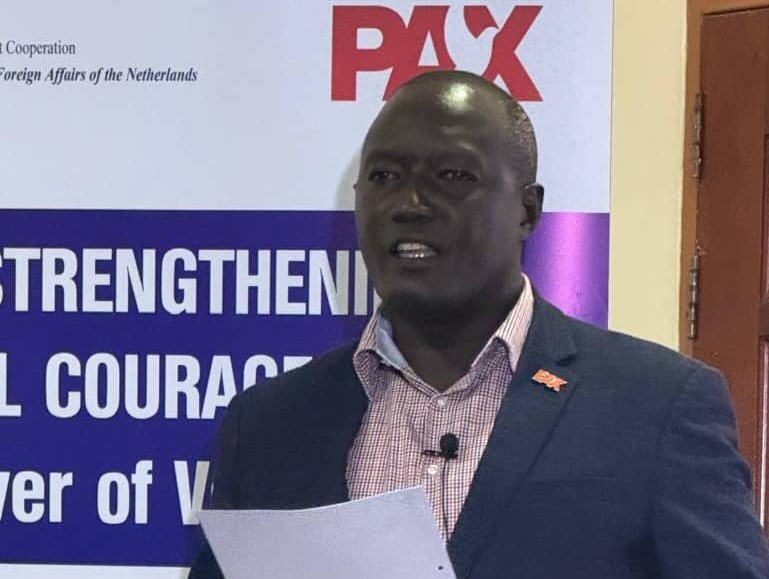
Emmanuel Ira, PAX’s Country Director, summarized the project’s broad reach, noting 112 distinct achievements have been recorded.
He stated that through the interventions, PAX has reached many social actors including those in government and traditional leaders.
He extended heartfelt gratitude to the Kingdom of the Netherlands.
“You have demonstrated to the people of South Sudan that you are good friends,” he said. “You will be cherished.”
The Secretary-General of the South Sudan Council of Churches described the project as ‘a journey of partnership and encouragement’ that allowed them ‘to reach hotspots and hard-to-reach communities’ to deepen the work of peace and reconciliation.
While the ‘Power of Voices’ project has formally ended, the event underscored a new beginning. It provided a crucial space for the partners—which also included the Catholic Dioceses of Torit (CDoT) and Malakal (CDoM) and the Women Advocates Association in South Sudan (WAASS), to forge a unified network.
The aim now is to build on this foundation, creating a solid block to collectively address the nation’s ongoing challenges of justice, peace, and security for the benefit of all citizens.