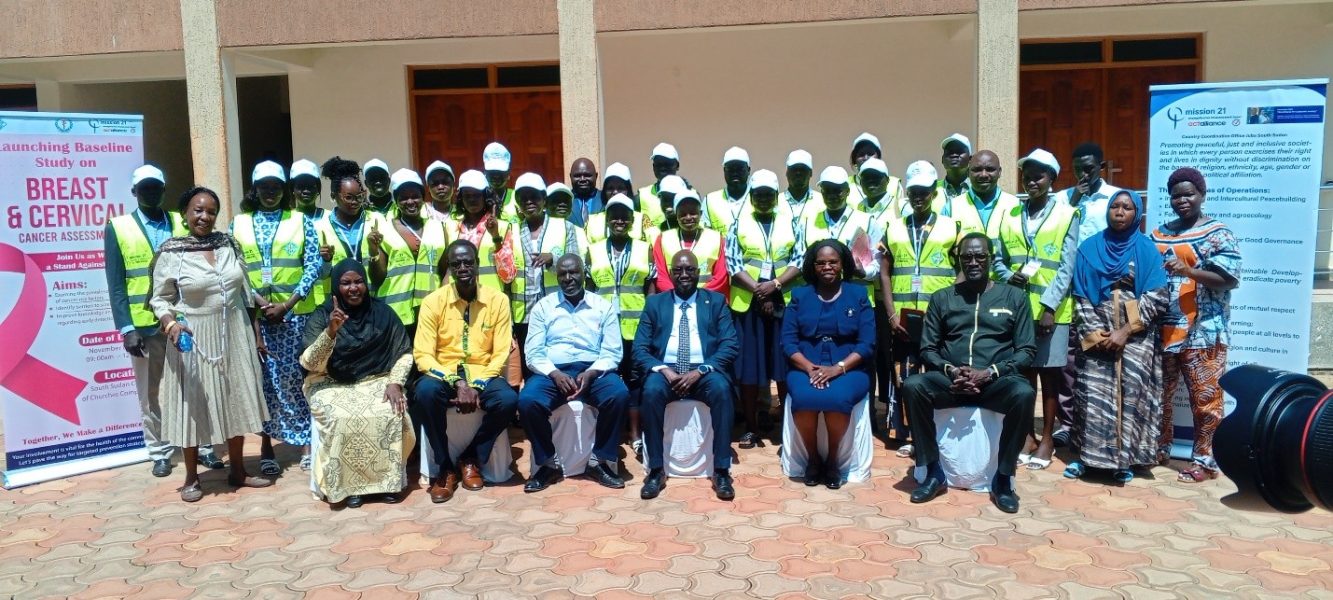
A cancer assessment initiative was launched in Juba on Thursday, November 6th, marking a positive step in the fight against a disease that has long been a silent and challenging threat in the country.
The survey is led by Mission 21, a global faith-based community, will be conducted primarily in Juba County, with a major focus on breast and cervical cancer.
While the survey was launched on Thursday, fieldwork will officially begin on Monday, November 10th.
Its primary objectives are to gather vital data to expand health awareness and screening programs, enhance the early detection of breast and cervical cancer, strengthen healthcare infrastructure, and create professional opportunities for South Sudanese women.
Speaking at the launch ceremony, Guliba Florence Hakim, Country Representative for Mission 21 in South Sudan, said the assessment marks a transition from a reactive to a proactive approach.
“For too long, cancer has posed a silent yet challenging threat, often detected only after it has progressed, complicating treatment options,” she stated.
The assessment will specifically target women aged 18 to 70, aiming to understand their knowledge, attitudes, and practices regarding cancer prevention.
It will also evaluate access to screening services and identify socio-economic, cultural, and educational barriers to effective care.
She said the initiative goes beyond mere medical interventions, adding that it represents a movement, a collective effort to cultivate a culture of health and resilience.
Ms Florence urged communities to fully participate in the assessment survey.
“We are united by the conviction that early action can alleviate the burden of cancer, transforming fears into hope.”
Following the assessment, she said Mission 21 plans to support the Midwifery School under the Presbyterian Relief and Development Agency (PRDA) by providing early detection tools and raising public awareness.
Kabuye Gerald, the Lead Consultant, detailed the methodology for the baseline survey, which he described as essential for tackling the ‘silent killer’ of cancer.
He emphasized that the goal is to establish comprehensive data on the technical, social, and institutional factors influencing cancer prevention in a country with limited existing information.
He said the survey will employ a mixed-method approach, combining quantitative house-to-house questionnaires with qualitative interviews and focus group discussions.
It will be conducted across several payams and blocks within Juba County, targeting a sample size of 2,287 respondents (70% women, 30% men), including people with disabilities.
Gerald highlighted that starting in Juba County is a strategic first step. “We start small and steadily. When we gain ground, there could be an opportunity to spread to other places and possibly cover the entire country.”
The data collection is scheduled for 10 working days, with a final report and validation workshop planned for December.
The cancer assessment survey was officially launched by Dr. Justin Bruno Tongun, Director of Al-Sabah Children’s Hospital, who also represented both the National and State Ministries of Health.
He declared the exercise ‘the most important to ever happen,’ comparing the threat of cancer to a form of national insecurity.
“When something goes wrong with the mother, what happens? The likelihood that that family will not eat today,” Dr. Tongun said, stressing why the focus on women’s cancers is critical. “When the mother dies, it leaves orphans. That is a disaster.”
He appealed to the enumerators to conduct their work with integrity. “
Do it honestly. Don’t forge the information. Don’t go and sit under a tree and begin filling your tablets. We need a correct answer.”
Dr. Tongun also called on local government and community leaders to ensure the research teams have safe and unrestricted access to households.
He confirmed that some cancer screening and diagnostic services exist within the country, notably at Al-Sabah Children’s Hospital and several other health centers, but acknowledged severe limitations in treatment capabilities.
He urged Mission 21 to involve the nation’s few cancer specialists in the initiative and to ensure the findings are widely published.
“To Mission 21, as a researcher, I have one request. After all this exercise is done… please kindly publish the information. Send the information out there so that people know how big our problem is.”
Officials say the success of the baseline survey would be foundational for planning future healthcare interventions, mobilizing resources, and ultimately, saving lives across South Sudan.