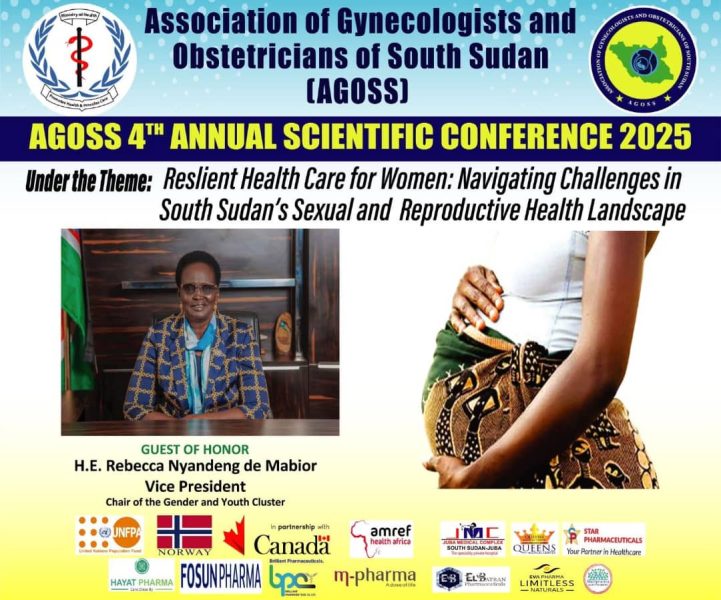
The Association of Gynecologists and Obstetricians of South Sudan (AGOSS) has called on the government to urgently increase national health sector financing and expedite the passage of long-pending professional health bills.
They group said, both steps are critical to reversing the country’s alarming maternal mortality trends.
The appeal was issued during the association’s 4th Annual Scientific Conference held on Sunday at in Juba, where senior clinicians, researchers, policymakers, and development partners gathered to discuss South Sudan’s most pressing reproductive, maternal, and adolescent health challenges.
Reading out the conference resolutions, Dr. Garang Dakjur Lueth, Assistant Professor of Obstetrics and Gynecology at the University of Juba, said South Sudan’s health system will remain weak unless the government fulfills key commitments starting with allocating 15% of the national budget to health, as outlined in the Abuja Declaration.
South Sudan’s maternal mortality rate stands at 692 deaths per 100,000 live births, one of the highest in the world.
According to AGOSS, the leading causes include postpartum hemorrhage, unsafe abortion, inadequate health funding, weak infrastructure, and poor referral systems.
The association called for strengthened maternal death surveillance, improved emergency obstetric care, promotion of respectful maternity services, and reinforcement of the Boma Health Initiative to improve community-level access.
AGOSS further urged the government to pass the Midwives and Nurses Council Bill and the Allied Health Professional Bill, saying their enactment would help regulate practice standards, accountability, and training quality across the health workforce.
The conference highlighted a growing crisis in male reproductive health, with 84% of 2,287 semen samples analyzed in Juba found to be abnormal.
AGOSS recommended establishing fertility services in key public hospitals including Juba, Wau, Kuajok, and Malakal Teaching Hospitals.
Menopause another neglected health area in South Sudan was flagged as a priority requiring more awareness, clinical training, and community engagement to support women experiencing silent but serious symptoms.
AGOSS reaffirmed that access to voluntary family planning is a basic human right and expressed concern that male dominance in household decision-making continues to restrict women’s access to contraceptives.
The association called for expanded adolescent-friendly SRHR services, more community awareness, and programs to curb the country’s high teenage pregnancy rate.
Delegates also raised alarm over gender indicators: child marriage at 52%, an adolescent birth rate of 158 per 1,000, and persistently high levels of gender-based violence.
They urged Parliament to fast-track the GBV Bill and empower women to make their own health decisions.
With more than 80% of births occurring at home, obstetric fistula remains a serious concern.
AGOSS called for improved awareness on facility-based delivery, more trained fistula surgeons, and strengthened rehabilitation support for survivors.
The conference committed AGOSS to deepen cooperation with the Ministry of Health, UN agencies, NGOs, universities, and private-sector partners to improve health outcomes.
The association pledged to continue supporting postgraduate training programs with institutions such as the University of Juba, the College of Physicians and Surgeons, and ECSACOG.
AGOSS also announced plans to extend future scientific conferences to three days, publish annual proceedings, and establish an AGOSS Research Grant to support young researchers.
The 4th AGOSS Annual Scientific Conference concluded with a united call for greater investment, stronger policies, and accelerated reform to strengthen South Sudan’s reproductive and maternal health sector.
The association said that only through sustained financing, professional regulation, and community-centered health programs can South Sudan reduce preventable maternal deaths and secure a healthier future for women and families nationwide.