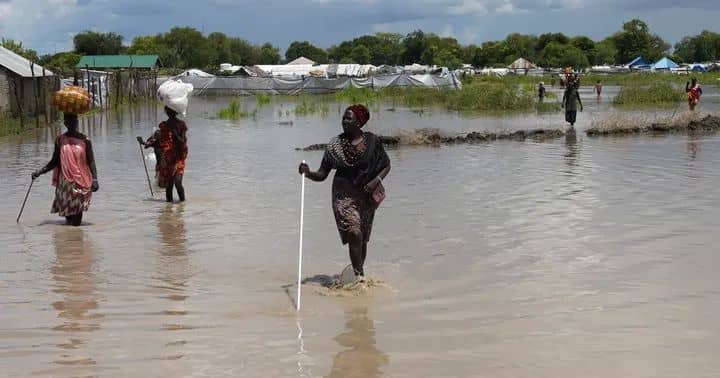
Floods, displacement, and the collapse of basic services have turned simple illnesses into life-threatening emergencies for the women of Rubkona County.
With health facilities washed away or left without medicines, thousands of mothers face an impossible reality: walk for days or go without care altogether.
For many, survival now depends on endurance, determination, and the hope that help will still be available when they finally arrive.
At 21, Nyandeng Nancy should be preparing for school exams or dreaming of a career. Instead, she is navigating a dangerous, waterlogged landscape where medical care is a two-day walk away from her home in Kaljak.
When sickness strikes, she has no choice but to leave before dawn, walk through mud, dodge floodwaters, and sleep outdoors to reach Nyaldiu Mobile PHCC temporary clinic supported by UNFPA.
“I came here because I am sick, and there is no medication in Kaljak,” she says, lowering herself gently onto the clinic bench after the long journey.
Her first visit months earlier was for a stubborn skin infection. This time, she is pregnant with her first child and desperate for antenatal care.
Nyandeng once dreamed of becoming a doctor. She speaks about it slowly, aware of how far away that path now feels.
“I still wanted to study,” she says. “If I get a chance, I want to be a doctor so I can help my community.”
Her feet ache. Her clothes are still damp from crossing flooded plains. But she is relieved today, at least, she made it in time.
A mother fighting for her life: Nyadhuola’s story
Across the courtyard, 30-year-old Nyadhuola Patai Jiol sits quietly, her face still pales from days of weakness. She arrived barely able to stand dehydrated, feverish, and fearful of losing her pregnancy.
“I cannot know what medication to take unless the doctor checks,” she says. “I was very sick.”
The clinical team diagnosed her with water-related diarrhea and treated her with Mitra Nizol, Daringa, Paracetamol, and Amoxicillin. A few hours later, her voice is stronger. She can finally sit upright.
“When I came, people looked like they were running. Now I feel better,” she says, smiling faintly. “I am very happy with Health Link. God will bless you.”
Nyadhuola has endured miscarriages before. This time, she refuses to give up.
Frontline pressure: Health workers brace against crisis
Inside the facility, staff move briskly between the consultation room, maternity tent, and pharmacy shelves, many of which are half empty.
Sexual and Reproductive Health Officer Juan Roy says the demand for services has surged dramatically.
“This project targets flood-affected and hard-to-reach communities,” he explains. “Before, we saw just a few cases. Now we receive around 70 clients every day.”
Women come for everything, OPD consultations, antenatal visits, family planning, postnatal care, vaccinations. Some arrive shaking from exhaustion. Others are carried by relatives.
Roy says stigma remains a major challenge.
“Many women seek contraception secretly because they fear their husbands or the community,” he says. Injectables are the most preferred because they are discreet and easy to hide.
Midwife Achiro Evaline agrees. She has delivered babies under torchlight, treated mothers in the rain, and improvised equipment when supplies ran out.
“Even with shortages, we try our best,” she says. “Mothers depend on us.”
Nyaldiu Mobile PHCC is a lifeline, but it is also fragile.
There is no electricity, no reliable water supply, no delivery bed, limited diagnostic tools, chronic drug shortages, and a roof that leaks whenever it rains.
Staff rely on manual labor, makeshift equipment, and sheer willpower to keep services running.
Still, women keep coming some from villages 10 to 20 kilometers away.
Some arrive with newborns tied to their backs. Some come heavily pregnant. Others come carrying children too sick to walk.
Every woman comes with a story of struggle—and every story speaks of a public system that has all but collapsed.
Walking through crisis, hoping for change
Nyandeng prepares to start her long walk home. She adjusts the wrap around her waist, ties her documents into a plastic bag to protect them from the water, and looks toward the flooded horizon.
“It is far,” she says simply. “But I must go.”
For women like her, healthcare is not a right but a journey measured in miles, endurance, and uncertainty.
Yet the Nyaldiu facility, powered by local staff and humanitarian partners, remains a fragile beacon of hope.
Even without electricity, even with empty shelves, the team continues to show up proving that in the heart of crisis, it is people, not buildings, who keep communities alive.