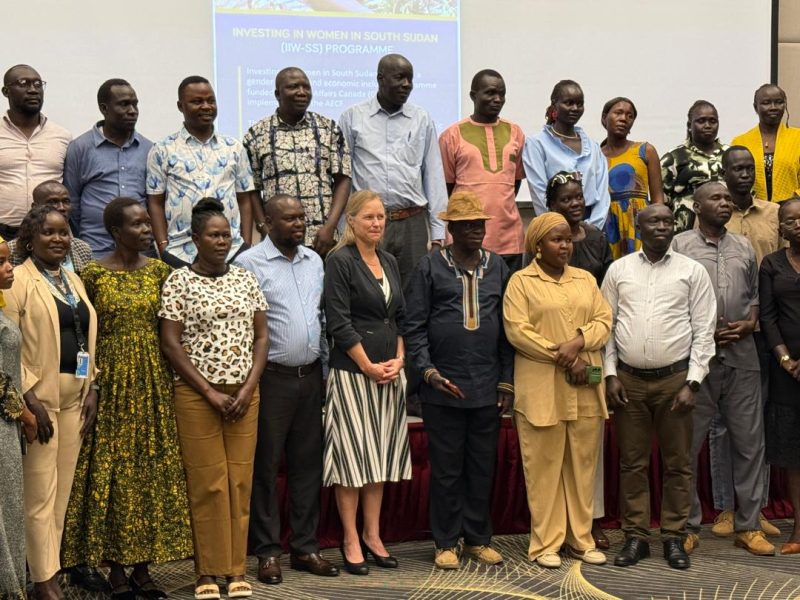
Partners, government officials, and civil society leaders have called for urgent adoption of gender-responsive policies to strengthen women’s participation in agricultural value chains, during a high-level Policy Dissemination Forum organized by the Africa Enterprise Challenge Fund (AECF) in Juba.
Speaking on behalf of the UN Women Country Representative, Adong Betty, Program Analyst for Women, Peace, and Security, delivered a compelling call to dismantle the systemic inequalities faced by women farmers.
She emphasized that although women produce the majority of household food in South Sudan, they remain largely excluded from decisions, resources, and market opportunities.
“Women till the land that feeds families and communities, yet their contributions remain invisible,” she said.
“When women are empowered, children eat better, communities grow stronger, and societies flourish. We must remove the barriers that prevent them from realizing their full potential.”
The forum highlighted persistent challenges including discriminatory land rights, limited access to credit and technology, and cultural norms that restrict women’s voices.
These obstacles continue to undermine productivity in a sector that employs more than 70% of the population.
The forum, part of the Investing in Women, South Sudan (IIW-SS) program implemented in partnership with CEPO and funded by Global Affairs Canada, brought together key stakeholders to discuss findings from a new policy brief addressing gender barriers in agriculture.
The group echoed the call, stressing that gender equality in agriculture is essential for national food security, economic stability, and long-term peace.
Participants also reviewed actionable recommendations from the policy brief, which outlined strategies for strengthening women’s leadership, improving resource access, and integrating gender considerations into agricultural policy frameworks.
Closing the event, partners reaffirmed their commitment to ensuring that women farmers are not only supported but fully recognized as central actors in South Sudan’s agricultural transformation.