Nearly 1,000 weapon-wounded patients have been treated in hospitals supported by the International Committee of the Red Cross (ICRC) across South Sudan this year, marking the highest figure recorded since 2018.
The sharp rise underscores the renewed intensity of violence in several parts of the country and signals deepening humanitarian concerns as health facilities struggle to cope.
According to the ICRC, escalating clashes since early this year have led to a surge in injuries caused by gunshots, explosions, and other weapons.
Many patients arrive at hospitals after long delays due to insecurity, poor roads, and limited access to transport—factors that drastically reduce their chances of survival.
“We were eight people and among the eight, I was the only one who survived,” recounts Paul Gabriel Renze, now undergoing treatment at the ICRC-supported Juba Military Hospital.
“They shot me in the waist and both legs. After three days, my wounds were rotting and developing maggots… The seven bodies were also rotting.”
Paul was rescued after a passerby alerted others, leading to his evacuation from Nagero County to Juba. He has since undergone several surgeries and continues to recover.
His story is far from isolated. ICRC teams have evacuated nearly 400 critically wounded patients by air this year alone, transferring them from remote counties to surgical facilities where they can receive life-saving care.
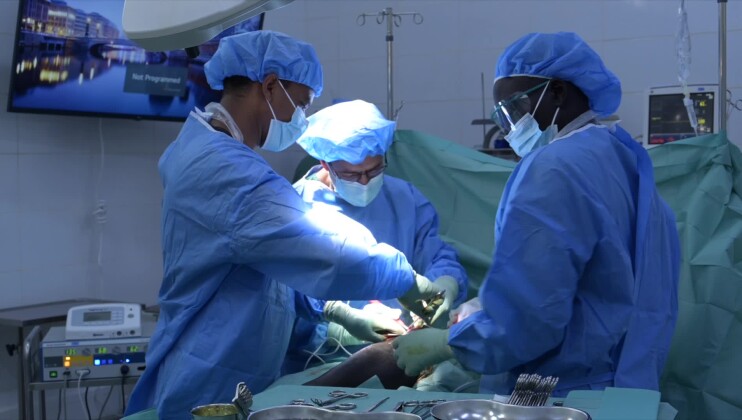
Medical staff say the severity of injuries has also increased, with many patients presenting with complex leg, pelvic, and chest wounds requiring multiple operations.
“The basic principle is to save lives, to save the limb. But as soon as life and limb have been saved, we broaden our perspective,” said ICRC surgeon Slobodan Miroslavljev, whose team has operated on hundreds of patients at Juba Military Hospital this year.
Surgeons continue to work under immense pressure as casualty numbers grow.
Over the past eight years, ICRC surgical teams in South Sudan have performed more than 25,000 operations on about 5,000 weapon-wounded patients.
But surgery is often only the beginning of a long road to recovery. Many patients face permanent disabilities, requiring months sometimes years of rehabilitation.
In 2025 alone, over 3,700 people received physical rehabilitation services at ICRC-supported centres in Juba, Wau, and Rumbek.
This figure, the highest in a decade, reflects not only increased violence within South Sudan but also a spillover of conflict from neighbouring Sudan.
“We’ve seen a growth in the numbers of persons from Sudan refugees or returnees coming to access physical rehabilitation services,” said Oluwafifunmi Odunowo, ICRC’s physical rehabilitation manager in South Sudan. “Compared to last year, it’s about a 40% increase.”
The combined effects of conflict in both Sudans, recurring intercommunal violence, and severe flooding have devastated communities and stretched humanitarian resources thin.
With the year’s weapon-related casualties already at a seven-year high, aid agencies warn that the situation risks worsening unless violence subsides and access to medical and humanitarian services improves.
As fighting persists, the numbers tell a stark story: South Sudan’s most vulnerable continue to bear the heaviest burden of a conflict showing no signs of slowing down.