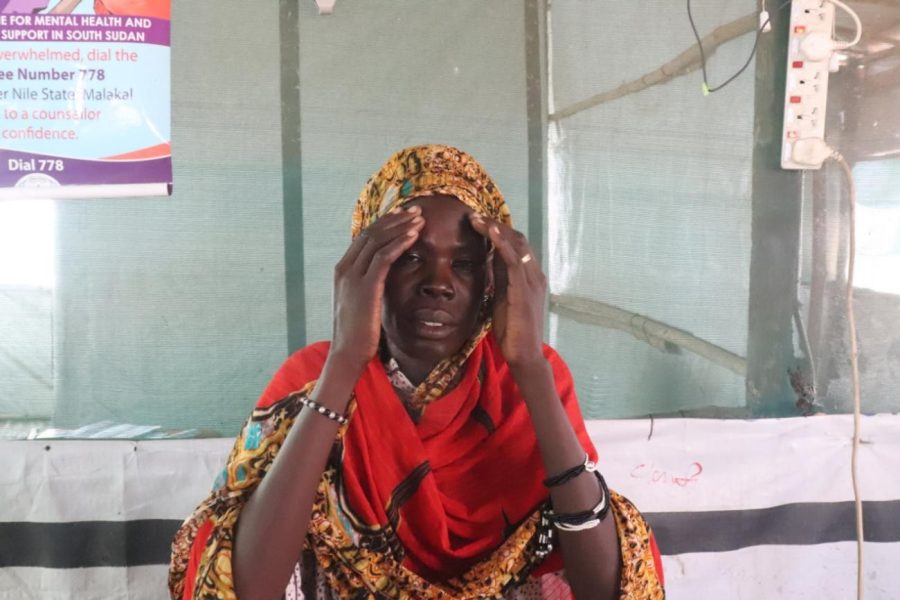
Nyabol Alor Chola, a 33-year-old South Sudanese mother, endured a horrific ordeal during a violent raid targeting foreign nationals in Khartoum. Her husband and two eldest sons were forcibly taken. When she attempted to resist, armed forces shot her twice in the legs and struck her head with a gun. She was unconscious for hours. Upon regaining consciousness, she discovered her loved ones had gone.
“They shot me twice. When I woke up, my child and husband were taken,” she recounted, tears streaming down her face as she remembered the traumatic incident. Their residence had been completely looted and devastated.
Desperate to find her family, Nyabol searched throughout Omdurman and surrounding regions, but her efforts proved futile. Her remaining four sons were subsequently moved to Joda, then transported to Renk, and finally relocated to Malakal.
Currently situated at the transit centre in Wau, Nyabol expresses her willingness to relocate to Abyei if it means ensuring the safety of her remaining children.
“I called a soldier to help me when I saw them, but they were adamant. Instead, they forced me into a car and brought me to the border town without my first-born son. I came with the other four. God saved these sons of mine, and I am grateful,” she expressed, lifting her hands in prayer, tears shining in her eyes.
Nyabol represents countless South Sudanese citizens forcibly evacuated from Sudanese cities as the ongoing two-year conflict between the Rapid Support Forces and the Sudan Armed Forces rages on.
On October 10th, another South Sudanese woman named Nunu was awakened by soldiers, believed to be RSF members, who demanded her immediate departure. Though her children were at a neighbor’s residence, she was forced into a vehicle and detained with other South Sudanese women for four days along Airport Road. On day five, they were transported to the South Sudan–Sudan border at Joda.
Following five challenging days in Joda, Nunu and her group made it to Renk. With assistance from IOM and South Sudanese authorities, Nunu and her five children were transported to Malakal on November 1, awaiting further relocation.
“At Joda, life was terrible. We slept on the floor. My two brothers are still missing, and I fear the same for my husband and father. But I am hopeful that the life I left behind is over and a better one is ahead,” she shared.
Patrice Len Karmelio, another deportee, was also transported to Joda, separated from his brother “A lot of people were killed as we fled. Along the way, my brother was taken and has not been seen since,” he said.
The journey to South Sudan’s border presented numerous challenges, including severe shortages of aid. “When we came from Shamal, a lot happened—they beat you, killed, tortured you,” he added.
Patrice remained at the Renk border point for a month before being transported to Malakal.
At the Bulukat Transit Centre, Juma Aru Bol, who leads the task force, explains that displaced individuals and returnees typically spend about a week receiving comprehensive assistance across multiple sectors.
“We receive an average of 400–500 individuals daily. Since 2023 to date, over 223,889 people have arrived, 16,347 have departed, and 11,227 refugees have been transported to their final destinations. Everyone who arrives here departs for where they choose to go,” Juma elaborated.
The facility, launched in 2023 through a collaborative effort between the Upper Nile Government, UNHCR, and IOM, delivers crucial support to those transitioning from Renk and Malakal.
Despite the construction of twelve permanent shelters accommodating 144 families, recent budget constraints have limited access to essential provisions including food supplies, medical resources, and basic bedding.
Through the DTM system, returnees undergo fingerprint registration, choose their final destination, and receive transport arrangements via a detailed manifest.
UN statistics reveal that the Sudan conflict has driven 1.2 million people into South Sudan—predominantly returning South Sudanese nationals, alongside more than 400,000 Sudanese refugees. By October 31st, South Sudan was providing shelter to over 595,000 refugees, with Sudanese nationals comprising 95 percent.
During her inspection of Bulukat Refugee Centre, SungAh Lee, IOM’s Deputy Director General for Management and Reform, emphasized the urgent need for increased funding to address the needs of those displaced by Sudan’s ongoing crisis.
She highlighted the unprecedented scale and complexity of the displacement crisis, which has affected millions nationwide and exacerbated existing challenges.
“The recent funding situation is challenging. That is why we need to collaborate with many other entities, UN agencies, but also with government and local communities. We want to make sure our humanitarian work also leads to transition, recovery and resilience, empowering local communities and stakeholders so that they can live with dignity and stability in their lives,” urged IOM’s DDG SungAh Lee.
The nation currently faces multiple interconnected challenges, including widespread violence, sustained economic deterioration, and climate-related disasters, all of which continue to intensify food insecurity, malnutrition, and the ongoing influx of refugees and returnees fleeing Sudan’s conflict.