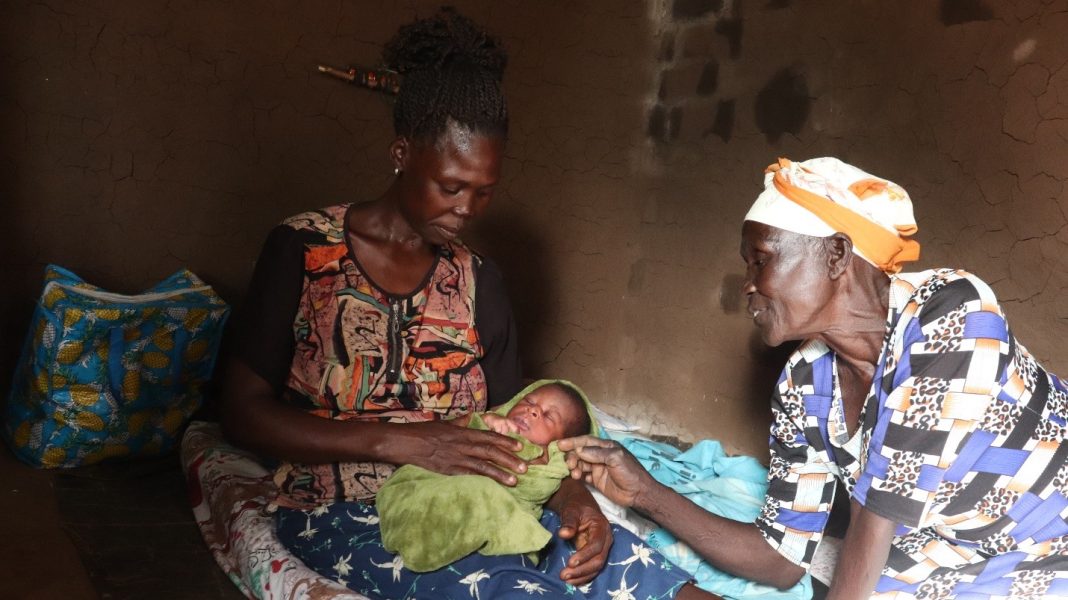
In the hot afternoon, after returning from her farm in Obbo Payam of Magwi County, expectant mother Joska felt sharp waves of pain while peeling her cassava. The pain was serious. She had been sent home from Obbo Primary Health Care Centre (PHCC) just the previous day because her early labour was not active and the facility, with its limited beds, could only admit the most critical cases.
With no transport or midwife nearby, a neighbour’s child was sent to fetch Akello Lina, a 67-year-old Traditional Birth Attendant (TBA) from Pokongo village. Lina hurried through footpaths to reach her. By the time she arrived, Joska was already in advanced labour.
While the Ministry of Health discourages home births and TBA-led deliveries due to the risks associated with limited knowledge and fragile home environments, the reality in South Sudan’s overstretched system often leaves no other option.
Lina safely assisted with the delivery at home, then immediately escorted the mother and newborn to Obbo PHCC for postnatal care and vaccination. This handoff from TBA to health facility is part of a vital, unofficial collaboration that is saving lives despite a crumbling health infrastructure.
The poor state of the health system is visible inside Obbo PHCC. Worn-out mattresses lie on metallic electric beds that show no signs of ever having been operated. Here, expectant mothers are asked to buy their own cord clips, gloves, suckers, and even polythene sheets to cover the worn-out beds.
This is a reflection of a health system stretched thin, surviving on limited government allocations and the goodwill of donors.
Government health funding remains below 2% of the national budget. According to UNFPA, maternal mortality stands at 1,223 per 100,000 live births, under-five mortality is at 99 per 1,000 live births, and infant and neonatal mortality rates are 64 and 40 per 1,000 live births, respectively.
Health services are under severe strain, with only 7.6 health workers and 1.4 health facilities per 10,000 people, a critical gap in service delivery.
Akello Lina represents an enduring link in the community’s safety net. Trained in the 1980s, she was among few traditional birth attendants trained to support expectant mothers. She continued her work even during the liberation struggle, receiving further training in a Ugandan’s Kyangwali refugee camp. Since returning to South Sudan in 2008, the number of active TBAs in Obbo Payam has dwindled from ten to just four. Yet their role has evolved from primary deliverers to crucial facilitators.
“We have gloves to respond in emergencies, but women must give birth in the hospital where complications can be managed,” Lina said. For her work, she receives no salary, only small tokens such as soap.
Although discouraged by the Ministry of Health, TBAs like Lina continue to play a crucial role in Obbo Payam. They now serve as first responders, escort mothers to hospitals, provide emergency support, and follow up after delivery.
In cases of home delivery, Lina and other TBAs carry out their duties and ensure follow-up at the hospital.
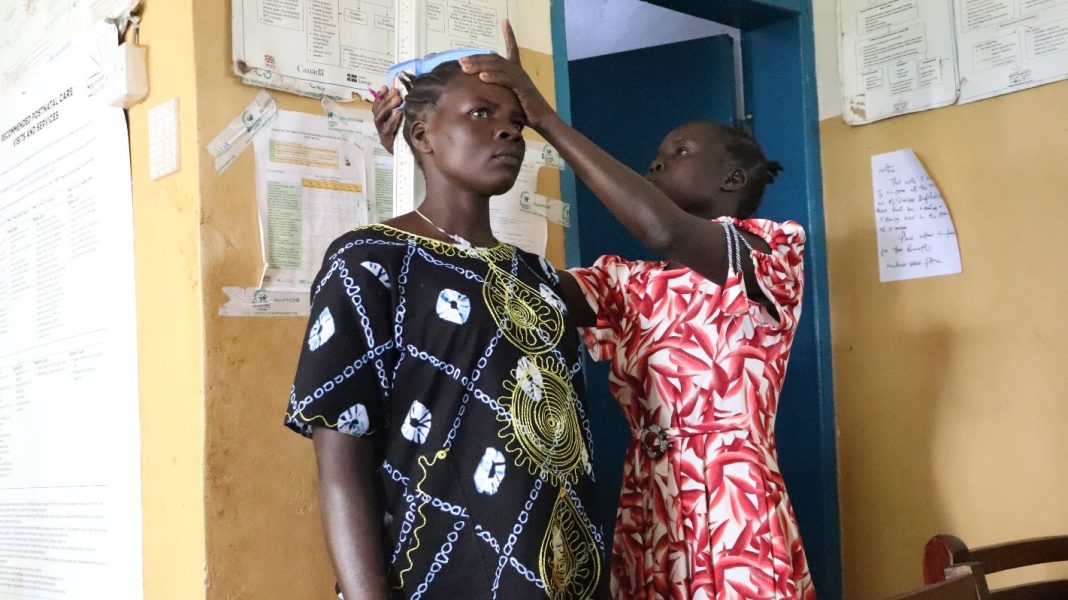
At the PHCC, the burden is carried by very few staff. Six women are being attended to by Anyek Florence Ben, a registered midwife who has been working in the facility since 2018. She is one of only three midwives at the facility, currently employed under the Health Sector Transformation Program (HSTP). The National guidelines require each PHCC to have at least three certified midwives and one registered midwife; Obbo PHCC operates with just these three.
A Partnership forged by necessity
It is here, in the space between policy and reality, that the life-saving partnership between midwives and TBAs thrives. The TBAs provide trusted community outreach, emergency first aid, and critical transport coordination. The midwives provide clinical expertise within the facility.
Pregnant women see the value of both. “Midwives and TBAs are doing their best,” says Alonyo Hellen, “but gloves and materials are very important for our safety.”
Auma Mary adds, “We are encouraged to deliver in hospitals, but the government must do more to provide equipment.”
This collaboration is yielding tangible results. Since January, over 200 babies have been safely delivered at Obbo PHCC, with fewer than 10 born en route.
“Hospital deliveries have improved, thanks to the Traditional Birth Attendants who are pushing these mothers to the hospital,” says Midwife Florence.
Challenges
The path for an emergency is a slow, bureaucratic chain, from Primary Health Care Unit, to Primary Health Care Centre, up to the state hospital. Each facility struggles with the same core deficit: a lack of equipment and consistent medical supplies.
Since June, Obbo PHCC has not received its quarterly medical package, leaving it, like most in the county, out of stock.
This scarcity forces medics to improvise. Anyek Florence Ben recounted using a polythene bag in early September to welcome a baby after the hospital ran short of gloves.
“I had to use a polythene bag to receive a child because the expectant mother did not come with a glove. She was brought from the farm direct to the hospital,” she narrated.
“The issue of gloves is a big problem, not even a piece will you get in this hospital. Some women come at night without gloves yet you have to attend to them,” she said. “All we need is good conditions, equipment to respond to our plea.”
While the Health Sector Transformation Project (HSTP) has provided some relief, with hospital authorities noting they have received medications and equipment twice on a quarterly basis, the underlying scarcity is deep.
Daniel Abonga Paul, the clinician in charge, explained, “The whole facility is running low on equipment, drugs, and it’s stretching, and it’s now a year.”
This resource crisis extends to transportation. With only one ambulance in the entire county, which is often unavailable, emergency referrals to Magwi County are a perilous 50-minute ride on a motorcycle, risking both mother and child.
“At the facility, there are no means; we ask the co-patient to provide a means to lift the patient from here to the next level,” Paul said. In early in 2025, a mother with severe anaemia died because no transport could be found.
Despite these challenges, the teamwork between midwives and Traditional Birth Attendants has directly encouraged hospital deliveries and improved outcomes.
Magwi County Health Director Okot Martin acknowledges the progress since the HSTP’s introduction, which included recruiting staff. “Since the introduction of the HSTP, there has been increased staffing at Obbo Primary Health Care Centre from 14 to 21, and no maternal deaths have been reported this year.”
However, the support is incomplete. Only 15 of the county’s 31 health facilities receive HSTP support, a shortfall due to funding shortages.
The state oversight committee is aware of the three cycles of consignments, but the quantities are inconsistent and insufficient.
The HSTP itself, a multi-donor initiative led by the South Sudanese Ministry of Health and funded primarily by the World Bank, aims to expand access to free services and strengthen the health system. Launched in 2024, it represents a structural effort to mend a broken system.
But on the ground, the immediate lifeline is the pragmatic alliance between Traditional Birth Attendants and midwives.
This collaboration, born not from official policy but from shared dedication, fills the voids left by a fragile health system. It is this resilience that ensures mothers like Joska, and their babies, have a fighting chance at survival.