The Moru Congregation has accused the Juba Diocese of the Episcopal Church of South Sudan of abuse of authority, intimidation, and unlawful takeover of church properties, calling for dialogue and the restoration of its autonomous status during a press conference held on Friday evening at St. Thomas Moru Church in Munuki, Juba.
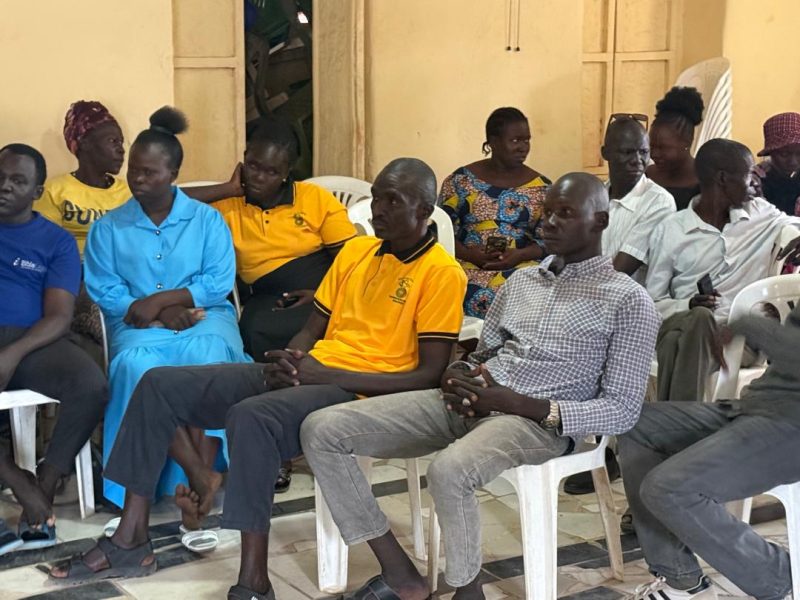
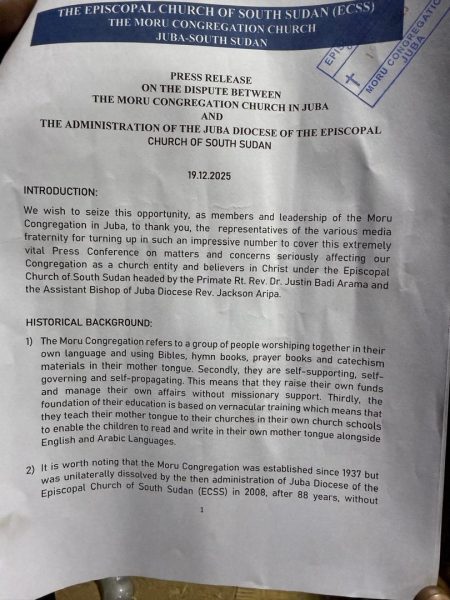
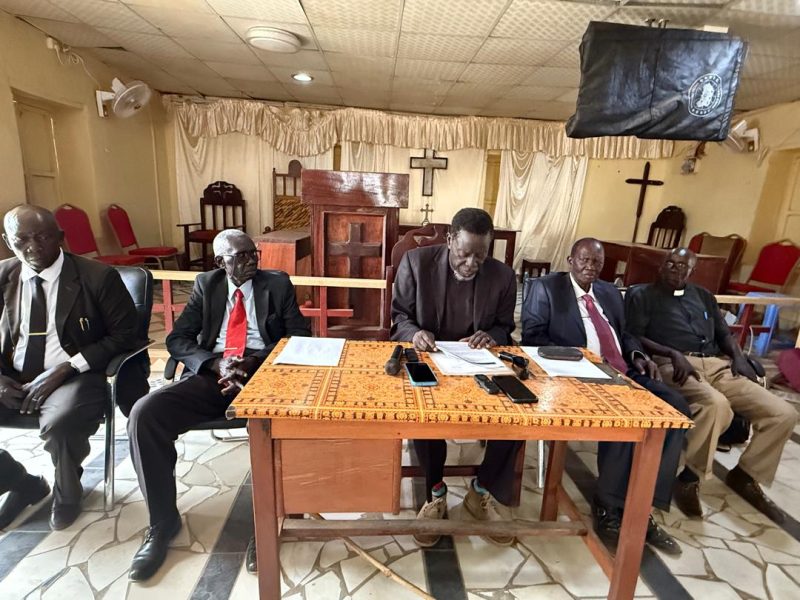
The press conference, attended by senior Moru church leaders, youth representatives, women’s groups, and congregants, followed the public reading of a detailed press release by Canon Isaac Oniel Yosia, who spoke on behalf of the congregation’s leadership.
Reading the statement, Canon Yosia said the Moru Congregation is a self-supporting, self-governing, and self-propagating Christian community, established in 1937, whose members worship in their mother tongue, alongside English and Arabic.
He emphasized that the congregation has historically financed, administered, and expanded its churches without reliance on missionary or diocesan funding.
According to the press release, the Moru Congregation had, prior to 2008, established nine churches in Juba and surrounding areas on land acquired by its members, without any financial or material support from the Juba Diocese.
The congregation also ran its own church schools, teaching children literacy in the Moru language alongside English and Arabic.
Canon Yosia told journalists that the Moro Congregation was unilaterally dissolved in 2008 by the then administration of the Juba Diocese, after 88 years of existence, without consultation, consent, or explanation to its members.
“The dissolution stripped the congregation of its original status and exposed its churches, schools, and land to takeover,” the statement read.
The congregation accused the diocese of claiming ownership of Moru churches and schools, demanding original land and property documents, and converting some institutions into commercial investment projects.
Specific concern was raised over schools and church properties that, according to the congregation, were built and maintained solely through community resources.
Canon Yosia said the Moru leadership repeatedly sought peaceful dialogue to resolve the dispute. He cited three formal appeals addressed to the Primate of the Episcopal Church of South Sudan dated June 20, 2023; January 21, 2025; and April 10, 2025 all of which, he said, received no constructive response.
Instead, the congregation alleged that responses from church leadership were dismissive and derogatory, leaving members with no option but to reclaim their original status.
As a result, the congregation formally restored itself on May 10, 2025, through what it described as a historic and lawful declaration by its members.
The press release further accused the Juba Diocese of arbitrarily suspending more than 20 priests, some of whom were outside South Sudan at the time of the alleged offenses.
According to Canon Yosia, no official charges or canonical explanations were provided, rendering the suspensions “null and void.”
The congregation also rejected claims that the affected clergy were outsiders, insisting many were born and raised in Juba, stressing that the capital city belongs to all South Sudanese regardless of ethnic background.
Canon Yosia accused diocesan officials of using security forces to intimidate worshippers, disrupt services, and fabricate allegations against Moro congregation members.
He cited incidents on October 6 and October 27, 2025, when church premises were allegedly closed without court orders, and a more serious incident on November 2, 2025, when armed security personnel reportedly forcefully dispersed worshippers at a peaceful service.
According to the statement, women, children, and elderly congregants were beaten, leaving several worshippers injured.
The congregation welcomed deliberations by the House of Bishops of the Episcopal Church of South Sudan, which reportedly recognized the legitimacy of the Moro Congregation’s grievances and recommended the formation of an independent committee to resolve the matter.
However, Canon Yosia said tensions escalated again on December 7, 2025, when diocesan leaders allegedly attempted to forcibly take over Moro church premises, prompting congregants to stand their ground and call for mediation.
The Moru Church in Munuki was peacefully reopened on December 14, 2025, following what members described as a colorful and prayerful ceremony, held under the protection of security authorities to maintain law and order.
The Moro Congregation emphasized that it is not seceding from the Episcopal Church of South Sudan, but rather seeking restoration of its original congregational status and respect for its administrative and financial autonomy.
The press release called on church leadership to: Enter immediate dialogue under a neutral mediation committee, withdraw court cases and defamatory accusations against members, cease intimidation and disruption of church services and respect the congregation’s property rights and cultural identity.
Canon Yosia concluded by urging peace, reconciliation, and unity in diversity, reaffirming the congregation’s commitment to worship freely, protect its heritage, and coexist peacefully with other Christian communities in Juba.
The press conference ended with Christmas and New Year messages to Christians across South Sudan and in the diaspora, calling for forgiveness, dialogue, and lasting peace within the church and the nation.