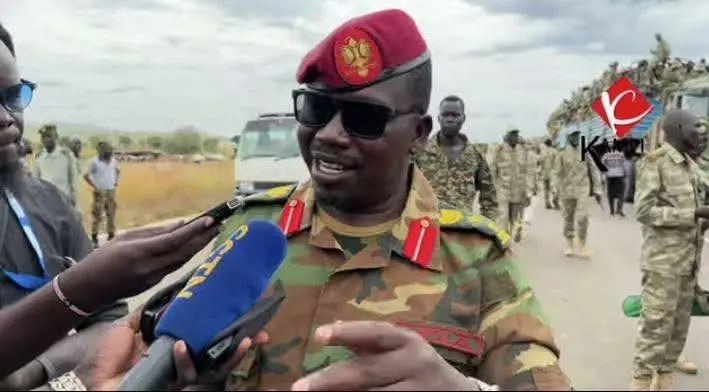
The Sudan People’s Liberation Movement/Army–In Opposition (SPLM/A-IO) has announced that its forces have captured South Sudan People’s Defence Forces (SSPDF) military bases in Yuai, Jonglei State, and Nadapal, Eastern Equatoria State.
The claim was made in a brief statement issued by Col. Lam Paul Gabriel, a spokesperson for the SPLA-IO, who said additional details would be released later.
As of the time of publication, the SSPDF has not yet issued an official response to the claims.
The announcement comes just few days after the SSPDF ordered civilians to evacuate areas under SPLA-IO control in parts of Jonglei State, citing the need to protect civilians and minimize collateral damage during anticipated military operations.
In a statement issued on December 30, 2025, by the SSPDF Directorate of Media and Press, the army directed civilians living near military barracks, assembly points, and rally areas to leave immediately.
The order specifically affects Lou Nuer counties of Nyirol, Uror, and Akobo.
According to the statement signed by SSPDF Spokesperson Maj. Gen. Lul Ruai Koang, the evacuation was intended to prevent civilians from being exposed to danger or used as human shields during what the army described as “phases of military operations.”
“The SSPDF command hereby orders civilians to immediately evacuate areas under the control of SPLA-IO, especially those in close proximity to barracks, assembly and rally areas,” the statement read, adding that the directive was meant to “avoid and minimize collateral damage.”
The announcement, issued from SSPDF General Headquarters in Bilpam, sparked anxiety among civilians and observers, particularly as it coincided with the Christmas season and came amid a fragile political transition expected in early January 2026.
Reacting to the evacuation order, Mr. Edmund Yakani, Executive Director of the Community Empowerment for Progress Organization (CEPO), described the directive as “worrying and seriously disturbing,” warning that it could signal a return to open conflict.
“Ordering civilians to evacuate SPLA-IO-controlled areas in Nyirol, Uror, and Akobo sounds like a new declaration of war,” Yakani said, arguing that the protection of civilians no longer appears to be a priority for the rival forces.
Yakani criticized both the SSPDF and SPLA-IO for what he described as a continued reliance on military solutions to political disagreements, warning that clashes reported in parts of Jonglei during the festive period point to a dangerous return to armed confrontation.
“The wages of military confrontation between SSPDF and SPLA-IO in parts of Jonglei State, even during Christmas, demonstrate a renewed military approach to resolving political disagreements,” he said.
Fears of Wider Conflict
The civil society leader cautioned that continued mismanagement of the political transition expected in early 2026 could significantly increase the risk of South Sudan sliding back into full-scale war, nearly a decade after the conflict erupted in 2013.
“It is beyond tolerance to continue seeing citizens repeatedly displaced as internally displaced persons or refugees since 2013,” Yakani said. “Children are growing up amid gunfire and military confrontations instead of peace.”
CEPO urged the leadership of both the SSPDF and SPLA-IO to immediately abandon military strategies and recommit to dialogue, calling on national stakeholders, citizens, and regional and international partners to intensify pressure for a peaceful political solution.
Yakani also appealed to IGAD, the African Union, and the United Nations to intervene urgently, warning that failure to act could lead to South Sudan fragmenting into multiple armed groups that would become increasingly difficult to mediate.
“If South Sudan breaks into pockets of armed groups fighting each other, mediation will become extremely difficult,” he warned.
The evacuation order and subsequent claims of military gains underscore rising tensions in Jonglei State, long affected by conflict, displacement, and inter-communal violence, raising fresh concerns over the durability of South Sudan’s already fragile peace process.