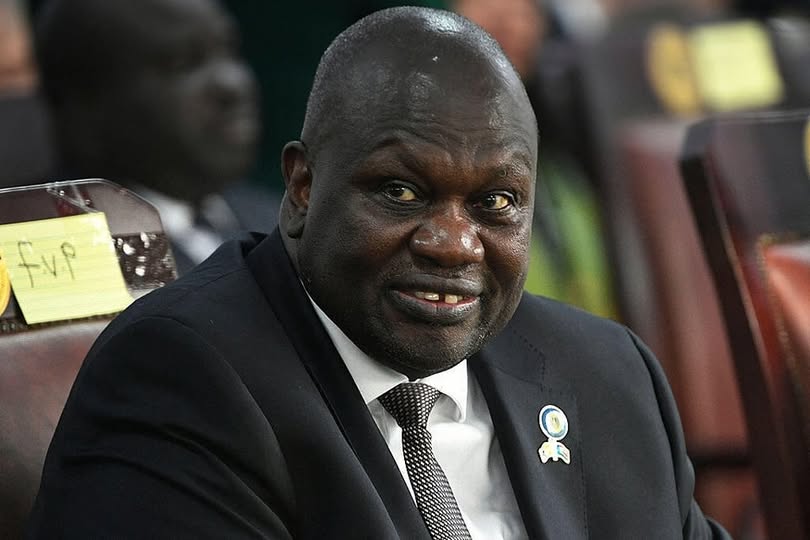
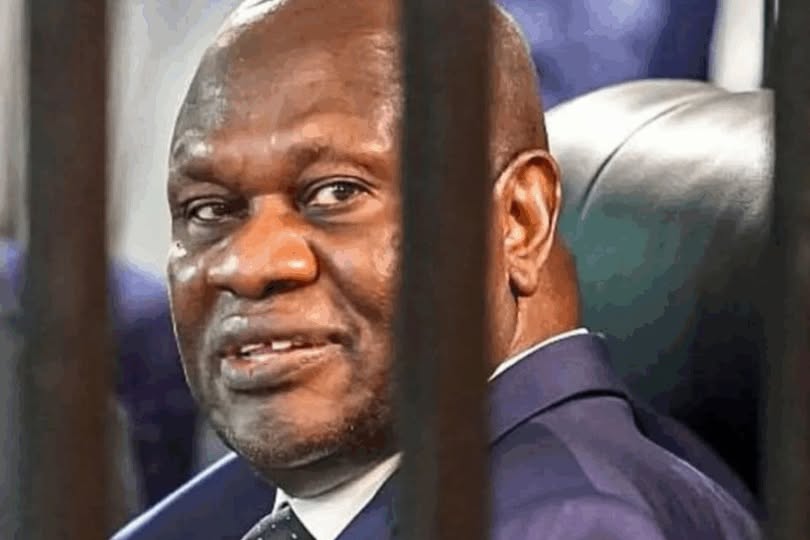
The Special Court on the Nasir incident held its 36th session on Monday at Freedom Hall, focusing on alleged ransom payments and phone communications involving First Vice President Dr. Riek Machar and the late Major General David Majur Dak, with Dr. Machar standing trial alongside seven senior SPLM/A-IO officials.
During the session, the defense team subjected the prosecution’s sixth witness, SSPDF Sergeant Mayen Kuol Chan, to extensive cross-examination.
Mayen, who served as a bodyguard to the late Majur and claimed to have survived the Wech-Yar-Adiu incident, provided further details regarding his alleged capture, detention, release, and movements following the events of March 7, 2025.
The witness told the court that he was allegedly detained by SPLA-IO forces at the Nasir garrison and later released after his family paid a sum of US $6,000.
According to Mayen, the money was sent to a bank in the Kuergeng area of Ethiopia and addressed to an individual he identified only as “Gattuong,” before being withdrawn in Ethiopian Birr.
He further testified that after his release, he traveled from Kuergeng to Pagak and later arrived in Juba aboard a chartered aircraft, with the ticket also reportedly arranged by his family.
Upon his arrival at Juba International Airport, Mayen stated that he was first taken to the military intelligence office at the airport before being transferred to the military intelligence headquarters.
There, he was interrogated by the SSPDF investigation committee probing the Nasir incident, after identifying himself as one of the bodyguards of the late Major General Majur.
A significant portion of the session focused on phone communications between Dr. Riek Machar and the late Majur in the days leading up to the incident.
The defense questioned whether the calls were intended to facilitate Majur’s evacuation to Juba. Mayen denied this, asserting that Dr. Machar instead urged Majur to surrender to SPLA-IO forces, and allegedly warned that no military equipment should be allowed to leave with weapons.
The witness further claimed that the conversations were conducted in the Nuer language, which both men spoke fluently.
The defense also probed inconsistencies surrounding phone usage, questioning why Dr. Machar allegedly contacted Mayen on his personal phone rather than Majur’s official military line.
Mayen said he did not know the reason, adding that military headquarters typically communicated with Majur through his official phone. He later told the court that both his own phone and Majur’s phone were lost during the fighting on March 7.
In an effort to challenge the witness’s credibility, the defense presented still images from a video allegedly showing a man with broken teeth.
Mayen identified himself in the image but rejected claims that his teeth were damaged, attributing the appearance to poor video quality and distance.
The court also reviewed photographic exhibits, although proceedings were briefly adjourned when some requested materials were not immediately available.
When the court panel took over questioning, presiding Judge James Alala Deng sought clarification on the language used during the phone calls and the identity of other individuals who had contacted the witness.
Mayen reiterated that Dr. Machar spoke in Nuer, while another caller identified as “Manyang” communicated in Arabic, allegedly to relay information about the arrival of aircraft.
He maintained that he did not personally know this individual.
The session concluded with the defense closing its cross-examination and the court adjourning proceedings to Monday, January 12.
On that date, the court is expected to rule on the prosecution’s application for witness protection measures, including a request to allow a witness to testify off-camera.