Learners and teachers in Rubkona County, Unity State, are celebrating a significant milestone in education with the transition from fragile grass-thatched shelters to newly constructed modern classrooms.
For years, pupils at Dengjaak Primary School endured harsh learning conditions, facing minimal protection from rain, heat, or strong winds.
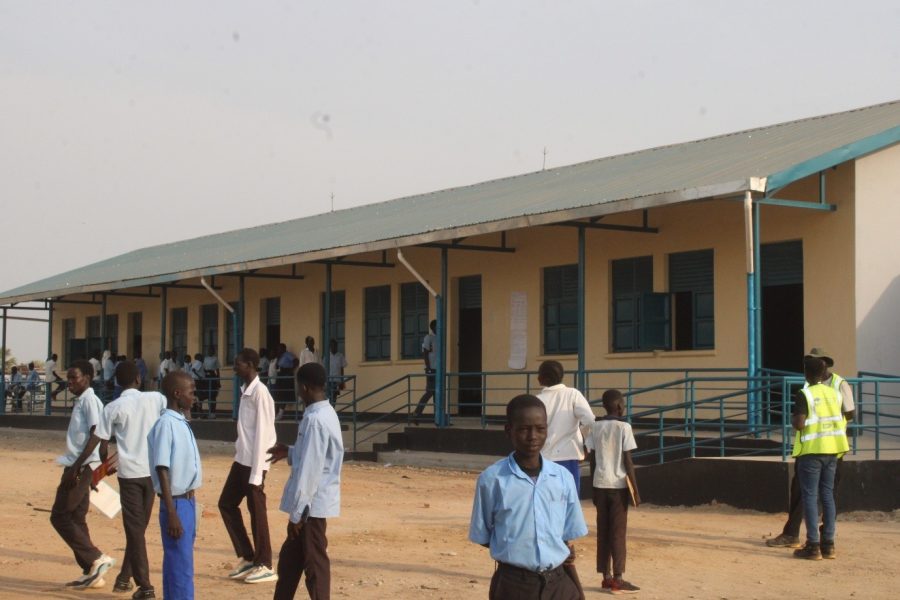
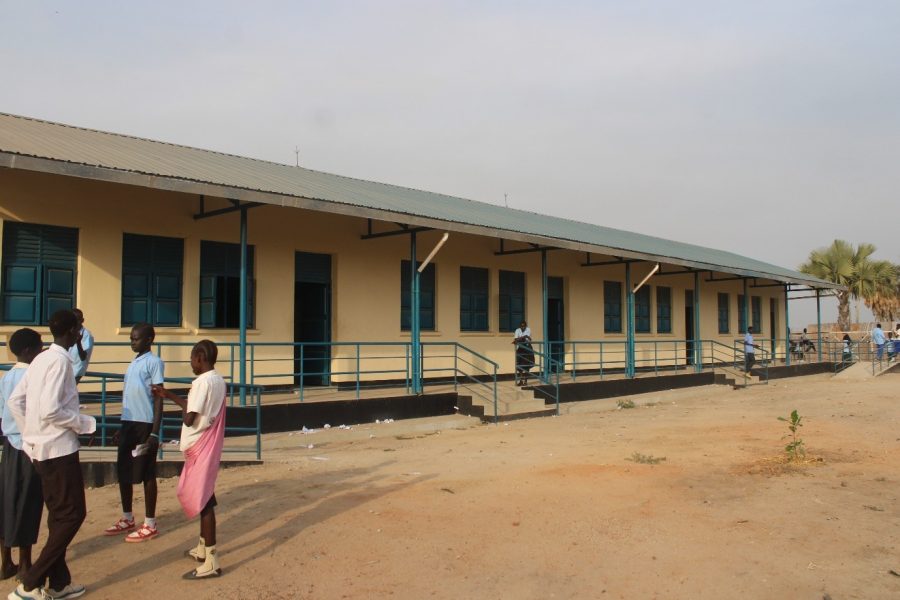
The completion of eight permanent classrooms, an administration block, and three well-constructed toilet facilities—designated separately for girls, boys, and teachers—has now provided a safe, dignified, and conducive learning environment.
This project, implemented by the Government of South Sudan in partnership with the International Organization for Migration (IOM), marks a crucial step forward in strengthening the education sector and restoring hope for the future of children in the area.
The new buildings feature concrete walls, iron-sheet roofs, and improved ventilation.
Micheal Jime Machar, a 19-year-old pupil in Primary Seven at Dengjaak Primary School, recounted the challenges they faced while learning in a dusty thatched shelter.
“We were actually learning in one grass-thatched structure, and when it rained, it leaked on us, sometimes interrupting our lessons,” Machar said.
He noted that the unfavourable environment contributed to low attendance and poor performance.
“Before the construction of this school, there was no fence, and people could enter from all directions, interrupting our learning,” he said.
Machar expressed gratitude to IOM and the government for their collaboration in bringing much-needed relief to the learners, who are now looking forward to utilising proper facilities.
“Thank you very much. I would like to express my gratitude to the Government and IOM for initiating the construction of this school,” he said.
He encouraged out-of-school children to join them and seize this opportunity to develop their potential.
This development is part of a government-led initiative, the Enhancing Community Resilience and Local Governance Project Phase II (ECRP II).
The ECRP II project, funded by the World Bank, is implemented by the Government of South Sudan in partnership with the International Organization for Migration (IOM).
Nyazal Chap Deng, a 15-year-old pupil in Primary Seven at Dengjaak Primary School, highlighted that, in the past, girls would venture into the bushes to relieve themselves due to the lack of available toilets.
“We did not have privacy. When you needed to help yourself, it was difficult to find a suitable space,” said Chap.
She noted that the new toilets have brought comfort, improved hygiene, and restored dignity and respect to their lives.
“Now that the toilets have been constructed, we can have privacy,” she said.
The $150 million project funded by the World Bank aims to benefit 950,000 individuals across 79 counties in Western Bahr el Ghazal, Unity, Upper Nile, Northern Bahr el Ghazal, and Warrap.
This five-year initiative is being implemented by the International Organization for Migration (IOM) as the main partner, along with various NGOs.
The second phase of ECRP aims to enhance access to services, bolster flood resilience, and improve institutional capacity for local service delivery and integrated disaster risk management at both national and local levels.
Dengjaak Primary School has a total of 376 pupils.
Kueth Dak, School Officer at Dengjaak Primary School, stated that the newly constructed school enhances access to quality education and expands learning opportunities for students.
“We know the construction is of high quality. We have enough chairs and tables. Our school has at least 376 pupils. We need more,” said Dak.
He emphasised that the project has created a safer and more conducive learning environment for hundreds of children.
The IOM and the Government are committed to creating a supportive learning environment, which is essential for ensuring quality education.
The new classrooms will enhance the learning environment by reducing overcrowding and alleviating the burden on existing facilities.
This project signifies significant progress in improving educational administration in the state and provides a better working environment for both pupils and teachers.
Miriam Mutalu, the IOM head of Sub-Office in Bentiu, stated that the project includes the construction of toilet blocks, boreholes, and the installation of a water system in the schools.
“The projects we are undertaking are community resilience projects. We have been constructing dykes to protect the population of Bentiu and Rubkona from flooding,” said Mutalu.
She described the project as a milestone in the community’s journey towards accessible and quality education.
“We are also implementing infrastructure programmes, building schools, water yards, and hospitals. We have been here for almost four years, working on community resilience projects,” she added.
These projects are supported by the community and implemented by IOM.
For over five years, relentless seasonal flooding has displaced more than half the population across Rubkona and other counties in Unity State.
Schools, health facilities, and farmland have vanished under water, forcing entire communities onto shrinking highlands.
The severe floods have hindered access to quality education in towns.
However, the construction of protective dykes in Rubkona County and Bentiu town has provided relief to communities in Unity State by pushing back ongoing floodwaters and restoring areas of land that had been underwater for years.