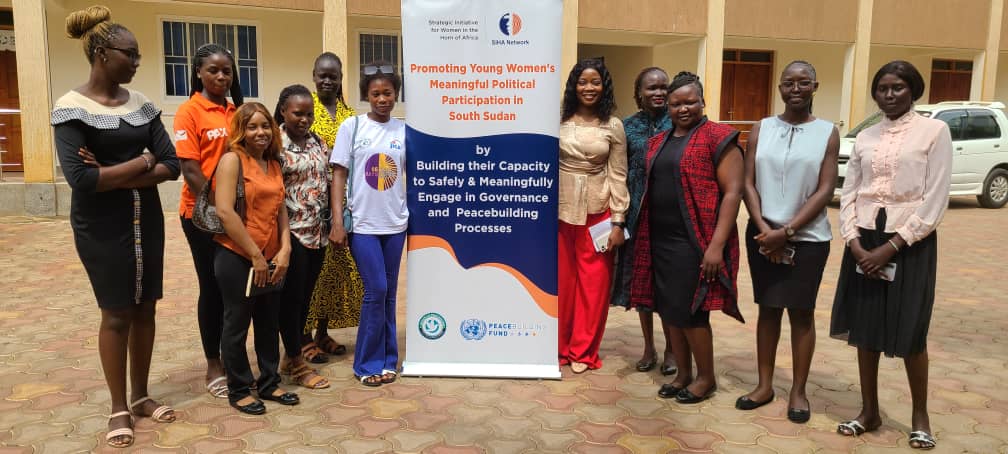
Young women leaders backed by the Strategic Initiatives Horn of Africa (SIHA) Network and the United Nations Peacebuilding Fund (UNPBF) have renewed calls for inclusive governance in South Sudan.
They warned that continued exclusion of women particularly young women from political leadership threatens both democratic participation and sustainable peace.
The warning was issued during a press engagement held under the Inclusive Governance for Peace Project, following recent leadership appointments in Central Equatoria State in which only one woman was named among 19 key positions, with no young woman represented.
Participants described the appointments as a clear reflection of systemic barriers that continue to sideline women from meaningful political participation.
Speaking at the event, SIHA Country Coordinator Jackie Bage said the concerns raised by young women are grounded in evidence and lived realities rather than political ambition.
She explained that SIHA, a feminist organization, conducted a study across Central Equatoria, Western Equatoria, and Western Bahr el Ghazal to assess women’s participation in leadership and decision-making processes.
“The findings show that cultural norms continue to undermine women’s leadership,” Bage said. “Young women also operate in unsafe environments characterized by sexual harassment, violence, and intimidation, coupled with limited access to mentorship and empowerment opportunities.”
To respond to these challenges, Bage said SIHA designed the Inclusive Governance for Peace Project, which currently supports 35 young women leaders through mentorship programs focused on leadership development, advocacy skills, and civic engagement.
The project aims to equip young women with the tools to participate meaningfully in political and peace processes at community and national levels.
Representing the project participants, Adore Kuyo, a young woman leader from Juba, said young women possess fresh ideas, energy, and innovative solutions that remain largely untapped in South Sudan’s political landscape.
She noted that young women understand their own challenges and are well positioned to advocate for change using diverse platforms, including social media and community engagement.
Participants emphasized that the absence of young women in leadership means their specific needs and priorities are often ignored in policy and decision-making.
They also raised concerns about legal and structural barriers, particularly provisions in the Political Parties Act, which they argue contradict constitutional guarantees of equality and equal participation in public life.
Others highlighted the issue of tokenism, saying women are often present in meetings but excluded from real decision-making processes.
The young leaders stressed the importance of peer representation, noting that young women feel safer discussing sensitive issues such as gender-based violence, political intimidation, and economic exclusion with leaders who share similar lived experiences.
Responding to questions on next steps, Bage warned that advocacy efforts would intensify if authorities fail to act. “Inclusion is not optional; it is constitutional,” she said, adding that excluding women and young people from leadership undermines sustainable peace and social cohesion.
The young women reiterated their key demands, including the full implementation of the 35 percent affirmative action quota, a review of recent leadership appointments, transparent and inclusive future selection processes, and the creation of safe spaces that enable meaningful participation of women and youth in governance.