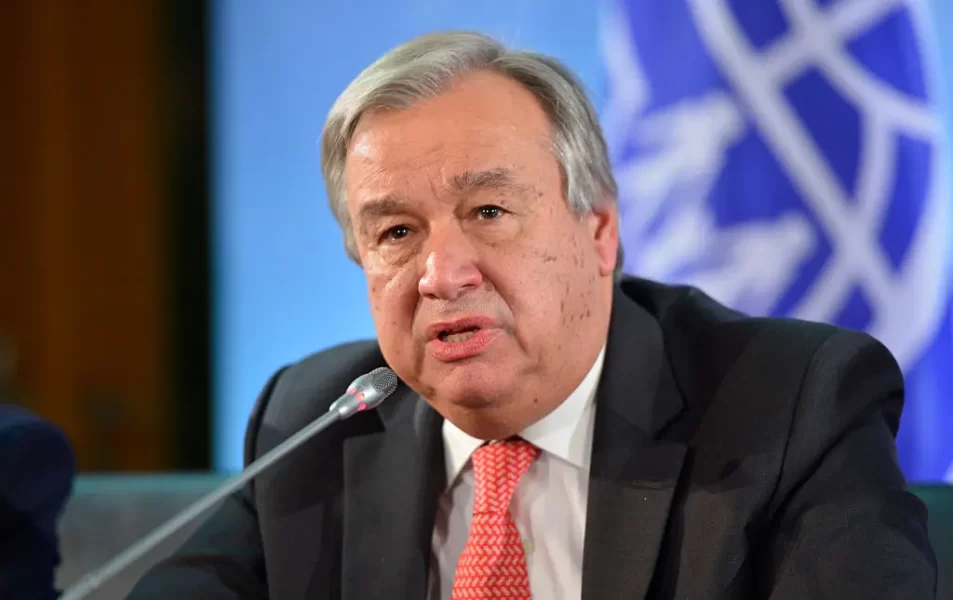
United Nations Secretary-General António Guterres has called on South Sudan’s leaders and warring parties to immediately halt all military operations.
He warned that the escalating violence across the country is deepening civilian suffering and pushing the fragile nation closer to collapse.
In a statement issued in New York on January 29, the Secretary-General said he was “deeply concerned” by the continued escalation of violence, particularly in Jonglei State, where fighting has reportedly killed and injured many people and displaced about 180,000 civilians.
He also raised alarm over inflammatory rhetoric targeting specific communities and the expansion of military operations, saying such actions would further endanger already vulnerable populations.
Guterres warned that the violence is worsening an already dire humanitarian situation. According to the Government of South Sudan, at least 250,000 civilians have been displaced in the first weeks of 2026 alone due to ongoing conflict.
He urged all parties to protect civilians, ensure unimpeded humanitarian access, and guarantee the safety of United Nations peacekeepers and humanitarian workers.
“The crisis in South Sudan requires a political and not a military solution,” the Secretary-General said.
The UN SG called on the government and opposition forces to de-escalate tensions through inclusive dialogue and to agree urgently on a consensus-based road map for the final year of the transitional period to enable credible elections.
The UN chief also welcomed mediation efforts by the African Union and the Intergovernmental Authority on Development (IGAD), encouraging neighbouring countries to intensify their support for dialogue.
South Sudanese civil society groups have echoed the UN’s call, warning that continued fighting is eroding the country’s chances for peace and stability.
Edmond Yakani, Executive Director of the Community Empowerment for Progress Organization (CEPO), welcomed Guterres’ message, describing it as timely and necessary.
“I would like to take this opportunity, with high respect, to welcome the strong message made by His Excellency António Guterres to the attention of the leaders of South Sudan, particularly the warring parties, for them to stop the military action going on in the country,” Yakani said.
Yakani stressed that military solutions to political crises benefit no one and only bring suffering to ordinary citizens. “It is true, military solutions to political crises benefit nobody, apart from causing harm to the civilian population and making citizens pay a very expensive price with their lives and their livelihoods,” he said.
He noted that civil society groups have consistently urged leaders to de-escalate violence and return to inclusive political dialogue, but said many leaders continue to rely on force.
Yakani warned that heavy fighting between the South Sudan People’s Defence Forces (SSPDF) and the SPLA-IO in parts of the country shows that South Sudan is already at war, despite claims to the contrary.
Yakani also cautioned that mismanagement of the transitional period in the coming months could further derail the country’s political process, including preparations for elections.
“Time is running out and time is getting tight,” he said, adding that continued military confrontation risks pushing the country toward collapse.
Calling on leaders to act without delay, Yakani said the opportunity for peace still exists but is rapidly narrowing.
“The chance for you to have a ceasefire is now, not tomorrow. The chance for you to have inclusive political dialogue is now, not tomorrow,” he said.
He warned that prolonging the conflict would only deepen atrocities against civilians and undermine the meaning of South Sudan’s independence.
“Unfortunately, we regret that we have leaders who decided to use the blood of citizens as a means of strengthening their influence on governance,” Yakani added.
Both the United Nations and civil society leaders say an immediate ceasefire and renewed political dialogue remain the only viable path to ending the crisis and preventing further suffering for South Sudan’s people.