The Permanent Ceasefire in South Sudan remains under severe strain as ongoing violence and repeated ceasefire violations continue to undermine the peace process.
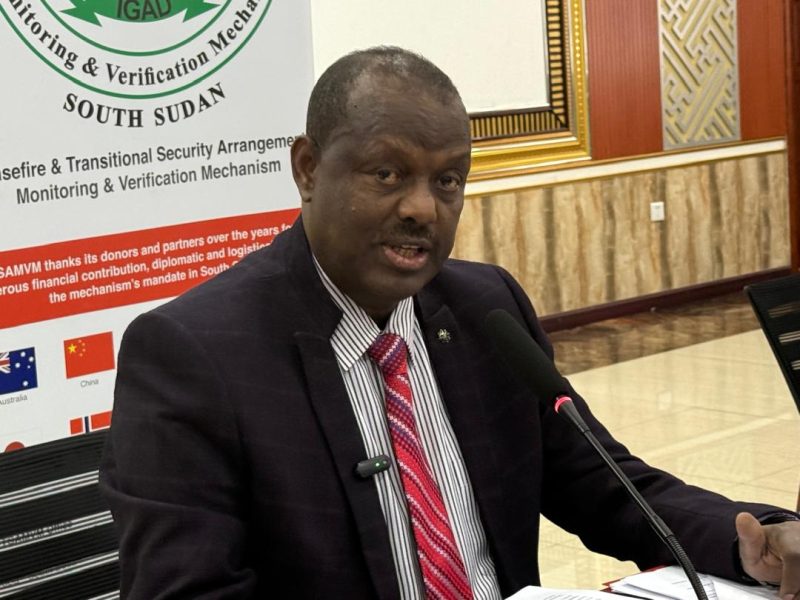
At the CTSAMVM Technical Committee, Maj. Gen. Teshome Anagawe Ayana, Chairperson of CTSAMVM, warned that South Sudan’s ceasefire remains under threat.
He highlighted recent violence, including a coordinated 1 March attack in Abiemnhom, Ruweng Administrative Area, which killed numerous civilians, destroyed homes, and displaced thousands, with local government officials among the casualties.
“The last 12 months have been marked by repeated attacks on the peace agreement. We cannot, and must not, accept the widespread violence,” Maj. Gen. Teshome said, emphasizing that only signatory parties to the Revitalized Agreement on the Resolution of the Conflict in the Republic of South Sudan (R-ARCSS) can deliver lasting peace.
Clashes have continued in Jonglei State, where fighting in Akobo escalated in early March following an SSPDF offensive aimed at retaking the town from SPLM/A-IO forces.
The operation led to mass displacement, with reports indicating that up to 200,000 people fled toward Ethiopia, while humanitarian operations were disrupted by looting and movement restrictions.
Maj. Gen. Teshome also expressed concern over a recent Memorandum of Understanding signed on 6 March between SPLM/A-IO and the National Salvation Front (NAS), which commits the groups to closer political and military coordination a move CTSAMVM said contravenes the principles of the peace agreement.
Operational challenges continue to affect CTSAMVM’s monitoring work. Due to financial constraints, three Monitoring and Verification Teams (MVTs) were closed in January, leaving teams in Juba, Malakal, and Wau responsible for expanded territories.
Planned long-duration patrols were either blocked or canceled due to security risks, highlighting the difficulties in maintaining full oversight of ceasefire implementation.
Despite these challenges, Maj. Gen. Teshome underscored CTSAMVM’s commitment to impartial monitoring and verification.
The organization also noted its engagement with civil society, donors, and regional partners to support operational capacity and to strengthen protections for civilians, particularly women and children affected by the conflict.
“Lasting peace ultimately depends on the political will of the Parties to uphold the permanent ceasefire, ensure the protection of civilians, and engage in constructive, inclusive dialogue,” Maj. Gen. Teshome stated, urging all stakeholders to exercise restraint and prioritize the welfare of the South Sudanese people.
The Technical Committee meeting also reviewed five new violation reports from Western Equatoria, Morobo County, and the Greater Upper Nile Region, reaffirming CTSAMVM’s ongoing mandate to monitor, verify, and report on ceasefire compliance across the country.