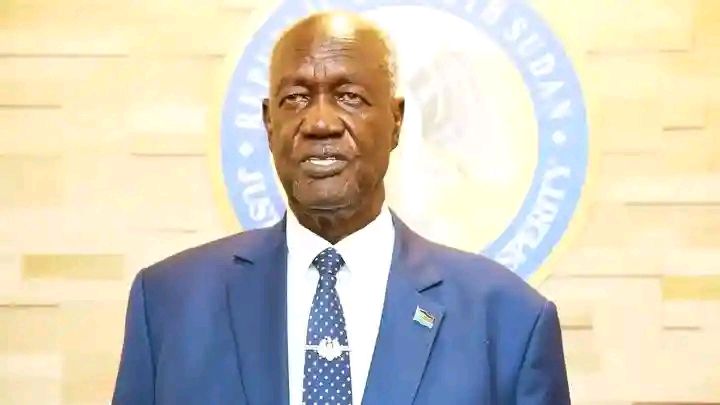
Kuol Manyang Juuk has ignited a storm of debate after appealing to the United States for financial support while placing blame for the country’s economic struggles on what he described as widespread youth “laziness.”
Speaking during a requiem mass for the late Bishop Nathaniel Garang Anyieth at All Saints Cathedral in Juba, the senior presidential advisor Kuol Manyang Juuk urged Washington to extend a loan to help the government clear pension arrears.
For him, the move aimed retire long-serving civil servants arguing that the current system is blocking job opportunities for younger generations.
“America, our problem is pension give us a loan. Not a grant, but a loan so we can pay off pensioners, build roads, and repay because we have gold, oil, and fertile land,” he said.
Manyang stressed that the government’s inability to fund pensions has left aging officials in office for decades, limiting space for youth employment and contributing to growing frustration among young people.
However, it was his blunt remarks about the role of youth in the country’s economic hardships that drew the strongest reactions.
He claimed that South Sudan’s hunger and poverty are not primarily the result of conflict or tribal divisions, but rather a lack of effort, particularly in agriculture.
The comments have since triggered widespread discussion across South Sudan, with many citizens and observers divided over whether his assessment reflects hard truths or oversimplifies deeper structural challenges.
Supporters of Manyang’s view argue that the country’s vast natural resources including arable land and water remain underutilized, and that greater commitment to farming and self-reliance could ease food insecurity.
Critics, however, say the remarks overlook the impact of years of conflict, displacement, weak infrastructure, and limited access to tools and markets, all of which have made large-scale agricultural production difficult for many communities.
On the same day, the United States Embassy in Juba reiterated that its engagement in South Sudan is focused on promoting peace, strengthening governance, and encouraging responsible use of public resources.
“We do not seek to impose a political or ideological model,” the embassy said in a statement. “We do seek peace, appropriate use of public revenue, and an end to assistance abuse.”
The contrasting messages an urgent appeal for financial support on one hand, and calls for accountability on the other highlight the ongoing tensions surrounding economic management in the country.
As the debate continues, Manyang’s remarks have struck a nerve, raising broader questions about responsibility, governance, and the path forward for a nation still grappling with economic pressure and delayed reforms.