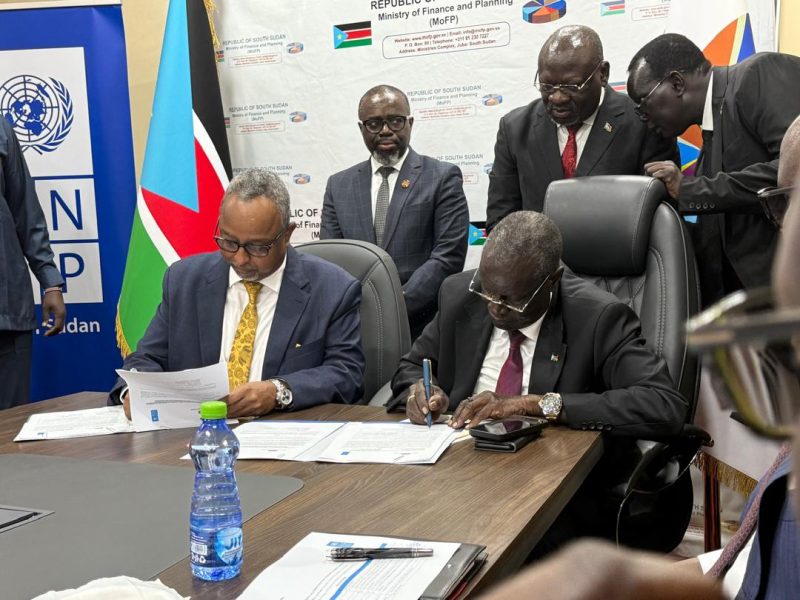
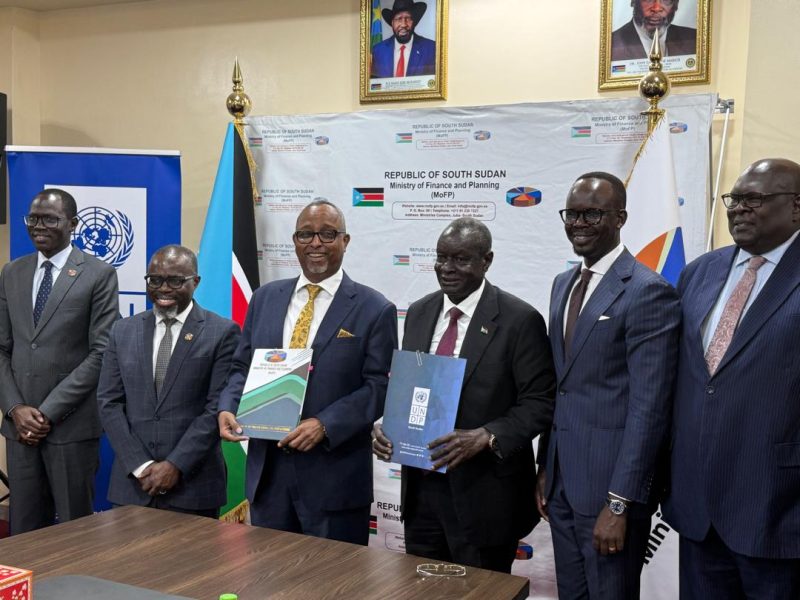
South Sudan has signed a $5 million public finance reform deal with the United Nations Development Programme, marking a shift toward government-led management of public resources.
The five-year initiative, led by the Ministry of Finance and Planning, is aimed at strengthening financial controls, improving transparency, and enhancing the delivery of basic services such as healthcare and education.
It marks the first time the government is directly financing a reform programme implemented in partnership with the UN system.
Speaking after the signing, UNDP Resident Representative Mohamad Abchir described the agreement as a “historic moment” for South Sudan, noting it reflects growing confidence and commitment from the government to take charge of its reform agenda.
“This is a very strong signal from the government that public finance management is at the heart of its priorities,” he said.
“It is also a unique turning point in the partnership between UNDP and the government.”
Mr Abchir added that, unlike previous donor-driven initiatives, the project will be largely managed by South Sudanese technical experts working within government institutions, with UNDP providing implementation support and oversight.
The programme builds on earlier public finance reforms supported by international partners, including Norway, over the past six years.
However, officials say the latest agreement represents a decisive shift from externally funded efforts to a government-led and sustained reform process.
Undersecretary for Planning in the Ministry of Finance and Planning, Benjamin Ayali, said the government will finance about 90% of the programme’s cost equivalent to roughly $1 million annually over five years.
“The most important message we are sending is that this is a government project, and it is our responsibility to fund it,” he said.
“We appreciate the support of our partners, but we have reached a point where we must take ownership.”
Mr Ayali explained that part of the funding will come from savings generated through ongoing payroll reforms, including a nationwide biometric headcount aimed at eliminating so-called “ghost workers” individuals who draw salaries without being legitimate employees.
“We believe there are inefficiencies in the system,” he said. “By cleaning the payroll, we will save resources that can be redirected not only to pay genuine civil servants, but also to support reforms and service delivery.”
Civil servants in South Sudan have faced delays in salary payments in recent months, raising concerns about the government’s fiscal capacity.
But Mr Ayali argued that the reform programme itself is part of the solution.
“It is not only about lack of money,” he said. “It is also about how efficiently we manage what we have. If we reduce waste and improve systems, the resources we have can go much further.”
The reform initiative will target key weaknesses in public financial management, including budgeting processes, procurement systems, and expenditure controls. It will also introduce stronger checks and balances to ensure public funds are used effectively.
A major component of the programme is capacity building across government institutions.
Training will be rolled out in phases, starting with senior officials such as undersecretaries and directors-general, before extending to technical staff at lower levels.
“We want everyone to understand not just what reforms are being implemented, but why they matter,” Mr Ayali said.
“Prudent financial management benefits all citizens.”
In addition to training, the project will support institutional strengthening and the expansion of financial management systems across ministries, departments and agencies.
Officials say there are also plans to extend reforms to state and county levels, where a significant portion of public spending takes place.
Oversight will be provided through a project steering committee, with regular reviews and audits conducted by the Auditor General to ensure accountability and transparency.
Mr Abchir said the programme could also attract additional donor support over time, as development partners respond to what he described as a “clear demonstration of leadership” by the government.
Public finance reform is a key pillar of South Sudan’s peace agreement, particularly under provisions aimed at improving economic governance and accountability. However, officials acknowledge that progress will take time.
“This is not an event, it is a process,” Mr Ayali said. “Other countries have taken decades to build strong public finance systems. What we are doing today is just the beginning of a long journey.”
Authorities say the ultimate goal is to create a system that ensures value for money, reduces corruption risks, and enables the government to invest more effectively in public services.
“If we manage our resources well,” Mr Ayali added, “we can build the schools, hospitals and infrastructure our people need.”