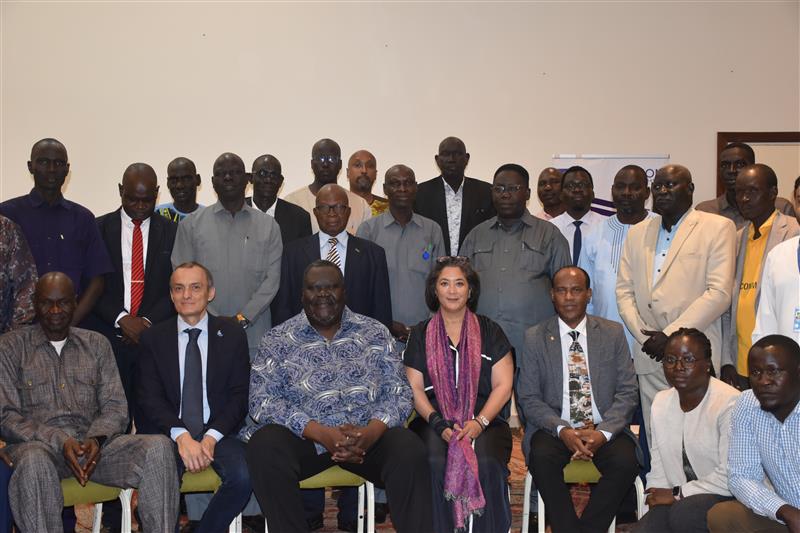
Government officials, international partners, and land governance specialists meeting in Juba have acknowledged a widening gap between South Sudan’s legal framework on land and its implementation, warning that the disconnect is fueling conflict, displacement, and stalled recovery.
The concern emerged during a high-level workshop convened in the capital, where participants described the country’s land laws as largely ineffective in practice despite a relatively robust legal foundation.
South Sudan’s Transitional Constitution, the Land Act, and provisions under the Revitalized Peace Agreement collectively set out clear principles on land ownership, access, and management.
But experts say these frameworks remain weakly enforced, leaving communities vulnerable to disputes, land grabbing, and overlapping claims.
“On paper, the laws are there. But in reality, enforcement is limited, institutions are weak, and accountability is lacking,” one participant noted during the discussions.
Speaking on behalf of the government, Robert Ladu Lwoki acknowledged the scale of the challenge, describing land as a double-edged issue that can either drive development or deepen divisions.
He pointed to persistent problems including internal displacement, cattle-related conflicts, and delays in passing key land policies, warning that governance gaps continue to undermine trust in state institutions.
Lwoki also raised concerns about land grabbing and the absence of strong oversight mechanisms, calling for greater transparency and political will to address systemic failures in land administration.
International partners echoed the urgency of reform. Vijaya Souri, Chief of Mission for the International Organization for Migration (IOM) in South Sudan, stressed that land governance is central to peacebuilding and long-term stability.
“Land is far more than a physical resource,” she said. “When managed inclusively and transparently, it becomes a foundation for stability and opportunity. When left unaddressed, it can undermine trust and delay durable solutions.”
Her remarks come as millions of South Sudanese remain displaced, with housing, land, and property disputes continuing to block safe returns and reintegration.
Participants at the workshop warned that without secure land tenure, effective dispute resolution systems, and credible institutions, efforts to achieve durable solutions for displaced populations will remain fragile.
The European Union, which supports land governance initiatives in the country, underscored the economic dimension of the crisis, noting that unclear land rights not only drive conflict but also deter investment and slow development.
Officials highlighted the need for a unified cadastral system to improve land registration, planning, and management, alongside stronger coordination between national and local authorities.
A recurring theme throughout the discussions was the disconnect between statutory laws and customary land systems, which often operate in parallel without clear alignmen creating confusion and, in some cases, conflict.
Participants called for greater community involvement in land decision-making processes, arguing that inclusive approaches are essential to rebuilding trust and ensuring equitable access.
The workshop is expected to produce concrete, time-bound recommendations aimed at closing the gap between policy and practice.
As South Sudan continues its fragile transition from conflict, stakeholders warned that failure to address land governance challenges could undermine broader peacebuilding efforts leaving one of the country’s most critical issues unresolved despite years of legal and policy commitments.