
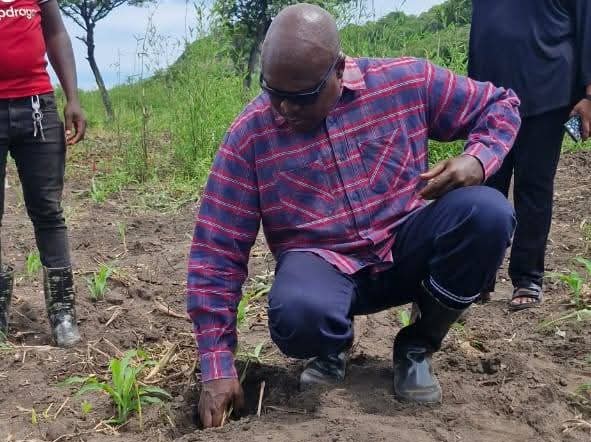
Governor of Eastern Equatoria State, Louis Lobong Lojore, was recently seen engaging in farming activities in Torit, as state authorities intensify calls for residents to embrace agriculture as a means of improving food security and reducing reliance on external assistance.
The governor’s appearance in the field comes at a time when many parts of the state continue to face food shortages driven by erratic rainfall, high food prices, and limited economic opportunities.
By taking part in cultivation himself, Lobong sought to reinforce official messaging that households should make use of available land to support their own food needs.
State officials say the renewed emphasis on agriculture is part of a broader strategy aimed at strengthening local production and cushioning communities from ongoing economic pressures.
They argue that increasing household-level farming could help reduce dependence on humanitarian aid, which remains a key source of support for vulnerable populations across Eastern Equatoria.
During the visit, the governor encouraged residents, particularly youth and returnees, to take up farming not only for subsistence but also as a potential source of income.
He emphasized that small-scale agriculture, if widely adopted, could contribute to stabilizing food supply in local markets while improving household resilience.
However, observers note that while such initiatives may raise awareness, farmers in the state continue to face structural challenges that limit productivity.
These include limited access to quality seeds and tools, poor rural road networks that hinder market access, and insecurity in some areas that disrupt farming activities.
Local residents expressed mixed reactions to the governor’s actions. Some welcomed the gesture as a sign of leadership engagement with everyday realities, while others pointed out that more sustained support such as agricultural inputs, extension services, and investment in infrastructure will be necessary to translate calls for self-reliance into tangible improvements.
Humanitarian agencies operating in the region have repeatedly warned that food insecurity remains a pressing concern, particularly among rural households affected by displacement and economic hardship.
They stress that while promoting local production is important, it must be complemented by coordinated support to address immediate needs and long-term agricultural constraints.
The state government maintains that encouraging farming at the household level is a practical step toward building resilience, but analysts caution that meaningful progress will depend on consistent policy implementation and the availability of resources to support farmers.
As Eastern Equatoria navigates these challenges, the push for self-reliance through agriculture is likely to remain central to both government messaging and community coping strategies in the months ahead.