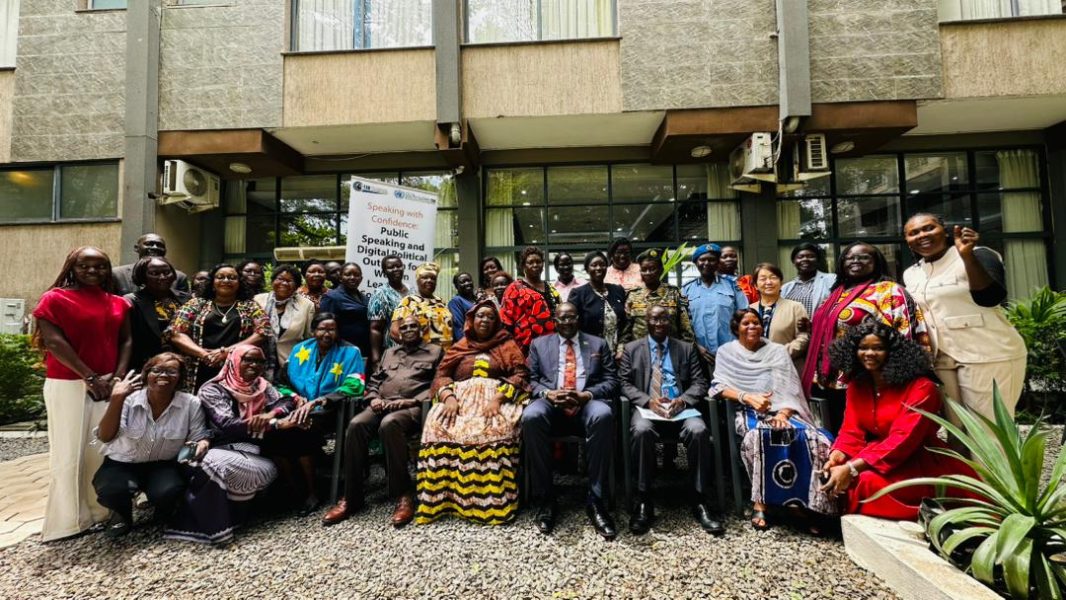
Women leaders, journalists, civil society representatives, government officials, and development partners gathered in Juba for a two-day workshop aimed at strengthening women’s communication skills, public speaking, and digital leadership in South Sudan.
The training, organized by the Female Journalists Network in partnership with the United Nations Mission in South Sudan, focused on empowering women to participate more effectively in public life, governance, media engagement, and digital platforms.
Participants discussed the growing role of women in leadership and peacebuilding, while also addressing the challenges women continue to face in political participation, online engagement, and access to media platforms.
Opening the workshop, Leila Osman, Deputy Chairperson of the Female Journalists Network, said the initiative comes at a critical moment when women remain underrepresented in leadership and decision-making spaces despite their contributions to national development.
She noted that women journalists across the country often operate under difficult conditions, including financial hardship, limited opportunities, and social barriers, yet continue to play an important role in amplifying community voices and promoting peace.
Osman said strengthening communication and digital skills would help women leaders and journalists engage more confidently with the public and advocate effectively on issues affecting communities.
South Sudan’s State Minister for Gender, Child and Social Welfare, Elizabeth Lugor, stressed the importance of effective communication in leadership and public service.
She encouraged women to speak with confidence and use their voices to influence change in society.
“Every person has a story to tell, but if you cannot communicate it effectively, nobody gets to hear it,” she told participants.
The spokesperson of the Transitional National Legislative Assembly, Oliver Mori, described women as central to democracy, peacebuilding, and national development.
He said societies that silence women ultimately weaken their own progress and called for stronger support for women’s participation in governance and media.
Mori also raised concerns over increasing cases of cyberbullying, online harassment, and hate speech targeting women and girls on digital platforms.
He said Parliament recently passed the Cybercrime and Computer Misuse Act to strengthen protections against online abuse and promote safer digital spaces for citizens.
Representing the Special Representative of the Secretary-General and Head of UNMISS, Dr. Musa Gasama praised South Sudanese women for their resilience and contributions to peace and community development.
He said the 35 percent affirmative action quota for women was not merely a political commitment, but recognition that sustainable peace and democracy cannot be achieved without women’s equal participation.
Dr. Gasama also called for safer working environments for women journalists and stronger institutional support for women leaders across the country.
Meanwhile, the National Minister of ICT and Postal Services, Ateny Wek Ateny reaffirmed the government’s commitment to media freedom and responsible digital innovation.
He pledged support for journalists operating within the law and announced plans to establish a national ICT Authority with at least 40 percent female representation.
Participants concluded the workshop by calling for stronger partnerships between government institutions, media organizations, civil society groups, and international partners to promote women’s leadership, digital literacy, and meaningful participation in national development and peacebuilding efforts.