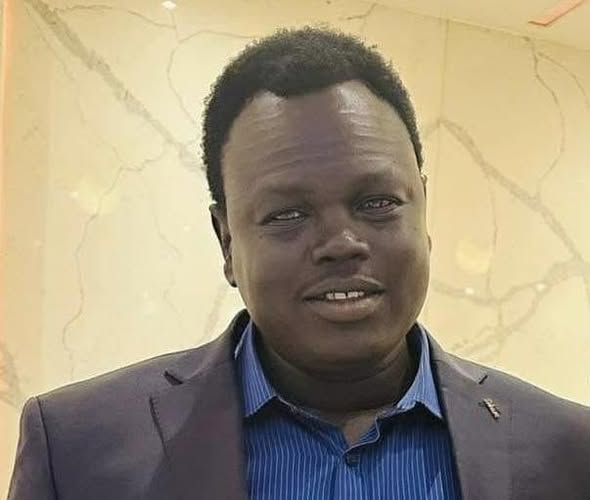
The ongoing Nasir case resumed in Juba on Monday with the second accused, businessman Mam Pal Dhuor, continuing his testimony before the court, where he firmly denied allegations that he acted as an intelligence collector or liaison between political figures in Juba and armed youth in Upper Nile State.
Dhuor rejected claims linking him to communications with armed commanders in Nasir and Ulang counties, arguing that the prosecution had failed to present credible evidence to support the accusations.
“I am not an intelligence officer, but a businessman,” Dhuor told the court, maintaining that none of the witnesses who had testified previously had provided proof that he communicated with armed youth leaders.
The businessman challenged findings presented by a digital forensic expert, particularly allegations that he received and responded to messages from individuals allegedly connected to the conflict in Nasir.
Addressing claims that he received a message from Tor Gile Thoan on March 10, 2024, Dhuor said records cited in the expert’s own report showed that he never responded to the message or any associated call.
“Your lordships, the expert did not disclose or show the message that was claimed to have been sent by an unknown individual to this honorable court,” he said.
Dhuor further denied having any contact with Tor Gile, stating: “I did not talk to Tor Gile Thoan, let alone contact him, as claimed by an expert witness who also failed to tell the court what I supposedly discussed with Mr. Tor Gile Thoan.”
He also dismissed allegations that he received intelligence reports concerning military movements in Upper Nile, including claims regarding weapons allegedly stored at Upper Nile University and reports on SSPDF barges.
“Your lordships, I am not aware of this message and have nothing to do with it, as it is not my line of work,” he told the court.
Questioning the consistency of the prosecution’s evidence, Dhuor pointed to what he described as contradictions in witness testimony concerning the origin of several messages presented during the trial.
“Your lordships, this message was presented by the investigator as a message from Jimma Chuol Tharjiath, but when the expert witness testified, he presented it as a message from Gatrial Thiang. I am confused as to whether Jimma and Gatrial Thiang are the same person,” he said.
Dhuor also denied allegations that he compiled and shared lists of White Army casualties with the first accused, arguing that the prosecution had failed to explain how such information, even if it existed, could have contributed to the outbreak of violence in Nasir.
“I would like to inform this honorable court that I was not and am not an intelligence collector or a liaison between the accused in Juba and the armed youth,” he stated.
The accused further questioned the reliability of digital communications presented as evidence, highlighting what he described as major discrepancies between his own report and that of the first accused.
He argued that conversations allegedly exchanged between the two appeared with different timestamps and content in separate reports prepared by the same expert.
“The expert stated that I am the one who sent those messages; if that were true, why did those messages not appear in my individual report, and instead appear in the first accused’s report?” Dhuor asked.
He added: “This indicates that these messages were fabricated by the prosecution, their expert witness, and the National Security Services. There is no way that messages between two individuals, whose phones were examined by the same expert, could start at different times on the same date.”
According to Dhuor, such inconsistencies should prompt the court to scrutinize the credibility of all evidence presented.
“This shows that these reports were manufactured by certain individuals based on their own interests,” he said.
The businessman also denied allegations that he exchanged messages expressing support for attacks against SSPDF forces or that he facilitated financial support for armed actors.
He argued that the expert witness had admitted under cross-examination that some conclusions presented to the court were based on personal analysis rather than documentary proof.
“When the expert witness was asked by the defense to produce the document indicating I sent money to William Deng B, he admitted that the statement was merely his own opinion and analysis. This means the allegations regarding these messages are false and fabricated,” Dhuor testified.
He further criticized the court’s decision to reject a defense request to inspect the physical mobile phones that were examined during the investigation, arguing that such an inspection would have helped verify the authenticity of the messages.
In another challenge to the prosecution’s evidence, Dhuor pointed to what he described as impossible timelines in communication records.
“I ask the honorable court and the public: if you send a message at 1:46 a.m., is it possible for the timestamp to revert to 1:45 a.m.? This is proof that these messages were fabricated, as time does not run backward,” he said.
Dhuor concluded his testimony by rejecting allegations that he had insider knowledge of the arrest of the first accused. He told the court that reports of the arrest were already circulating widely on social media before he was detained.
“When I was arrested the following day, I found him at the National Security Service facility at the Riverside,” he said.
Following the testimony, Presiding Judge James Alala Deng adjourned the proceedings until June 10, when Dhuor is expected to continue presenting his defense before the court.