South Sudanese civil society leaders have called for urgent national consensus ahead of the country’s scheduled elections on 22 December 2026.
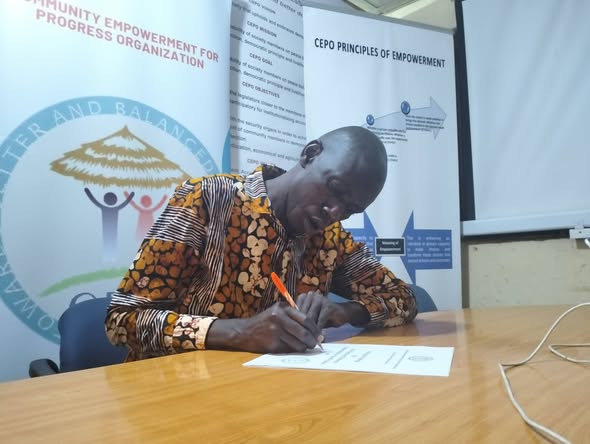
The appeal was made by the Executive Director of the Community Empowerment for Progress Organization (CEPO), Edmund Yakani, following the recent visit of African Union High-Level Representative for the Horn of Africa and the Red Sea, Jakaya Kikwete.
Kikwete was in Juba for consultations with political leaders and stakeholders on ways to move South Sudan from conflict towards lasting peace and stability.
Yakani said the country remains trapped in a political stalemate involving both signatories and non-signatories to the 2018 Revitalized Peace Agreement, a situation he warned is slowing the transition process and creating uncertainty over the country’s political future.
He cautioned that unresolved political disagreements and continued instability could undermine efforts to achieve a peaceful democratic transition.
According to Yakani, violence continues to pose a serious threat to stability at a time when South Sudan should be focusing on implementing measures that would create an environment conducive to credible, peaceful and inclusive elections.
“The whole country is in a serious political stalemate that hinders genuine and timely transition from violence to peace,” Yakani said. “It seems violence is taking precedence over political stability and peace.”
The civil society leader, however, welcomed Kikwete’s engagement with South Sudanese stakeholders, describing the consultations as an important effort by the African Union to help restore political consensus among the country’s leaders.
He noted that Kikwete’s consultations in both Juba and Dar es Salaam had provided an opportunity for various political actors to express their views on the country’s transition and future governance arrangements.
“We appreciate His Excellency Jakaya Kikwete’s proactiveness on driving the file of transitioning the country from violence to peace,” Yakani said.
Yakani said the African Union’s AUC5 Declaration provides a framework for addressing the country’s political challenges through inclusive dialogue and consensus-building. However, he warned that translating the declaration into practical action appears to be facing resistance from some quarters.
He expressed concern that public debate has increasingly focused on the planned elections while giving less attention to other critical provisions of the AU roadmap aimed at creating conditions for sustainable peace.
“It seems we tend to look at elections above the AUC5 Declaration,” he said.
The CEPO director emphasized that while elections remain an important democratic process and a legitimate means of transferring power, they must be conducted under conditions agreed upon by all stakeholders.
He called on the African Union Commission and South Sudan’s National Elections Commission to work together in developing a comprehensive election roadmap that would guide preparations for the December 2026 polls.
“If we want to go for elections, there is a need for us to commit ourselves to factors that will make us witness credible, peaceful and non-violent elections,” Yakani stated.
He further urged political leaders to embrace dialogue and compromise, arguing that consensus remains essential if the country is to avoid a return to instability.
“There is a need for the country to have a consensus conversation for paving the pathway for transitioning the country from violence to peace,” he said.
Yakani also called for the implementation of key provisions contained in the AUC5 Declaration, including the release of political detainees, adherence to the cessation of hostilities, and the promotion of an inclusive political dialogue that leaves no stakeholder behind.
As South Sudan moves closer to its first elections since independence, Yakani stressed that national unity and political consensus will be critical in ensuring that the vote becomes a milestone for peace and democratic governance rather than a source of renewed tensions.
“Election is one of the viable and nonviolent options for transfer of power,” he said. “But we need to reach an agreement on what defines a good enough condition for the conduct of the election as scheduled for 22 December 2026.”