South Sudan has announced an incremental increase in telecommunications charges, with authorities saying the move is necessary to sustain mobile network operations and prevent disruptions to essential communication services across the country.
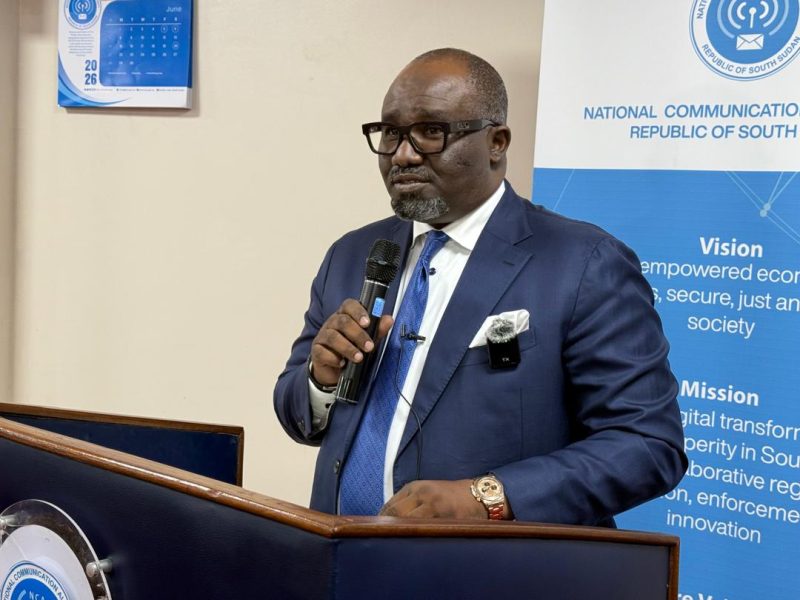
The National Communication Authority (NCA) announced on Thursday that the revised rates will take effect from midnight on June 26, 2026, following months of consultations with government institutions, telecommunications companies, lawmakers, and civil society groups.
Addressing journalists in Juba, NCA Director General Razig Dominic Samuel said the decision was reached after mobile network operators reported mounting financial pressures caused by rising operational costs, inflation, currency depreciation, and difficulties accessing foreign currency needed to maintain and upgrade network infrastructure.
According to the regulator, the telecommunications sector has been grappling with rising energy prices, the depreciation of the South Sudanese Pound, and the high cost of importing equipment and technology required to keep networks operational and aligned with international standards.
“The authority was concerned that without timely intervention, operators would be forced to scale down operations, risking service disruptions and reduced connectivity across the country,” Razig said.
He explained that the adjustment followed extensive consultations involving the Ministry of Information, Communication Technology and Postal Services, parliamentary committees, the NCA Board of Directors, mobile network operators, and civil society organizations.
The move was also guided by Council of Ministers Resolution No. 13 of 2026, which directed relevant institutions to address challenges affecting the telecommunications sector.
Razig stressed that the decision should not be viewed as a major tariff increase but rather a limited adjustment intended to help operators remain financially viable while continuing to provide services.
“This is not a tariff increase in the conventional sense. The underlying rates have remained unchanged for nearly ten years. What we have approved is a necessary adjustment to reflect current economic realities while ensuring that telecommunications services remain available to citizens,” he said.
Under the new arrangement, international benchmark rates remain at four US cents per minute.
However, the exchange rate used to calculate local charges has been adjusted to better reflect prevailing market conditions.
The NCA said telecommunications companies have been operating under exchange rates that no longer correspond with the actual cost of accessing foreign currency through commercial banks.
Officials argued that this discrepancy has significantly reduced operators’ revenues when converted into dollars, making it increasingly difficult to finance operations and network expansion.
Razig revealed that some operators have recorded substantial financial losses over the past two years, forcing them to reassess the sustainability of services in several parts of the country.
He warned that without intervention, operators could have been compelled to shut down services in remote areas where operational costs are particularly high.
“Closing a network is easy, but reopening it is much more difficult. We had to make a choice between allowing services to deteriorate or taking measures that would enable operators to continue serving the public,” he said.
The telecommunications regulator acknowledged that the adjustment would place an additional burden on consumers already struggling with the country’s economic challenges.
However, Razig argued that the increase was deliberately kept to the minimum necessary, with operators absorbing the larger share of inflationary pressures.
“The authority recognizes the economic hardship facing citizens. That is why we required operators to shoulder most of the burden while only a small portion is reflected in the approved adjustment,” he added.
Beyond maintaining services, the NCA said the measure is expected to support investments in network modernization and improved service quality.
Officials noted that many operators have struggled to upgrade infrastructure due to limited financial resources and restricted access to foreign currency needed to purchase equipment and technology.
The regulator pledged to closely monitor implementation of the new charges and ensure that consumers benefit from improved network reliability and service delivery.
“We will continue engaging operators and monitoring performance to ensure that the intended benefits of this intervention are realized. Our goal is to maintain national connectivity while protecting consumer interests,” Razig said.
South Sudan’s telecommunications sector plays a critical role in connecting communities, facilitating business transactions, supporting humanitarian operations, and enabling access to digital services.
Authorities say preserving the sector’s sustainability remains essential as the country continues to navigate a challenging economic environment.