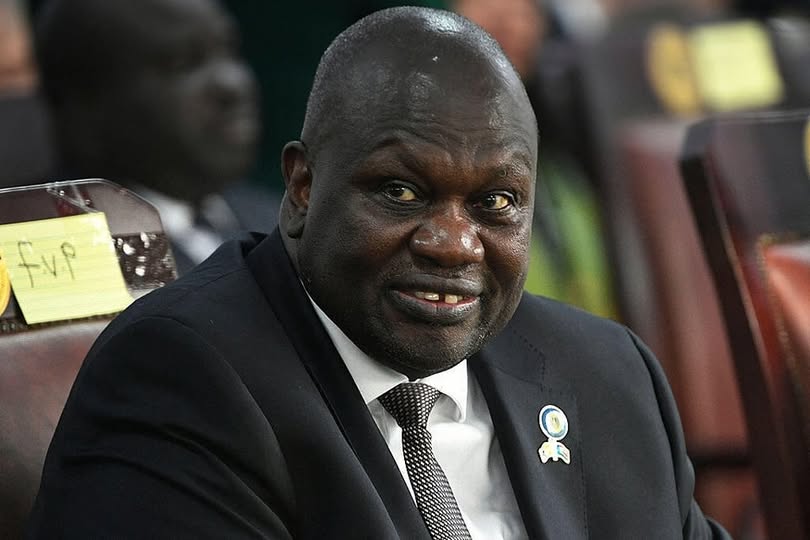
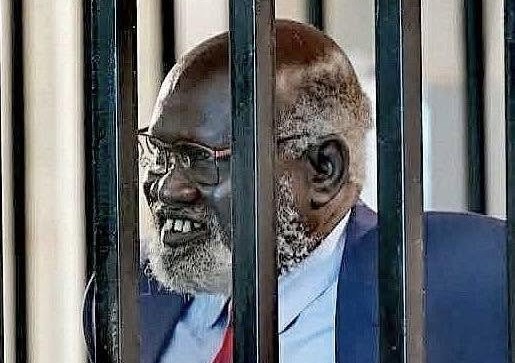
Gatwech Lam Puoch, a member of South Sudan’s Transitional National Legislative Assembly (TNLA) representing Nasir County under the SPLM-IO, has concluded his defence testimony before the Special Court trying Dr. Riek Machar and his co-accused, asking judges to dismiss the charges against him and reject the prosecution’s digital forensic evidence.
Mr. Puoch, the third accused in the case, spent much of his testimony arguing that his actions during the security crisis in Nasir and Ulang counties between 2024 and 2025 were part of his constitutional responsibilities as an elected lawmaker and were aimed at preventing further violence.
The prosecution alleges that the accused were linked to the violence that engulfed Nasir County earlier this year. Mr. Puoch denied any criminal wrongdoing, insisting his role had consistently been to promote dialogue and de-escalation.
Addressing the court, he said:
“Between 2024 and 2025, Nasir County experienced repeated armed clashes between the SSPDF and local armed youth. These incidents caused the loss of many innocent lives and created serious insecurity in both Nasir and Ulang Counties.”
He added that members of parliament representing the two counties responded by undertaking several initiatives to restore calm.
“Members of the National Legislature representing these two counties took active steps to reduce tensions, promote peace, and prevent further violence.”
During his testimony, Mr. Puoch outlined a series of initiatives he said were undertaken jointly with other lawmakers.
He told the court he repeatedly raised the deteriorating security situation on the floor of parliament under the legislature’s rules of procedure to alert the national leadership and seek intervention.
He also said he appeared twice on Miraya FM in August 2024 and February 2025 to encourage peaceful intervention before the conflict escalated further.
According to Mr. Puoch, lawmakers from different political parties representing Nasir County agreed to put aside partisan differences and work together for peace.
“Despite belonging to different political parties, we agreed to put political affiliations aside and work together as sons and daughters of Nasir County for the peace and safety of our people.”
He said the legislators jointly wrote to President Salva Kiir, First Vice President Dr. Riek Machar, the Presidential Security Adviser, the Chief of Defence Forces and the United Nations Mission in South Sudan (UNMISS), seeking urgent intervention.
Mr. Puoch also described meetings with military leaders, including then Chief of Defence Forces Gen. Santino Deng Wol and other senior officers, where lawmakers advocated for deploying the Necessary Unified Forces instead of regular SSPDF troops.
He told the court the military leadership agreed that deploying unified forces under the 2018 peace agreement would be a better approach and acknowledged that indiscipline among some soldiers had contributed to tensions.
The MP said legislators later briefed First Vice President Machar on the outcome of those discussions and sought logistical support to facilitate the deployment, although the plans were later disrupted by changes in military leadership.
As tensions rose again in February 2025, Mr. Puoch said he personally appealed to senior military commanders, including the current Governor of Upper Nile State, Lt. Gen. James Koang Chol, and Lt. Gen. Johnson Olony Thabo, to suspend troop movements to Nasir.
“I asked and urged them to temporarily suspend the movement of forces because of the serious security risks, to give us an opportunity as members of parliament to go to our constituency in order to mitigate the rumours and reduce the tension. Unfortunately, these appeals were not accepted.”
He also defended two press conferences held by lawmakers from Nasir and Ulang counties in February 2025, describing them as efforts to calm the situation and support implementation of the Revitalised Peace Agreement.
Mr. Puoch argued that all his public statements and parliamentary interventions were protected under parliamentary privilege.
“All the efforts we made to de-escalate tension in Nasir and Ulang counties… were undertaken in our capacity as members of parliament, protected by parliamentary immunity and should not be subjected to any criminal procedure.”
A significant part of the defence focused on challenging the prosecution’s digital forensic evidence.
Mr. Puoch denied authoring or sending the messages, videos, audio recordings and images allegedly extracted from his mobile phone.
“The messages, videos, images, and audio recordings allegedly extracted from my phone are false and are not supported by credible evidence. I firmly deny creating or sending any of them.”
He further questioned the integrity of the evidence by arguing that his phone had remained exclusively in the custody of the National Security Service (NSS) after his arrest.
“My phone remained in the custody of the National Security Service from the day of my arrest until it was produced before this Honourable Court.”
He alleged that his password had been obtained under duress and claimed the device could have been manipulated while in state custody.
“Since the phone was under their exclusive control for all that time, there was ample opportunity for the alleged messages and other data to be inserted and altered in an attempt to implicate me.”
The prosecution has not publicly responded to those allegations in court.
In his closing remarks, Mr. Puoch argued that the prosecution had failed to meet the legal threshold required in criminal proceedings.
“Criminal responsibility must be proven through clear, credible, and convincing evidence. Suspicion, speculation, and assumptions cannot satisfy that burden.”
He maintained that his involvement in Nasir affairs long predated the events at the centre of the case and had consistently focused on dialogue and reconciliation.
“At no time have I supported or encouraged violence against the people of South Sudan. On the contrary, I have always advocated for peaceful coexistence, reconciliation, and lasting peace.”
Mr. Puoch concluded by formally asking the court to dismiss the case against him.
He requested judges to:
dismiss the criminal complaint for failure to disclose a prima facie offence;
affirm that his statements were protected by parliamentary immunity; and
exclude the prosecution’s digital forensic report on the grounds that it lacked reliability, authenticity and legal admissibility.
The Special Court adjourned proceedings until Friday, July 17, when judges are expected to question Mr. Puoch and rule on several outstanding prosecution applications.
All eight accused appeared before the court during Thursday’s session, after the seven detainees held by the National Security Service were not produced at the previous hearing.