
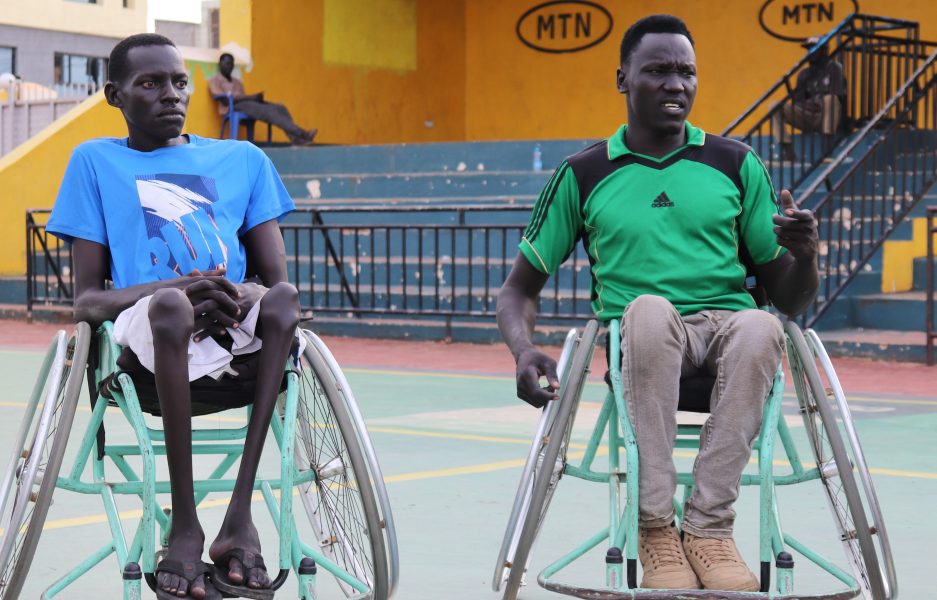
Wheelchair basketball did not simply give Amaudit Makuei Manyiel a sport. It gave him a way back into society.
“Wheelchair basketball gave me a new identity not as a victim or former fighter, but as a teammate, competitor and survivor. That’s where my healing really began,” says Amaudit, a former child soldier from South Sudan.
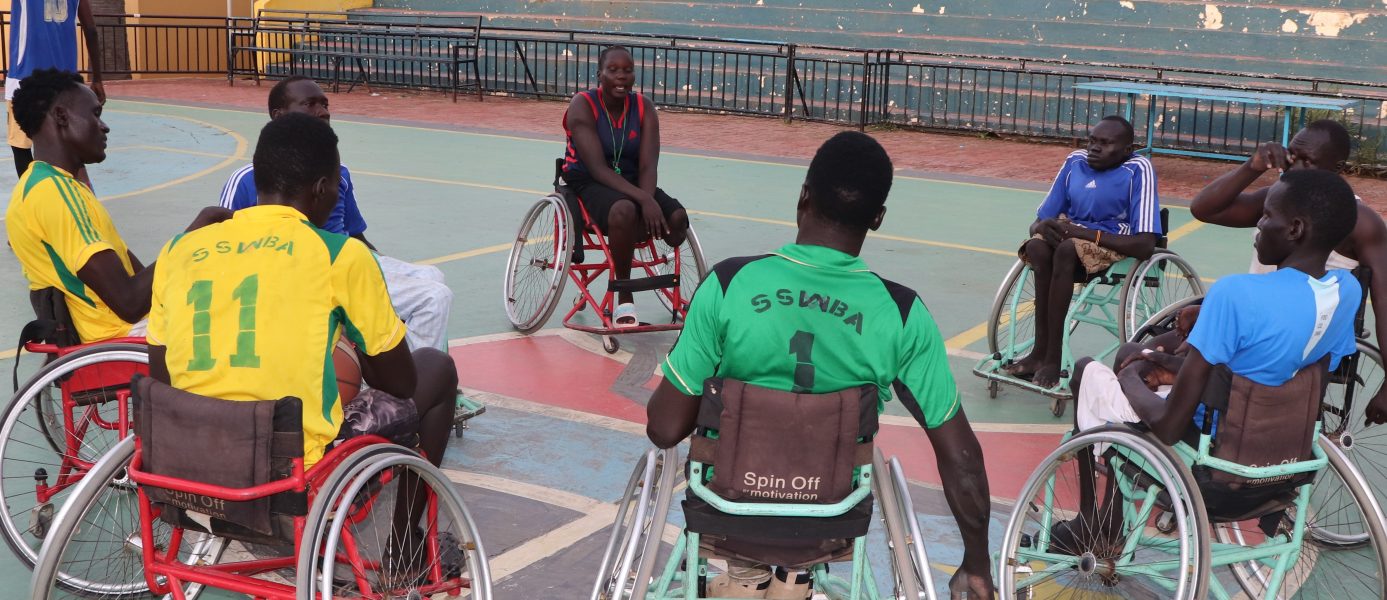
Inside Nimra Talata Basketball Stadium in Juba, a tight circle of 12 players forms at the end of an intense training session. Still in their kit, sweat-streaked and breathless, they sit in their wheelchairs, eyes fixed on their coach.
The empty stands amplify his voice as he breaks down the session; what worked, what didn’t, and what lies ahead.
“This is the future of South Sudan wheelchair basketball,” the coach says. “The South Sudan Bright Star wheelchair basketball team. Commitment and teamwork will lead us to our dream one day.”
For the players, the team is more than a squad. It is a community, one that has learned to look beyond disability, trauma and past lives shaped by war.
Three times a week, the 30-member squad trains under Juba’s punishing sun, using equipment and facilities donated by the Luol Deng Foundation. Some players wait their turn on the sidelines, others cheer, joke and push through drills with visible determination.
The team includes children formerly recruited and used by armed forces or armed groups, amputees injured in accidents, polio survivors and people living with other physical disabilities.
Amaudit is one of seven children formerly recruited and used by the armed forces or armed groups on the team.
In 2013, at just 15, he was recruited from a military barrack where his father served. Two years later, during the conflict, a gunshot wound to his waist left him paralysed. After three months of treatment, he returned home to Yirol.
“After I was wounded and returned home, I felt lost physically and emotionally,” he says. “I didn’t know where I belonged anymore.”
No longer part of the armed group, Amaudit says he felt rejected by his community. While attending rehabilitation sessions supported by the International Committee of the Red Cross (ICRC), he was introduced to the idea of wheelchair basketball.
“At first, I wasn’t sure. I had never played basketball before, and I didn’t see myself as an athlete,” he says. “But something in me wanted to try.”
The first time he pushed across the court, ball in hand, something shifted.
“The first time I held the ball and moved across the court, I felt something I hadn’t felt in a long time, freedom.”
At home, he felt isolated and ashamed. On the court, he found belonging.
“For the first time in a long time, people didn’t look at me as a ‘wounded ex-child soldier’, but simply as a teammate and someone who mattered.”
He smiles as he looks towards his teammates, resting his hands lightly on his knees.
“On the court, I learned to trust again. I laughed, struggled, improved, and I wasn’t alone. Every pass, every game, every practice helped rebuild my confidence and self-worth. I began to believe that my life had meaning beyond my past.”
Now in his third year of study, Amaudit says wheelchair basketball has helped him heal not only physically but also emotionally.
He has represented South Sudan at a regional level, including the first mixed African wheelchair basketball tournament in Kinshasa, where the team finished second.
“[Before,] I saw myself as limited, maybe even useless,” he says. “Then I realised my body still had strength, my mind still had fight, and my life still had purpose.”
His story echoes that of thousands.
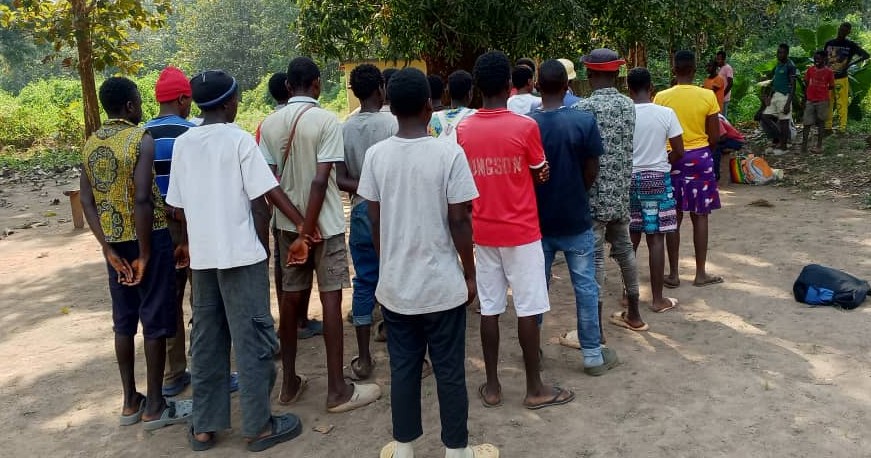
According to a 2019 UNICEF report, an estimated 19,000 children have been recruited and used by armed forces and armed groups since South Sudan’s conflict erupted in 2013.
Although 1,775 children were released in 2015, reintegration has often been marked by stigma and trauma. On the basketball court, some are finding a path back to dignity.
The Bright Star team was founded in 2018 by Malat Wei, an international player and coach and a polio survivor, with support from the ICRC. Wei says the sport is as much about healing as it is about competition.
The 32 players and coaches describe themselves as a family.
“Off the court, the support is just as strong,” says James Luate, a team member and secretary for the SPLM Disabled League at the Ministry of Youth, Culture and Sports. “We check in on each other, share advice and listen when someone is struggling.”
Luate says people with disabilities in South Sudan continue to face deep-rooted discrimination.
“Public places, schools, sports facilities and transport systems are often inaccessible,” he says. “Employment and professional sports opportunities are limited. These physical and social barriers prevent full participation in daily life.”
He urges the government and sponsors to invest in adaptive sports, expand wheelchair basketball and provide psychosocial support for former child soldiers.
“Wheelchair basketball isn’t just a sport,” he says. “It’s a tool for healing, reintegration and empowerment.”
Yet challenges persist. The team lacks formal federation registration, adequate equipment, and consistent funding, which limits its participation in international competitions.
Amaudit dreams of change.
“I want South Sudan wheelchair basketball to become a symbol of hope, resilience and inclusion,” he says. “I want to mentor younger players to show them that who you were doesn’t define who you can become.”
Beyond the court, the struggle to end child recruitment and use in armed conflict continues.
Oluku Andrew Holt, national coordinator for Disarmament, Demobilisation and Reintegration, says failure to fully implement the 2018 peace agreement has left children vulnerable. While progress has been made through government and partner collaboration, violations persist.
“When rumours of recruitment emerge, we treat them as emergencies,” Holt says. “Any child seen carrying weapons or wearing uniforms is investigated.”
Verification teams document cases, provide sensitisation and support reintegration. But funding shortages, slow implementation and renewed insecurity undermine these efforts.
“The hardest part was feeling like I didn’t belong,” Amaudit says quietly. “Not in my community, not in school, sometimes not even in my own family.”
Wheelchair basketball did not erase his past. But it gave him a future.
“From pain to purpose,” he says. “That’s the journey I want to continue.”
This story is reported with a grant from Journalists for Human Rights and Dallaire Institute for Children, Peace and Security.