
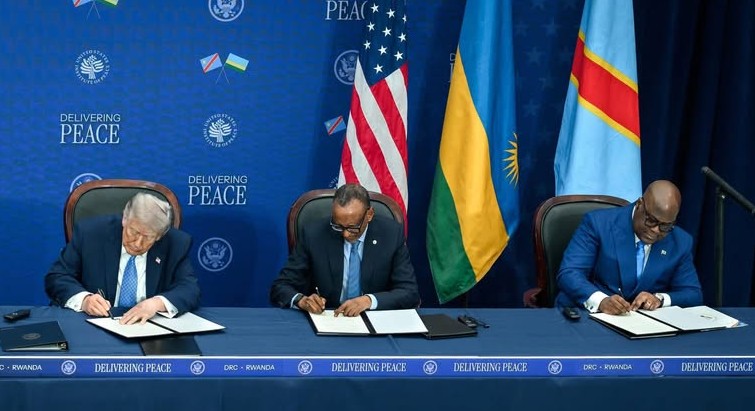
In a major diplomatic breakthrough aimed at ending one of Africa’s most persistent and devastating conflicts, U.S. President Donald Trump hosted Rwandan President Paul Kagame and Democratic Republic of Congo (DRC) President Felix Tshisekedi for the signing of a historic peace agreement between their two nations.
The deal, hailed by all three leaders as a turning point for the Great Lakes region, commits Rwanda and the DRC to a permanent ceasefire, the disarmament of rebel groups, and the safe return of refugees displaced by years of violence.
It also lays out a new framework for economic cooperation and cross-border development, a move Trump described as essential for “a stable and prosperous future.”
“I have a lot of confidence in both leaders. This agreement represents a real chance to turn the page. We’ll keep these commitments,” Trump said during the ceremony.
For the DRC, the signing marks a moment of renewed hope after decades of war that have left deep scars on the population.
For decades, the conflict has claimed countless lives and uprooted entire communities. A generation of children has been stripped of its innocence denied education, safety, and the simple promise of a stable childhood.
Normal commercial life and vital cross-border trade were shattered, crippling development and deepening the suffering of millions.
This prolonged hardship, leaders said, represents a profound injustice to the people of Eastern Congo, who deserve lasting peace.
Addressing the gathering, Congolese President Tshisekedi expressed “deep gratitude and clear hope,” pledging that his government would fully honor the terms of the accord.
“We are committed to our side of the agreement and we trust Rwanda will respect both the letter and spirit of the deal. Our joint struggle against armed groups must now begin with renewed determination,” he said.
Rwandan President Paul Kagame praised Trump for what he described as an “even-handed and pragmatic” approach to mediation.
“While our region is often far from global headlines, President Trump saw an opportunity for peace and immediately took it,” Kagame said.
“As a result, we now have the clearest and most viable path forward that we have ever had.”
Yet Kagame emphasized that the ultimate success of the agreement rests not in Washington, but in Africa.
“The future of this peace lies on the shoulders of African leaders. It is our responsibility to build the stability our people deserve,” he added.
As the ink dried on the accord, optimism filled the room tempered by the reality that previous peace efforts in the region have faltered. But for many, this moment carries renewed promise: a rare alignment of political will, regional leadership, and international support.
Whether it becomes the long-awaited turning point for Eastern Congo will depend on what happens after the cameras are gone.
For now, however, millions across the region can dare to hope that a different future one marked by stability, dignity, and shared prosperity may finally be within reach.