
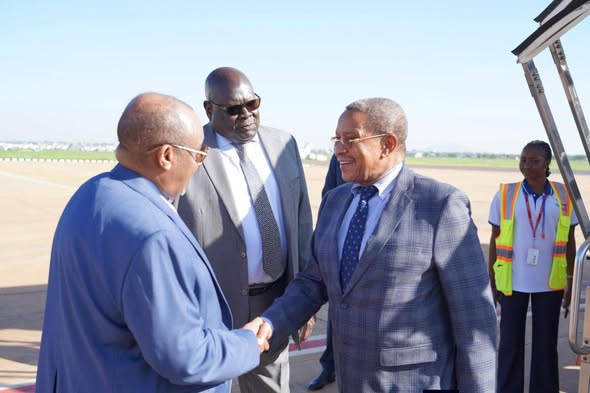
A high-level delegation from the African Union, led by former Tanzanian president Jakaya Mrisho Kikwete, arrived in Juba on Wednesday for a three-day mission aimed at reinvigorating South Sudan’s faltering peace process.
The visit comes at a critical moment, with the implementation of the 2018 revitalised peace agreement facing persistent delays.
Key provisions including security arrangements, constitutional reforms, and preparations for long-awaited elections remain largely unfulfilled, raising fears of renewed instability.
Diplomatic sources say the AU delegation is expected to engage senior government officials, opposition figures, and civil society representatives in a series of consultations focused on breaking the current political deadlock.
Among the issues likely to dominate the talks are the continued detention of opposition leader Riek Machar Teny and the broader question of creating conditions conducive to inclusive dialogue.
Machar, a central signatory to the peace agreement and leader of the SPLM-IO, remains a pivotal figure in South Sudan’s political landscape.
His detention has heightened tensions and cast uncertainty over the prospects of meaningful negotiations, with observers warning that progress may prove elusive without the participation of key stakeholders.
The AU’s renewed engagement underscores growing concern among regional and international actors over the slow pace of the peace process.
Kikwete, who has previously played a mediating role in regional conflicts, is expected to press for confidence-building measures and practical steps to restore trust among rival parties.
The visit also comes ahead of a planned conference in Pretoria later this month, widely viewed as a potential turning point.
The gathering is expected to bring together regional leaders and South Sudanese stakeholders in an effort to chart a path forward.
However, analysts caution that its success will depend heavily on resolving contentious issues such as political detentions and reaffirming commitment to the peace deal.
For many South Sudanese, the AU mission represents a renewed, if cautious, hope that sustained diplomatic pressure could help steer the country back toward stability after years of fragile peace.