
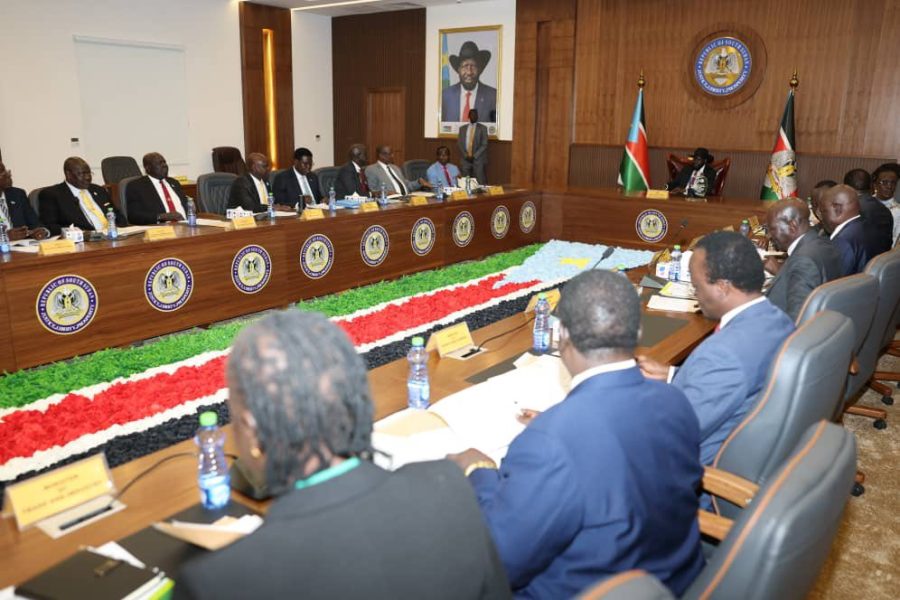
President Salva Kiir Mayardit on Friday presided over an extraordinary Cabinet meeting that once again placed the long-standing issue of unpaid and delayed salaries for public servants and members of the organized forces at the center of government deliberations.
The meeting, convened in Juba, focused on the timely payment of monthly salaries and the growing backlog of salary arrears owed to civil servants and the armed forces, an issue that has repeatedly strained household livelihoods and public confidence in government commitments.
Briefing journalists after the meeting, Information Minister and Government Spokesman Ateny Wek Ateny said Cabinet ministers submitted a number of policy memoranda aimed at stabilizing government operations and improving service delivery, with salary payment identified as a critical pillar of public sector performance.
“The Cabinet deliberated on mechanisms to ensure the regular and timely payment of salaries and the settlement of accumulated arrears,” Ateny said, without providing a specific timeline for implementation.
Despite renewed assurances, the meeting offered few concrete details on when public servants—many of whom have gone months without pay can expect relief.
For teachers, health workers, civil administrators, and security personnel, the discussion echoed familiar pledges that have accompanied previous Cabinet meetings, fueling public skepticism over what many now describe as salaries permanently stuck in a “coming soon” phase.
Civil servants across the country have repeatedly warned that delayed wages have forced families into debt, disrupted school attendance, and weakened morale within essential public institutions.
The Cabinet also turned its attention to proposed amendments to the Revitalised Agreement on the Resolution of the Conflict in South Sudan (R-ARCSS).
Justice Minister Michael Makuei Lueth informed the meeting that changes to several critical provisions of the peace agreement are being prepared for submission to Parliament.
According to Makuei, the proposed amendments are intended to remove legal and administrative bottlenecks and pave the way for the conduct of general elections scheduled for December 2026.
In an acknowledgment of persistent implementation failures, Minister of Cabinet Affairs Martin Elia Lomuro proposed the establishment of a monitoring and compliance mechanism to ensure that salary payments and back wages are not only promised but executed on a consistent basis.
Observers note that similar proposals have been raised in the past, but the absence of enforcement frameworks and budgetary transparency has continued to undermine delivery.
In a separate but significant announcement, Minister of Agriculture and Food Security Hussein Abdelbagi Akol informed Cabinet that he has relinquished his position as Commander-in-Chief of the South Sudan Opposition Alliance (SSOA) forces, calling for the immediate integration of his forces into the South Sudan People’s Defence Forces (SSPDF).
Abdelbagi also revealed plans to form a political party, signaling fresh political realignments ahead of the anticipated transition to elections.
While the Cabinet’s discussions reaffirmed government awareness of the salary crisis, public servants remain cautious. Many say they have heard similar commitments before, with little change on the ground.
As prices of basic commodities continue to rise and household incomes remain uncertain, civil servants are once again left waiting hoping that this latest round of Cabinet deliberations will finally turn long standing promises into actual paydays, rather than another announcement filed under “coming soon.”