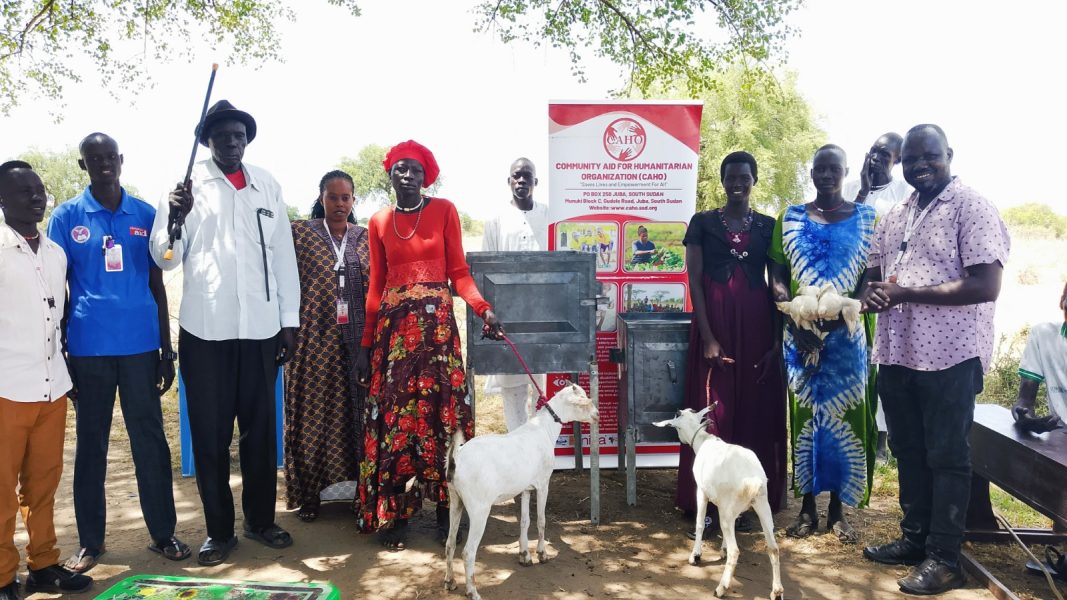
Community Aid for Humanitarian Organization (CAHO) has launched a livelihood support initiative aimed at strengthening income-generating activities and improving the economic resilience of vulnerable families in Terekeka County, Central Equatoria State.
The initiative, implemented under CAHO’s Livelihood Inclusion Program, began with the distribution of business-support equipment and livestock to beneficiary groups in Nyori and Reggo payams.
The support is intended to help vulnerable households establish and expand small businesses while creating sustainable sources of income to meet their daily needs.
The two-day distribution exercise commenced in Lwoki Boma of Nyori Payam, where a beneficiary group received a baking oven, a fish-drying oven, goats, and chickens.
Similar support was later provided to another beneficiary group in Reggo Payam, which received a baking oven alongside livestock to help strengthen community-based livelihood activities.
CAHO says the program is designed to empower families, particularly caregivers of vulnerable children, by providing practical resources that can generate income and reduce dependence on external assistance.
Speaking during the handover ceremony, Ms. Flora Keji, Chairperson of the beneficiary group in Nyori Payam, welcomed the support and said it would significantly improve the economic wellbeing of participating households.
“We are very grateful to CAHO for providing us with these items. They will help us start and strengthen our businesses so that we can earn income to support our families,” she said.
Keji noted that proceeds generated from the livelihood activities would help families meet essential needs, including paying school fees, purchasing learning materials, and providing food for children.
In Reggo Payam, beneficiary representative Cecilia Kiden praised the organization for supporting caregivers of children with disabilities, many of whom face financial challenges in providing adequate care and support for their families.
“These items will help us generate income and better support our children. We thank CAHO for standing with us and giving us hope,” Kiden said.
She emphasized the importance of livelihood programs in helping vulnerable households become more self-reliant and appealed for similar support to reach additional families facing hardship in the county.
According to CAHO officials, the initiative forms part of the organization’s broader efforts to promote inclusive livelihoods, social inclusion, and community empowerment across South Sudan.
Speaking on behalf of the organization, Livelihood Inclusion Officer Taban James said CAHO remains committed to ensuring that assistance reaches communities most in need.
“As a national organization, CAHO is dedicated to supporting vulnerable families with resources that can help them build sustainable livelihoods and improve their quality of life,” James said.
He explained that the provision of productive assets such as livestock and business equipment is intended to create long-term economic opportunities while enhancing household resilience against recurring social and economic challenges.
Community leaders and beneficiaries expressed optimism that the livelihood support will contribute to improved living standards, increased household incomes, and greater opportunities for vulnerable children and their caregivers.
The initiative is expected to strengthen local economic activities while helping beneficiary groups develop sustainable income streams that can support education, nutrition, healthcare, and other essential household needs.
As communities in Terekeka continue to face economic challenges, CAHO’s livelihood intervention is being viewed as an important step toward promoting self-reliance, improving family welfare, and building more resilient communities capable of supporting their own development.