
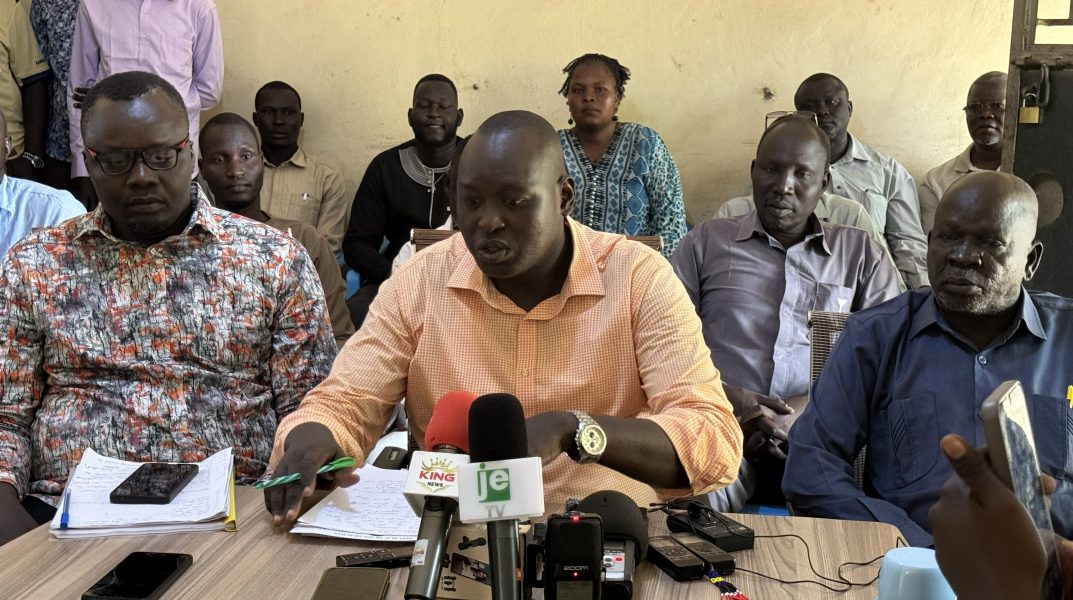
Central Equatoria State Chamber of Commerce, Industry and Agriculture has accused the Mayor of Juba City and the Commissioner of Juba County of illegally interfering in the affairs of the Chamber.
The Chamber claims the officials have been appointing and removing leaders without following established procedures.
Speaking in Juba on Tuesday, Chairperson of the Central Equatoria State Chamber of Commerce, Robert Pitia, condemned what he described as growing political interference in a private sector institution that operates independently from government structures.
While presenting documents he claimed were evidence of interference, Pitia said the Office of the Commissioner issued a letter removing an official from the Chamber leadership and appointing another person in his place.
“This is unacceptable. We don’t have that one in Chamber of Commerce,” he said.
He stressed that the Chamber of Commerce is not part of the administrative structure of Juba County and cannot be controlled through county authority.
“Chamber of Commerce is an independent private sector institution,” he said, adding that they collaborate and cooperate with the government to raise challenges that affect the traders.
Pitia warned that such actions risk undermining the independence of the business community, urging the commissioner to respect legal boundaries.
Pitia also accused Juba City Mayor Christopher Sarafino Wani of interfering in a matter currently before the courts.
He cited a letter allegedly issued by the Chief Justice ordering a halt to activities linked to a dispute between the National Chamber of Commerce and the Juba City Chamber of Commerce.
He argued that the mayor has no legal authority to intervene in a matter under judicial consideration.
“By now, he cannot interfere into issues concerning court,” he stated.
Pitia further claimed the Juba City Council does not have a Chamber of Commerce department in its structure, making it unlawful for city authorities to appoint individuals into Chamber leadership.
“Juba City Council, as a government, has not any Department of Chamber of Commerce in its structure to appoint someone who is close to him for his own interests,” he said.
He further stated that his office issued an administrative suspension order against a former official, accusing him of misconduct and misappropriation of Chamber funds and assets.
Instead, he claimed the suspended official is being protected by powerful individuals because of interests tied to prime business locations in Juba, including the northern part of Konyokonyo market.
“We are not going to allow it and we’ll never allow this thing to happen,” he said.
Pitia issued a direct warning to both the commissioner and the mayor never to interfere in the activities of the chamber of commerce.
“We strongly condemn the interference by Juba County Commissioner and Mayor of Juba City in the activities of the Chamber of Commerce, including relieving and appointing officials. We condemn it, and we are not going to accept it,” he said.
Meanwhile, Martin Juba, Chairperson of the Juba County Chamber of Commerce, said traders across multiple markets are facing unexplained increases in government fees, particularly garbage collection and market dues.
He explained that the official fee system is guided by a government-approved rate schedule book, which outlines the standard amounts payable by traders.
However, he said traders have reported sudden hikes beyond what is written in the approved fee schedule.
In Kuburi Aboba and Gurei markets, Martin said garbage collection fees were increased from 53,500 South Sudanese pounds to 235,000 SSP.
In another case involving ground rent, he said the amount was raised from 43,000 to 105,000 SSS.
He added that in some markets, traders were being asked to pay sums not reflected in the official fee book.
“Last week they increased the money for ground rent from 1,500 to 170,000 SSP now. And that money was not in the rate schedule,” he said.
Martin said the fee hikes have contributed to rising market prices, as traders pass the extra costs to consumers.
“Every market there is a very, very increase in the price because the money which was being taken from them is too much,” he said.
In Shirikat market, Martin said traders were initially asked to pay 1.3 million South Sudanese pounds, but after complaints, the amount was reduced to 300,000, despite the official schedule listing 200,000 SSP.
“We don’t know exactly why they increased that money,” he said. “We need the money to be paid, but it should be according to the rate schedule.”
Martin Further accused the Juba County Commissioner of removing a market chairperson in Rajab and replacing him with someone allegedly close to the commissioner, without consulting the Chamber.
He argued that the Chamber’s constitution provides clear disciplinary procedures, including investigation, warnings, and suspension, before any leadership change can take place.
“We don’t have somebody who was brought by a degree,” he said.
Meanwhile, Stephen Wani Aquilino, the chairperson of the Juba City Chamber of Commerce, said he was unlawfully removed from office by the Juba City Mayor.
He urged the Juba City Council to focus on implementing the government-approved rate schedule, rather than interfering in the Chamber’s leadership.
He also called on the council to strengthen public awareness and improve the management of garbage collection services across the city.
The Chamber of Commerce leaders called on government authorities to respect the Chamber’s constitution and the rule of law, warning that continued interference could destabilize market governance and worsen tensions between traders and local authorities.
Efforts to reach the Juba City Mayor and the Commissioner of Juba County were futile by the time of publication of this storyTop of Form
Bottom of Form
