
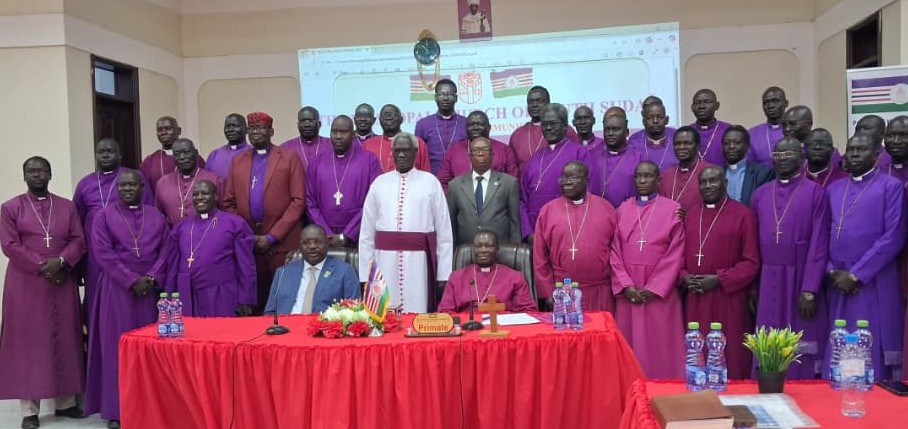
Senior church and government leaders have renewed appeals for unity, moral leadership, and national stability as the Episcopal Church of South Sudan (ECSS) convenes its annual House of Bishops Meeting in Juba.
The gathering, led by Most Rev. Dr. Justin Badi Arama, Archbishop and Primate of the ECSS, brought together bishops from across the country for two days of prayer, reflection, and guidance.
Archbishop Badi said the annual meeting draws representatives from all 61 dioceses, with 58 bishops in attendance this year.
Anchored on the biblical theme from John 16:33 urging believers to “take heart” amid hardship he encouraged clergy to remain spiritually grounded as they return to communities facing insecurity, economic strain, and social division.
“We encourage our bishops to stand firm and look to Jesus amidst all the challenges we face as a country, as families, and as a church,” Archbishop Badi said, expressing gratitude for God’s grace in enabling the meeting.
Newly reappointed Central Equatoria Governor Emmanuel Adil Anthony, attending the session only days after his confirmation, commended the ECSS for its frontline role in national healing and community resilience.
He assured the bishops of their safety in Juba and praised the Church’s unwavering service to vulnerable groups.
“Your dedication in faith and community service is a beacon of hope in our nation,” he said.
He highlighted the ECSS’s contribution to feeding the hungry, supporting the displaced, educating youth, and promoting reconciliation.
Quoting 1 Peter 1:15–16, Governor Adil emphasized the central role of moral leadership in steering the nation toward peace and stability.
He called for stronger church–government cooperation to address insecurity, rebuild trust among communities, and champion peaceful coexistence.
“With unity, determination, and faith, together we can confront the challenges our people face,” he added, urging leaders to cultivate tolerance, responsibility, and a shared vision for development.
As the bishops continue their internal deliberations, both Church and state leaders echoed a common message: South Sudan’s stability depends on the collective strength of its spiritual and political institutions working together to guide the nation forward.