
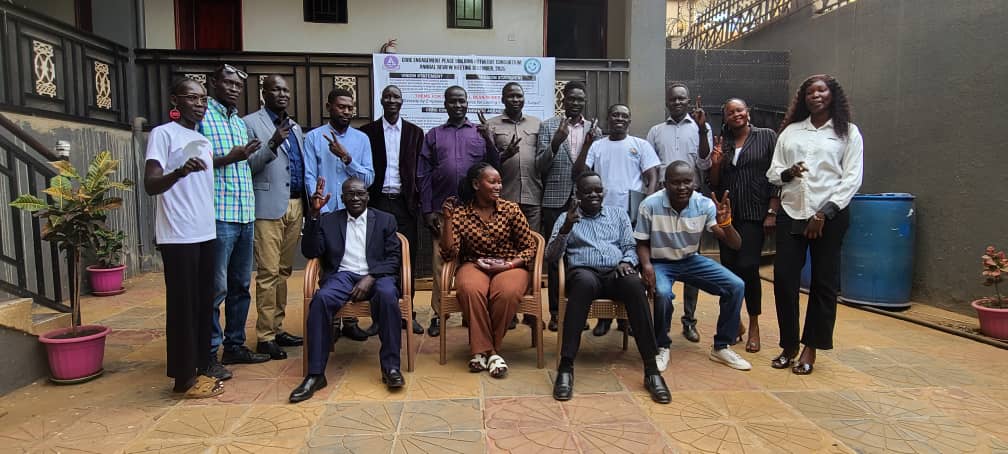
The Civic Engagement and Peacebuilding Initiative Consortium (CEPIC) has convened its annual review meeting in Juba, bringing together civil society organizations (CSOs) to assess progress made in 2025, share lessons learned, and set a strategic direction for the coming years.
Held under the theme “Unity in Diversity: Empowering Communities for Lasting Peace in South Sudan,” the one-day meeting attracted consortium members, partners, and government representatives from relevant institutions, with discussions centered on peacebuilding, civic engagement, and inclusive governance.
Speaking during the meeting, Daniel Matiop Ngang, Operations Manager of CEPIC, said the consortium comprising about 30-member civil society organizations had made tangible contributions to peacebuilding despite operating in a challenging environment marked by funding shortages and insecurity in parts of the country.
“Throughout the year, we focused on peacebuilding, civic engagement, protection, gender-based violence prevention, child protection, and inclusive governance,” Matiop said.
“Today, we presented our thematic and annual report highlighting what we have achieved collectively as a consortium.”
Matiop revealed that CEPIC members successfully established 15 peace clubs in Jonglei and Central Equatoria states, reaching more than 800 community members, particularly young people, through dialogue, awareness sessions, and peace education.
In addition, the consortium supported eight peace committees across different regions of the country. According to Matiop, these committees played a crucial role in resolving community-level disputes.
“Within the communities where they operate, the peace committees helped mitigate at least 14 localized conflicts during the reporting period,” he noted.
CEPIC also expanded its outreach through media engagement, including radio programs on peacebuilding and youth engagement, which reached wide audiences and encouraged community participation in nonviolent conflict resolution.
One of the year’s notable initiatives was a peacebuilding drama produced in July, which aired on television and radio stations nationwide.
The production showcased young people’s aspirations for peace and unity, resonating strongly with audiences across South Sudan.
A key highlight of the annual meeting was the official launch of CEPIC’s Strategic Plan for 2026–2030, which outlines the consortium’s long-term vision and priorities.
The plan emphasizes peacebuilding, civic engagement, inclusive governance, access to justice, human rights, prevention of election-related violence, and psychosocial support.
The consortium also announced the establishment of a new Peace Initiative Fund, a locally driven funding mechanism aimed at supporting member organizations amid declining international donor support.
“Peacebuilding is currently underfunded, yet the need is growing,” Matiop explained. “This fund is our response to ensure that civil society continues to serve communities, even when external funding becomes limited.”
Representing the government, Bol Diu Gok, Director at the Ministry of Peacebuilding, commended the consortium’s efforts and called for stronger coordination between CSOs and government institutions.
He urged civil society organizations to formalize their engagement through Memorandums of Understanding (MoUs) with the ministry and ensure proper registration and licensing with the Relief and Rehabilitation Commission (RRC) to create a safe and enabling operational environment.
“The Ministry of Peacebuilding will work collectively with other line ministries to ensure that CSO activities are impactful and contribute meaningfully to peace and reconciliation in South Sudan,” Diu said.
Despite the progress recorded, CEPIC acknowledged significant challenges, including funding gaps and insecurity in some operational areas, which limited the expansion of peace clubs nationwide.
Matiop noted that the consortium had initially planned to establish 200 peace clubs, but financial constraints reduced the rollout to 15.
Looking ahead, CEPIC called on the government and political actors to prioritize dialogue, end ongoing conflicts, and commit to peaceful and inclusive democratic processes.
“There can be no development where there is conflict,” Matiop stressed. “As a consortium, we call upon all stakeholders to embrace dialogue, end violence, and ensure that any future elections are inclusive and accepted by all parties.”
The annual meeting concluded with a renewed commitment by CSO members to strengthen collaboration, mobilize local resources, and continue empowering communities as a pathway to lasting peace and unity in South Sudan.