
Women’s Rights Are Human Rights. #KnowYourRights!
South Sudan is at a critical phase of managing conflicts, sustaining peace, and building a democratic society. The Revitalised Agreement on the Resolution of the Conflict in South Sudan (R-ARCSS) faces serious challenges, with violations threatening progress, including women’s inclusion and participation. The Reconstituted Transitional Government of National Unity (RTGoNU) has extended the R-ARCSS implementation period to February 2027, postponing elections to December 2026, and established a High-Level Standing Committee to monitor progress on constitution-making, security arrangements, the census, and credible elections.
Women’s political participation remains low due to structural inequalities, restrictive gender norms, insecurity, and limited access to decision-making. The R-ARCSS reaffirmed the 35 %quota for women in national and sub-national institutions, but this target has only been met in the presidency through the two female Vice Presidents making . Women have contributed strategically by mobilizing communities for peace, advocating for civic space and human rights, participating in transitional justice processes, and engaging in constitutional and electoral reforms. Despite these efforts, their influence remains constrained, with decision-making power largely concentrated among male elites and significant gaps persisting across parliament, the executive, security, and economic sectors.
Governance Milestones and Gender Provisions
South Sudanese women continue to struggle for the adoption of key legislation that would restore their dignity and protect them from violations and abuse. Critical draft bills, including the Anti-GBV, Family Law, Women’s Empowerment, and Women’s Enterprise Bills, remain pending. If enacted, these laws would promote gender equality and protect women and children: Family Law safeguards rights within households, women’s empowerment laws expand opportunities in education, leadership, and economic participation, and Anti-GBV laws prevent and respond to violence while promoting accountability and human rights. Together, they advance social justice, inclusion, and sustainable peace.
Women leaders, civil society organizations, and activists have deliberated on these drafts through the Ministry of Gender, Child, and Social Welfare, but they have not yet been tabled in Parliament for adoption. Separately, the Ministry of Justice and Constitutional Affairs has concluded the recruitment process for the CTRH Commissioners, including advertisement, shortlisting, and interviews. It is expected that at least three of the seven Commissioners will be women, with two South Sudanese and one African citizen.
Analysis of Women’s Representation in Governance Structures
National Executive
Based on last year’s data, women’s quota at the Presidency (comprising the President and five Vice Presidents) increased from 16% (one female Vice President) to 33% (two female Vice Presidents): H.E. Rebecca Nyandeng De Mabior, who chairs the Gender and Social Welfare Cluster and also serves as Acting Chair of the Governance Cluster, and H.E. Josephine Lagu Yanga, who chairs the Service Cluster. However, women’s representation continues to decline at the National Executive, Parliament, state governments, and local government levels, remaining below the 35% target. Among Ministers, women’s representation dropped from nine (9) (25%) to six (6) (17%) out of 35 ministerial positions, while among Deputy Ministers, it remains at 20% (two females out of ten). These figures highlight a continued decline in women’s representation, reflecting the lack of robust enforcement mechanisms, insufficient respect for policies and laws, and limited political will by political parties and the RTGoNU. This demonstrates that women’s participation is often treated as a favor or token rather than a right, despite commitments to empowerment and equality under domestic legislation and international legal instruments to which South Sudan is a party.
| Positions | Men | Female | (%) of women | |
| Presidency (President and Vice President) | 6 | 2 | 22 | Increase |
| Minister | 29 | 6 | 17 | Decrease |
| Deputy Minister | 8 | 2 | 20 | No changes |
Reconstituted Transitional National Legislative Assembly (RTNLA)
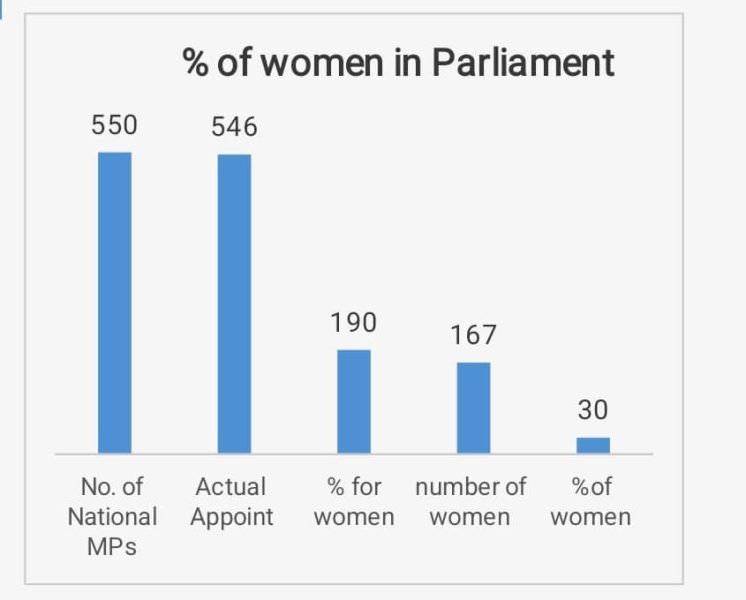
In the RTNLA, women represent dropped from 31% (169) females to 30% (167) out of 550 MPs). The RTNLA replaced 3 of the appointed women MPs with 3 men, 1 position not replaced yet and the position of the 4th Speakers continuously remain vacant. This brings the total loss seats for women MPs to 25. This replacement by males has exacerbated the gender imbalance at the RTNLA. Further, women chair 21% of Specialized Committees in the RTNLA (7 females out of 34) and are Deputy Chairpersons by 37% of the committees (13 females out of 35). This shows some progress in the committee roles, despite the overall drop in female parliamentary representation and the removal of the female Chief Whip.
Percentage (%) of female representation in Specialized Committees at RTNLA
| Position | Total No. | No. Male | No. Female | % for Female |
| Chairpersons | 35 | 28 | 7 | 21 |
| Deputy Chairpersons | 35 | 22 | 13 | 37 |
Council of States
Women’s representation in the Council of States has declined from 30% to 27%, with 27 female members out of 100 MPs. Among the three Speakers, there is one female, the First Deputy Speaker, Rt. Hon. Mary Ayen Mijok, representing 33% at that leadership level. However, administrative roles remain overwhelmingly male-dominated, with all 15 Clerk positions at both the State, Council of States and National Parliaments currently held by men.
State Executive and Administrative Areas
To date the number of female Governors, remain zero % following the removal of Hon Sarah Cleto from Western Bahr El Ghazal State. Meanwhile, the representation of female Deputy Governors dropped from at 30% to 10% with only one (1) female Deputy Governor from Warrap State.
Data of State Governors
| No | Male | Female | % of Female |
| Governors | 10 | 0 | 0% |
| Deputy Governors | 9 | 1 | 10% |
Women’s representation in State Governments across South Sudan remains significantly below the 35% constitutional target. Current data shows that women constitute only 22% of State Ministers (37 out of 170). In each of the Special Administrative Area, there is only one (1) female Minister (14%). Greater Pibor and Abyei Administrative Areas each have 6 women out of 25 officials (24%), while Ruweng Administrative Area has 7 women out of 25 officials (28%).
There are no female State Governors or Administrators, and only one female Deputy Governor (10%) has been appointed nationwide. At the county level, women’s participation is even lower, with only two female Commissioners out of 79 (2%). Overall, across 364 leadership positions reviewed—including Governors, Deputy Governors, Ministers, and Advisors—women hold 11 out of 50 Advisor positions (22%), and there are no women serving as Chairpersons of Independent Commissions. These trends demonstrate a persistent implementation gap in meeting the 35% women’s quota, reflecting weak enforcement mechanisms, limited accountability within political parties, and insufficient political commitment to women’s leadership and inclusion at sub-national levels.
| State Executive | % of Women | Remarks |
| CES | 17 | Decrease |
| EES | 17 | Decrease |
| Jonglei | 14 | Decrease |
| Lakes | 8 | Decrease |
| NBS | 14 | Decrease |
| Unity | 8 | Decrease |
| Warrap | 17 | Increase |
| WBS | 14 | Decrease |
| WES | 20 | Increase |
Special Administrative Areas Parliaments
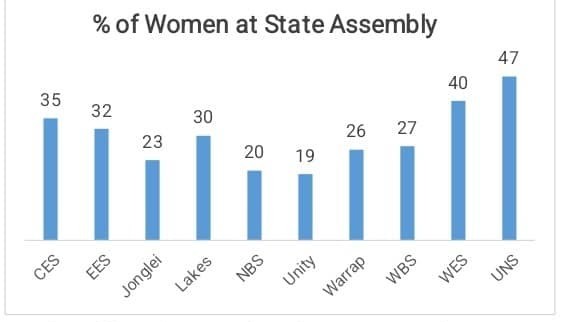
Women’s overall representation in State Parliaments has dropped from at 31% to 29% with 299 women out of 1,000 State MPs. There are currently three female Speakers in Jonglei, Lakes, and Western Equatoria states, and the number of State Deputy Speaker reduced from five to 2 female Deputy Speakers across the country.
Women account for 31% of representation in key governance and oversight mechanisms. The number of female Commissioners at the National Constitutional Review Commission (NCRC) increased from 18 to 19 out of 57 members, representing 33%. At the Political Parties Council (PPC), women hold 40% of the seats (4 out of 10 members), while in the National Election Commission (NEC), they comprise 22% (2 out of 9 members). It should also be noted that all 10 Returning Officers of the NEC are male, highlighting persistent gender gaps in electoral administration.
Conclusion
Strengthening women’s political participation in South Sudan requires legal, institutional, and advocacy measures to ensure meaningful inclusion at both national and state levels. The 35% quota should be legally institutionalized with enforceable mechanisms and supported by gender-responsive reforms in constitutional, electoral, and peace processes. Women’s engagement must be guaranteed across executive, legislative, and advisory bodies, as well as in transitional justice mechanisms, election preparations, and peace and security structures. Political parties and leaders should implement gender-sensitive nominations, ensure women’s participation in appointments and decision-making, and publicly report progress. Leadership development, mentorship, protection, and resource support are essential to enhance women’s influence, while sustained advocacy and lobby is critical to monitor implementation and hold institutions accountable. Full implementation of the quota, alongside structural reforms, is key to advancing inclusive governance, democratic consolidation, and a peaceful political transition in South Sudan.
Source: Presidential decrees, surveys, interviews, questionnaires, desk reviews, and stakeholder consultations.
This analysis and support to CIGPJ is made possible by the generous support of Norwegian People’s Aid (NPA) through the funding from Norwegian Ministry of Foreign Affairs. The views expressed here solely reflect the author and do not attribute to the supporting organizations.
