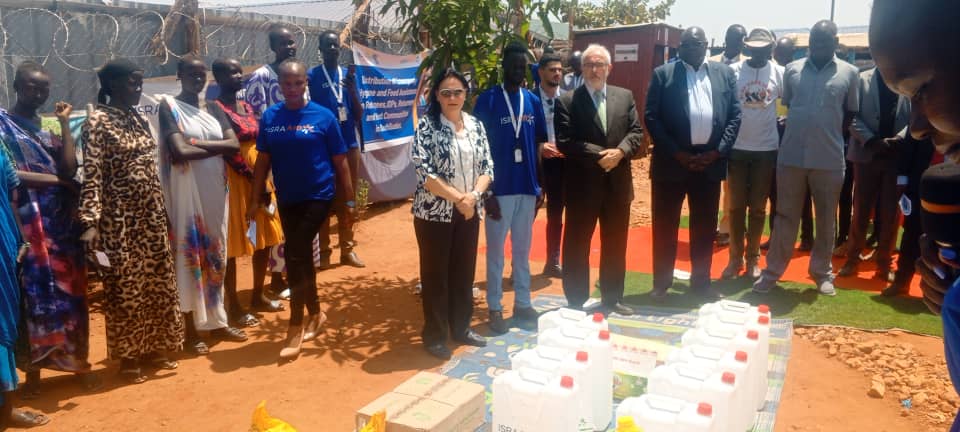
At least 2,000 vulnerable families in Juba’s Internally Displaced Persons (IDP) Camp III have received much-needed support after IsraAID, with support from MASHAV, distributed emergency humanitarian supplies aimed at easing daily hardship and restoring hope.
Each household received basic essential non-food items, including jerrycans for water storage, blankets, mosquito nets, soap, and Aqua Tabs for water purification. Food supplies such as maize flour, beans, cooking oil, sugar, and salt were also distributed to help families meet their immediate nutritional needs.
The support is part of IsraAID’s multi-sectoral work in South Sudan, focusing on improving access to essential health services, strengthening nutrition, and promoting better Water, Sanitation, and Hygiene (WASH) practices in Central Equatoria and Upper Nile states.
Speaking at the distribution ceremony on Tuesday at IDP Camp III, Camp Chairman Makul Gatluak expressed appreciation for the generous donation provided by IsraAID.
However, he called for increased support in the health sector, noting that the camp’s health facilities are not operational and lack essential medicines and qualified medical staff.
He said the absence of a functional medical unit has severely affected residents, particularly pregnant mothers who are forced to travel long distances to Juba Teaching Hospital or other health centres in town to access care.
Gatluak also highlighted the shortage of clean drinking water in the camp, describing it as an urgent challenge that continues to put vulnerable families at risk.
Israel’s Ambassador to South Sudan, Gerson Kedar, reaffirmed his country’s continued partnership and support to South Sudan.
He noted that since independence, Israel has been part of the country’s development.
“Every time I come, I try to bring something, whether it is capacity building, training, or experts in education, science, agriculture, or medicine.”
“But I am also sad that there is still a need for such aid. Humanitarian assistance does not solve the root causes of displacement.”
Kedar noted that many IDPs remain in camps due to political instability and violence, stressing that lasting solutions must come through peace, stability, and full implementation of political commitments.
Only then, he said, will families be able to return home and rebuild their lives permanently.
Head of Overseas Projects at MASHAV, Mrs. Irit Savion-Waidergorn, said visiting the field and witnessing the direct impact of assistance on families reinforces her agency’s commitment.
“When we see how this support is received and what it means to people, it gives us strength to continue,” she said.
In South Sudan, she said, the agency has supported various initiatives, including the establishment of an Intensive Care Unit at Juba Teaching Hospital in 2022 and training programs for South Sudanese professionals in health and agriculture.
Describing the aid as an expression of solidarity and shared responsibility, Savion-Waidergorn emphasized that development cooperation goes beyond emergency relief; it also focuses on empowering communities to stand on their own.
South Sudan’s National Minister of Health, Sarah Cleto Rial, expressed appreciation for the timely intervention.
“There are many people here with long-term health issues. There is no health center here, and food remains scarce. Yet people continue to live and persevere,” she said. “We thank our partners who made this day possible.”
She highlighted the urgent health challenges facing displaced communities, especially in informal settlements where access to medical services remains limited.
Cardinal Stephen Ameyu Martin Mulla, who also addressed the gathering, described the initiative as a powerful act of solidarity.
“In delivering medical equipment, water purification supplies, and food, Israel extends a hand of concrete support to people enduring hardship,” he said. “But charity must go hand in hand with justice and long-term development.”
He urged stakeholders to combine humanitarian aid with sustainable planning that enables displaced families to regain independence and dignity.
Operating in South Sudan since 2011, IsraAID has delivered integrated programs in health, protection, psychosocial support, and WASH services.