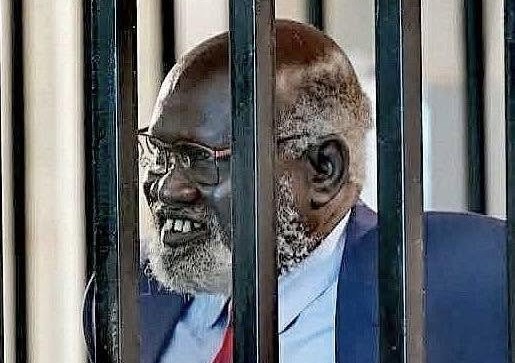
Gatwech Lam Puoch, a member of the Transitional National Legislative Assembly representing Nasir County and one of the co-accused in the ongoing Nasir incident trial involving First Vice President Dr. Riek Machar and other SPLM/A-IO officials, on Wednesday delivered an extensive defence before the Special Court.
During the 91st session of the proceedings held at Freedom Hall in Juba, Puoch challenged both the legal foundation of the charges against him and the evidence presented by prosecutors.
His testimony focused on three key areas: parliamentary immunity, allegations that he described certain armed groups as militias, and the authenticity of electronic evidence presented before the court.
Opening his defence, Puoch argued that the statements cited by prosecutors were made in his official capacity as an elected member of parliament and therefore fall under constitutional protections afforded to lawmakers.
According to Puoch, parliamentary immunity exists to allow elected representatives to perform their duties without fear of intimidation, arrest or prosecution for opinions expressed while carrying out their legislative responsibilities.
He told the court that as a representative of Nasir County, he enjoys both procedural and substantive parliamentary immunity, which protects statements, opinions and expressions made in the exercise of his constitutional mandate.
Puoch maintained that the prosecution was attempting to criminalize actions that were part of his legitimate parliamentary duties.
He argued that the statements referenced in the case originated from a public press conference where members of parliament discussed issues affecting citizens and matters of public interest.
According to his testimony, allowing such statements to become grounds for criminal prosecution would undermine democratic governance and weaken the independence of parliament.
Puoch warned that accepting the prosecution’s position could create a situation in which elected representatives are exposed to arrest or legal action simply for expressing views on issues affecting the public.
He therefore asked the court to recognize that parliamentary immunity protects lawmakers from liability arising from official statements made while performing their constitutional responsibilities.
Turning to the substance of the allegations, Puoch strongly denied claims that he had referred to Agwelek and Abu-Shok forces as militias or alleged that they had been deployed to disarm local residents in Nasir.
He told the court that prosecutors had misrepresented his statements and attributed words to him that he never uttered.
According to Puoch, the video evidence played before the court demonstrates that he described the groups as forces that had not yet been integrated into the South Sudan People’s Defence Forces (SSPDF) and were not part of the Necessary Unified Forces established under the 2018 Revitalized Peace Agreement.
He argued that this characterization was based on publicly available information and was supported by evidence presented by the prosecution itself.
Puoch pointed to testimony from prosecution witnesses as well as video footage that, according to him, confirmed that the integration process involving Agwelek forces had not been completed.
He further referenced public statements by senior military officials and government directives concerning the integration of forces into the national army, arguing that these developments supported the accuracy of his remarks.
The MP insisted that he deliberately chose his words carefully and never used the term militia.
He told the court that, as a legislator, he understands the significance of language when addressing sensitive public issues and therefore would not casually apply such descriptions.
Puoch accused prosecutors of acting in bad faith by attributing statements to him that were not supported by evidence before the court.
He argued that the prosecution’s own exhibits contradicted the allegations and demonstrated that the words in question had been spoken by other individuals rather than by him.
The final part of his testimony focused on electronic evidence, particularly WhatsApp messages allegedly linked to him.
Puoch categorically rejected the authenticity of the messages and claimed they were fabricated.
He questioned the methodology used by the digital forensic expert who presented the evidence and raised concerns regarding the handling and verification of electronic material.
According to Puoch, the forensic expert failed to identify the specific phone number allegedly associated with the messages, failed to identify the names of the WhatsApp groups in question, and did not establish who administered those groups or who their members were.
He also questioned why messages attributed to him appeared under his full name on a device allegedly belonging to him, arguing that such circumstances were inconsistent with the normal operation of personal smartphones.
Puoch further criticized the prosecution for relying on a forensic report stored on a flash drive rather than presenting the original devices for examination before the court.
He argued that modern smartphones preserve metadata showing when messages are created, received, modified or deleted and that such information should be available for independent verification.
According to his testimony, the prosecution failed to establish a clear chain of custody or prove the authenticity and reliability of the electronic evidence presented.
The Nasir County lawmaker concluded that the allegations against him were unsupported by credible evidence and urged the court to carefully examine both the constitutional protections available to elected representatives and the reliability of the evidence relied upon by prosecutors.
The hearing was adjourned until Friday, 26 June, when Puoch is expected to continue presenting his defence before the Special Court.