
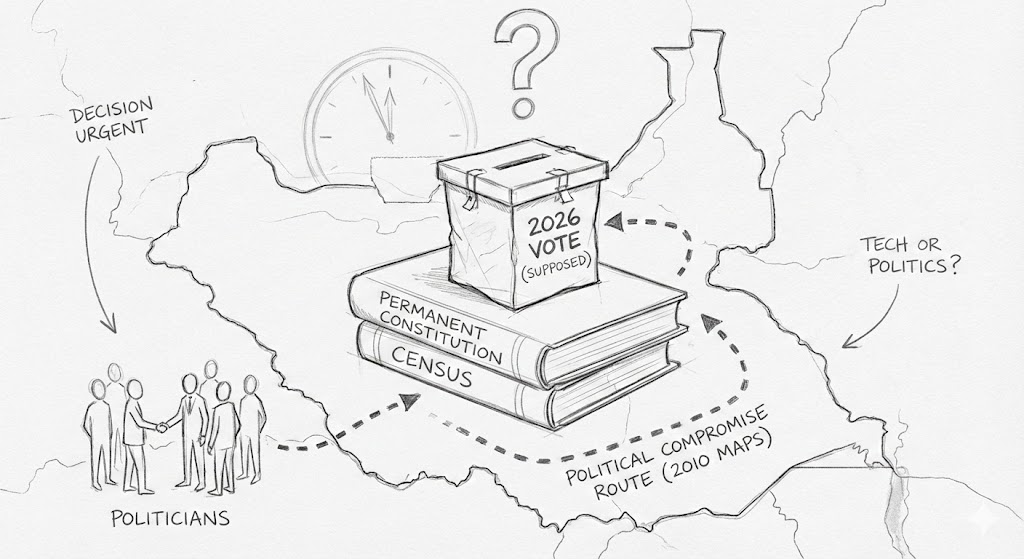
With approximately a year remaining before the scheduled conduct of the country’s first general elections since independence, National Election Commission (NEC) has stated that polls cannot be held in 2026 unless political compromises are made immediately.
Speaking at the National Stakeholders Dialogue in Juba, last week, Ahou Malou, the NEC’s Director for Budget and Planning, warned that critical prerequisites, such as the Census and the Constitution-making process, remain unaccomplished.
Malou explained that while the roadmap extension allows for 24 months, the tasks required by the Peace Agreement may not be achievable within the remaining period.
He noted that the Constitution-making process requires 18 months, while the national census requires 16 months. Furthermore, once a Permanent Constitution is adopted, the Election Act must be amended to align with it, a process requiring another two months.
“If we stick to the schedule, the Permanent Constitution was supposed to be ready by August 2024 and submitted to the Ministry of Justice by October. We are now past those dates,” Malou said.
To save the December 2026 election date, Malou indicated that specific conditions require a high-level political decision rather than a technical one.
The NEC suggests that for elections to proceed, the parties to the agreement must agree to bypass certain requirements, specifically the census and the drawing of new boundaries.
“If we need elections by December 2026, you delete this process,” Malou stated.
The Commission proposes using the geographical constituencies from the 2010 elections instead of waiting for new data.
“Section 41 of the Election Act states that if new constituencies are not ready prior to the election date, they cannot be used. Therefore, we would use the old constituencies,” Malou explained.
Malou emphasized that while the NEC is an independent institution, the unique nature of South Sudan’s vote, which he described as a conflict resolution election, binds it to the stipulations of the Revitalized Peace Agreement.
Issues regarding the census, the constitution, and boundaries are tied to the agreement and require political consensus to change, he added.
“We have told them: if you correct the schedule and make the necessary political decisions, specifically regarding the Census clauses and the constitution, then elections can be protected and secured.”
Despite the legal logjam, NEC reported operational progress on the ground. The Commission has established State Election Committees and renovated offices in nine states.
Malou said the Election Commission is ready to protect the election and is merely waiting for a political decision.
“If these decisions are taken quickly, the elections will remain secure.”
Constitutional progress
John Natana, Secretary General of the National Constitutional Review Committee (NCRC), presented an update on the Constitution-making process, stating that the institution has already conducted public engagements in four states, covering not only state capitals but also counties.
He noted that the outreach has since expanded, with teams dispatched to three additional states as of November 17. A fourth team is scheduled to depart for Western Equatoria imminently.
Natana stressed that each step is “extremely significant and cannot be wished away or delayed for unjustifiable reasons.”
He revealed that the Commission intends to advertise positions for the Constitutional Drafting Committee (CDC) before the year’s end.
This move is critical to ensure that as data from the public consultations comes in, the CDC is ready to immediately begin drafting the constitution.
“The data is going to CDC quickly, so that the process can start, so that we get a zero draft,” Natana explained. “This will enable the process to move to subsequent stages, including a National Constitutional Conference, which is expected to be transformed into a Constituent Assembly for final adoption.”
He affirmed that the people’s aspirations, gathered through the ongoing consultations, along with South Sudan’s history and traditions, will form the primary basis for the new constitution, supplemented by best regional and international practices.