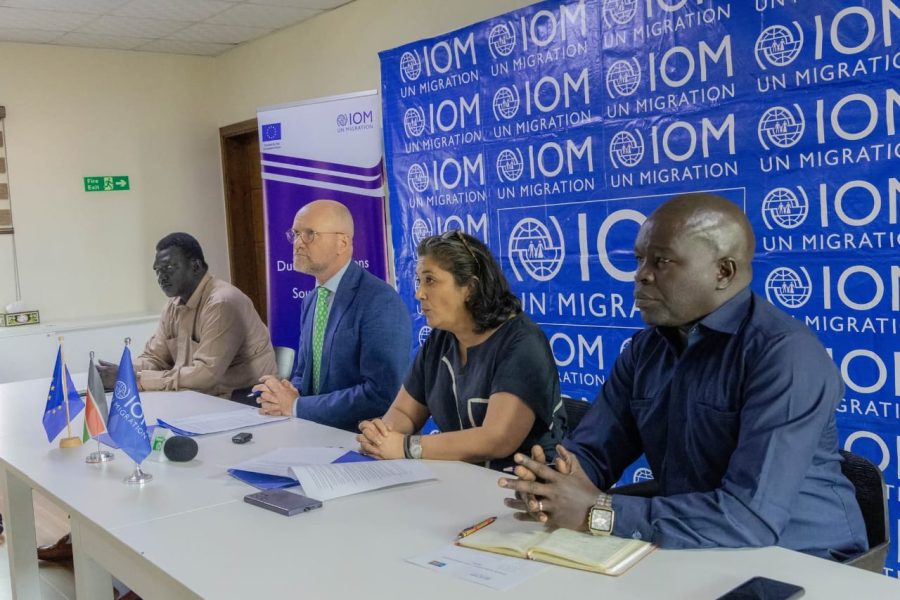
The European Union and the International Organization for Migration have launched a new long-term initiative aimed at helping displacement-affected communities in South Sudan rebuild their lives safely and with dignity.
The programme, known as Catalysing Durable Solutions, targets vulnerable populations in Rubkona County and Yei River County, focusing on livelihoods, urban planning, infrastructure, and land governance systems to support sustainable recovery.
Speaking at the launch in Juba, EU Ambassador Pelle Enarsson said the initiative seeks to address the root causes of urban displacement while strengthening the capacity of local authorities.
“By working closely with national and local authorities, we aim to strengthen their ability to manage displacement and prepare for climate-related shocks. But most displacement in South Sudan is driven by conflict without peace, there can be no durable solutions,” Enarsson said.
The programme will support both displaced families and host communities by expanding access to essential services and creating practical opportunities for households to rebuild their livelihoods.
IOM Chief of Mission Vijaya Souri said lasting recovery requires coordinated and sustained investment.
“Durable solutions depend on stability and practical investments in land systems, urban planning, and access to livelihoods. With EU support, we are creating real opportunities for families to secure their futures,” she said.
In Rubkona County, where recurrent flooding has displaced thousands, the initiative will build on previous EU and IOM investments through community planning, infrastructure support, and livelihood activities.
Meanwhile, in Yei River County, an important agricultural and trade hub, the programme will support implementation of the state’s Durable Solutions Roadmap, linking urban development with market growth and social cohesion.
A core pillar of the initiative focuses on housing, land, and property, including strengthening land governance, improving dispute resolution, and advancing digital land records to reduce conflict.
The 30-month programme, which began implementation in January 2026, will be carried out in close partnership with national, state, and county authorities to reinforce long-term stability and recovery.