Political parties in South Sudan are being encouraged to increase women’s participation in leadership and decision-making roles as the nation prepares for the 2026 elections.
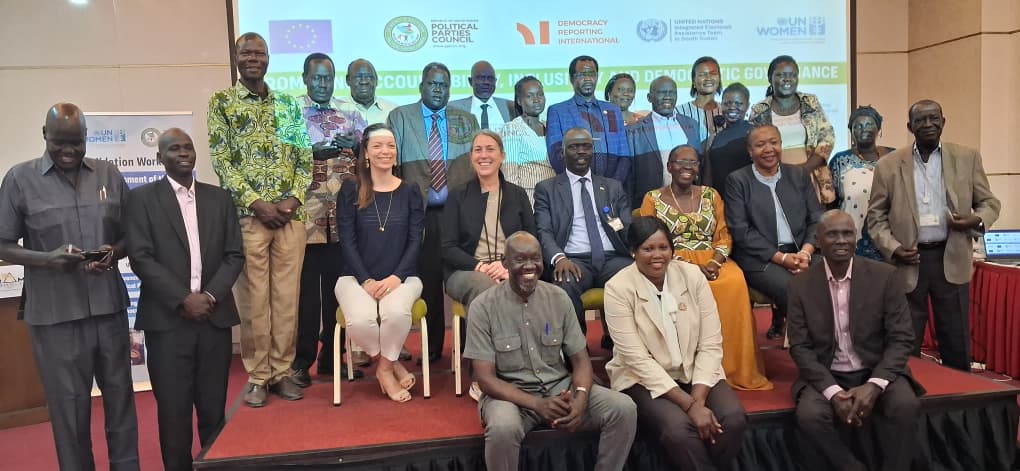
This renewed call came during a two-day gender assessment workshop that brought together political parties, civil society organizations, government institutions, and gender advocates to examine women’s representation within all registered political parties.
Speaking at the opening, Dr. Lorna Elia, Deputy Chairperson of the Political Parties Council (PPC), emphasized that the Transitional Constitution, the Revitalized Peace Agreement, and the amended Political Parties Act all mandate women’s representation 25% at the constitutional level and at least 35% within party structures. Yet despite these provisions, women remain significantly underrepresented, with only 6.5% serving as party chairpersons nationwide.
“Women are not asking to replace men. We are asking to work together as partners for peace, stability, and nation-building,” Dr. Elia said.
She urged political parties to begin identifying qualified women who can contest parliamentary and executive seats in the upcoming 2026 elections.
According to her, women bring diverse experiences and unique perspectives that strengthen policymaking, social welfare, and community engagement.
The gender assessment, funded by UN Women with support from the European Union (EU), aims to generate data that will guide reforms within political parties to improve women’s participation.
The EU has reaffirmed its commitment to supporting gender inclusion as a foundation for democratic governance and sustainable peace in South Sudan.
During the validation session, Ines Narciso, EU Programme Manager for Governance Cooperation, stressed that women’s political involvement is essential for inclusive democracy.
Although South Sudan faces multiple post-conflict challenges, she said the country also has significant potential to build strong democratic institutions by empowering women to participate fully in politics.
Narciso noted that women’s engagement in political parties directly influences priorities such as education, healthcare, and social protection sectors that shape community wellbeing.
She clarified that promoting women’s participation is not about displacing men, but ensuring fairness, equal opportunity, and collaborative leadership.
The 35% affirmative action requirement, she said, “represents voices that must be heard, not just a number.”
The EU continues to support South Sudan’s political processes through partnerships with the PPC, UN Women, UNDP, DRI, and the UN Integrated Electoral Assistance Team.
Narciso reaffirmed that the EU will remain committed to removing barriers, expanding opportunities, and championing women’s empowerment across all political platforms.
As South Sudan moves closer to its first elections since independence, experts and stakeholders say women’s inclusion in political parties is not only a constitutional obligation but also a crucial step toward building a peaceful, democratic, and equitable society.