
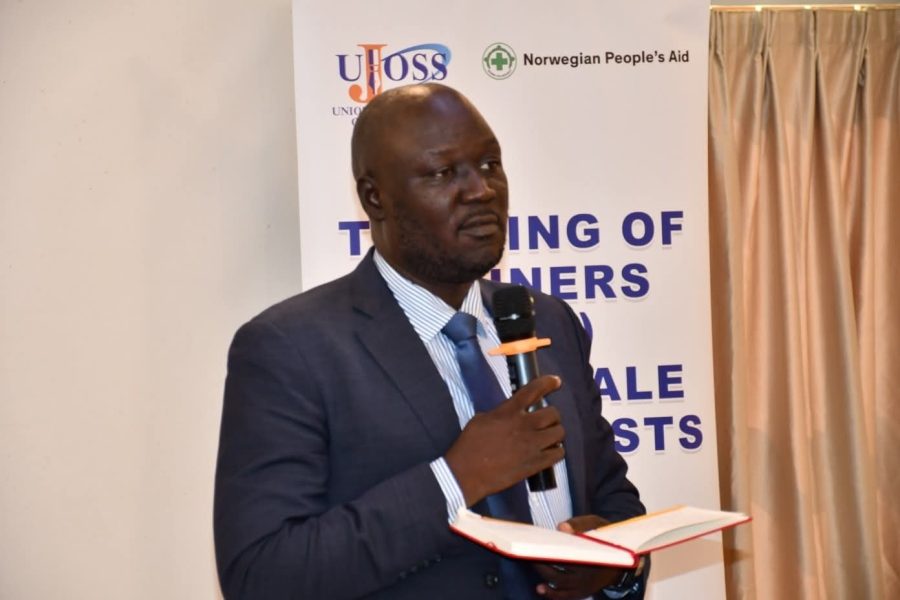
The Union of Journalists of South Sudan (UJOSS) has concluded a two-day Trainers of Trainees (ToT) workshop aimed at strengthening the Female Journalists Network, with plans underway to include the newly trained trainers in future engagements in various states to expand journalism mentorship and capacity-building programs across the country.
Speaking during the conclusion of the training session on Tuesday, February 10, 2026, UJOSS Chairperson Oyet Patrick praised the growing number of skilled female journalists now able to lead trainings, describing it as a major step forward in building local capacity within the media sector.
“I remember we used to only depend on one female journalist (Marina), whom we’ve moved with across the country, including going to Aweil and other places. But I can say now we are happy that we have many, we have many female journalists who conduct trainings,” he said.
He noted that female journalists have already played a key role in mentorship programs, particularly within juvenile schools, where several journalism-related initiatives have been carried out successfully.
“We want to move to other parts of the country for trainings and take some of you with us,” he added.
He emphasized UJOSS’s commitment to ensuring that the skills gained from the workshop are shared beyond Juba.
Oyet commended the participants for dedicating their time and energy to attending the workshop, describing them as professionals who have demonstrated strong leadership and growth in recent years.
He also highlighted that some of the female journalists in the network are award winners, which he said is a source of pride for the union.
“Among these people, we have award winners in journalism, which we are very proud of and we are having a lot of hope in them,” he said.
The UJOSS chairperson further encouraged universities and academic institutions to tap into the expertise of female journalists as guest lecturers, especially in specialized areas such as television script writing, mobile journalism, and multimedia storytelling.
“We have a lot of skills that should not just end in the newsroom but should go out there and also impact the society,” he said.
Oyet also pointed to the growing interest in journalism among students, revealing that the union has already received reports indicating that journalism clubs are expanding from secondary schools into primary schools.
“With the training people have been providing to the schools, especially secondary schools, this year we have already received reports that some primary schools are also opening up journalism clubs,” he said.
He described this development as a sign that the mentorship efforts are beginning to bear fruit, noting that journalism remains critical in strengthening truth-telling and giving voice to marginalized communities.
“As journalists, our work is to give voice to the voiceless and that is exactly what it is when you are training other people,” he said.
Oyet said UJOSS and its partners are considering launching an electronic newspaper platform that could publish student-written articles, supported by editors drawn from the female journalists’ network.
“We were discussing something about these students who are in the schools, in the secondary schools, can they start writing articles… and put together an e-paper that can be shared with them,” he said.
He appreciated Norwegian People’s Aid (NPA) for its continued support to journalism development initiatives in South Sudan, noting that more activities will be implemented under the ToT program throughout the year.
“We are moving in the right direction and for that we thank Norwegian People’s Aid once again for always standing with us,” he said.
The event ended with the NPA Program Manager who officially close the workshop and send off participants as the next phase of trainings is prepared for rollout in the states.