Deutsche Gesellschaft für Internationale Zusammenarbeit (GIZ) has stepped up its rural food security interventions in Yei River County and Magwi County, rolling out a large-scale post-harvest support initiative targeting smallholder farmers.
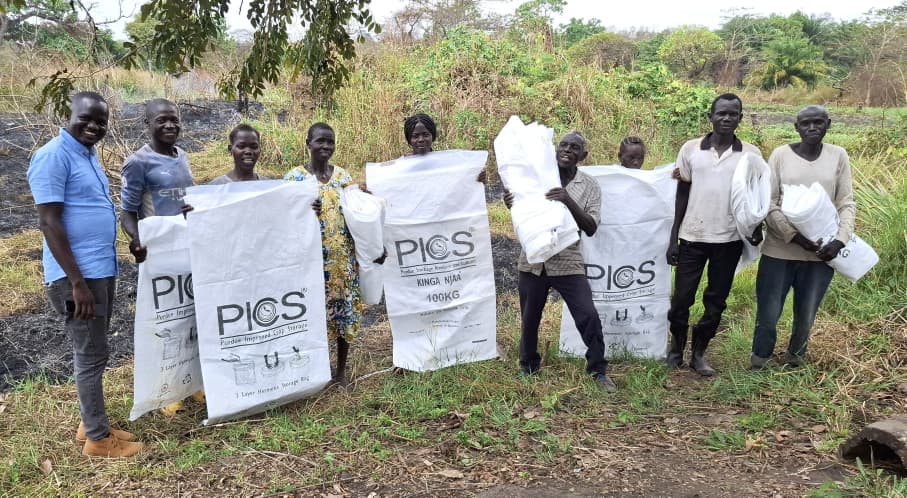
The intervention, implemented through the Community-Driven Rural Development (CDRD) and Improved Living Conditions and Psychosocial Support (ILiPS) projects, has seen the distribution of 21,000 hermetic storage bags to more than 2,500 farmers, cooperatives, and agro-dealers.
The storage materials provide a combined capacity of approximately 2,100 metric tons, aimed at addressing one of the most persistent challenges in rural agriculture post-harvest losses.
For years, farmers in the two counties have grappled with inadequate storage facilities, pest infestations, and limited technical knowledge on post-harvest handling.
These constraints often force households to sell produce immediately after harvest at lower prices, undermining both income stability and food availability.
The hermetic bags—designed as airtight, multi-layer storage systems offer a practical solution by protecting grains from moisture, mold, and destructive pests such as weevils.
Staple crops including maize, beans, sorghum, cowpeas, and soybeans stand to benefit significantly from the improved storage conditions.
Project advisors say the intervention was well-timed, aligning with the recent harvest season between December 2025 and February 2026, a period when storage challenges are most acute.
Farmers who received the bags reported strong acceptance of the technology, noting its potential to preserve crop quality and extend storage periods.
Beyond the distribution of materials, GIZ is integrating training on post-harvest management and value chain development.
The capacity-building component is intended to equip farmers with practical skills to reduce losses, improve product quality, and access better market opportunities.
According to development partners, post-harvest losses remain a major but often overlooked driver of food insecurity in South Sudan, with studies suggesting that a significant share of crops can be lost due to poor storage practices.
The introduction of hermetic storage technology is increasingly viewed as a climate-smart and cost-effective solution to this challenge.
The ILiPS project, which focuses on improving livelihoods for returnees, internally displaced persons, and host communities, is implemented on behalf of Germany’s Federal Ministry for Economic Cooperation and Development (BMZ).
Meanwhile, the CDRD project emphasizes community-led rural development and is co-funded by the European Union and the Embassy of the Kingdom of the Netherlands.
GIZ says the initiative forms part of a broader strategy to strengthen resilience, enhance rural livelihoods, and promote sustainable agricultural practices in South Sudan, where food insecurity continues to affect a large portion of the population.
As the program expands, stakeholders say scaling up access to modern storage technologies alongside farmer training and market support will be critical in transforming subsistence agriculture into a more stable and productive sector.