
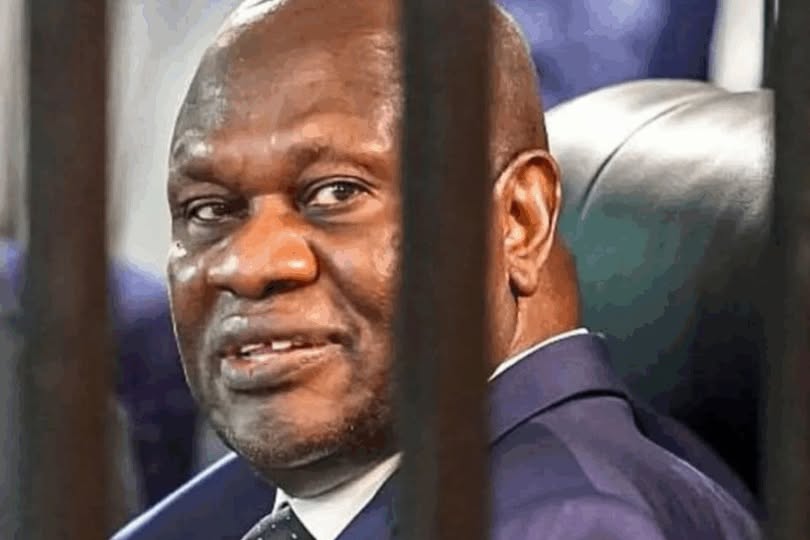
Judges sitting on the Special Court for the Incident of Nasir have admitted a disputed digital forensic report into evidence, rejecting objections raised by lawyers representing suspended First Vice President Dr. Riek Machar and other leaders of the SPLM/A (IO).
The ruling was delivered during the court’s 56th session held on Monday at Freedom Hall, where tension lingered over the credibility and timing of the contested forensic evidence.
At the heart of the dispute was a digital report whose certification dates were challenged by the defense as inconsistent and procedurally flawed.
Delivering the court’s preliminary ruling, Judge Stephen Simon Isaac, a member of the three-judge panel, said the court had “examined the document carefully” before striking down the defense objection related to Exhibit 9H.
He formally ordered that the controversial digital forensic report be admitted as part of the prosecution’s evidence.
However, the judge emphasized that the court’s decision was not the final word on the matter.
He clarified that the exhibit would be revisited later during the evidentiary evaluation phase, allowing for “a more detailed review” of its contents and reliability.
In the same session, the court also accepted exhibit 9I, which outlines the qualifications of Peter Rafadi Calvin, the digital forensic expert who prepared and submitted the report.
The court stated that it was satisfied that all procedural requirements governing expert testimony had been met.
The proceedings then shifted from technical arguments to questions of fairness and time.
Presiding Judge James Alala Deng asked the defense whether it was ready to begin cross-examining the forensic expert or required additional time to study the newly admitted report.
Defense lawyers requested an adjournment until Monday, 9 March 2026, arguing that they needed sufficient time to thoroughly review the technical material before questioning the expert.
They maintained that delays in the prosecution’s handling of evidence had already affected their ability to prepare adequately.
The prosecution opposed the request, describing it as “a waste of time” and a delay of justice. Prosecutors argued that the court had previously shown what they called “procedural mercy” toward the defense and said granting a week-long adjournment would unnecessarily slow the trial.
They also pointed out that copies of the prosecution’s documents had already been made available and noted that the expert had been present in the country for nearly a month, with health and other commitments.
After hearing arguments from both sides, Judge James Alala Deng sought a middle ground.
Acknowledging the defense’s need to prepare while also addressing concerns about delays, he adjourned the trial until Friday, 6 March 2026, allowing limited time for the defense to ready itself for cross-examination.