
In a bid to address local conflicts and amplify the voices of young people in Lakes state, the youth in Rumbek are taking the lead in promoting nonviolent approaches to ensure lasting peace and stability in the area.
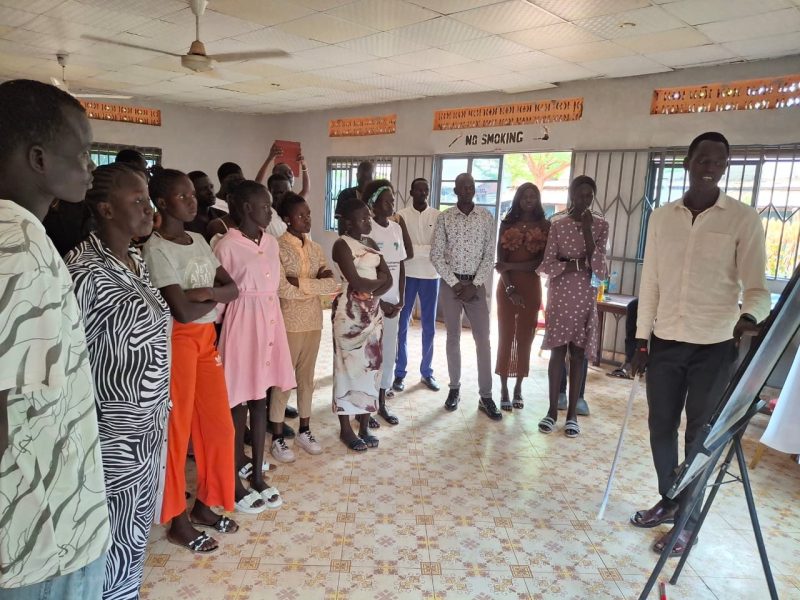
Between March 24 and 26 this year, the Rumbek Youth and Sports Association (RYSA) conducted a series of training on Synergizing Nonviolent Actions and Peace-building (SNAP) for youth activists from Wulu, Rumbek East and Rumbek counties.
The initiative was meant to draw youth from diverse backgrounds, equipping them with practical nonviolent action methods and techniques, skills in conflict resolution, dialogue mediation, negotiation and community engagement. About 35 participants were engaged.
Mary Alek Ater, a female activist, said the knowledge gained enables her to reach out to communities and champion peaceful coexistence.
“This training has opened my eyes to the power of nonviolent action. We have been trained on tips – the tools and the techniques, which we can use to solve certain situations,” she explained in an interview on March 26.
“I now feel confident to engage my community and help address conflicts in a peaceful and constructive manner,” Ater added.
During the exercise, the participants were trained on how to identify sources of conflict, manage tensions peacefully and promote unity within their communities.
“As young people, we have a responsibility to lead change. I am ready to use the skills gained to empower others, especially women and youth to become agents of peace,” she concluded.
Power analysis and pillars of support used for advocacy were also highlighted upon for societal betterment, according to the participants.
On his part, Emmanuel Marier Mabor, one of the youth leaders, revealed that the training had transformed his understanding of conflict and youth engagement and this equips him with tools to address challenges affecting his community.
“I have gained a lot from this course. It helped me realize that I have always been in the wrong direction before when approaching situations, but through the strategies and techniques we learned, I now understand how to approach issues affecting our communities in a more holistic manner,” he narrated.
The knowledge acquired, said Mabor, would be instrumental in tackling key issues such as drug abuse, early and forced marriage among young people across Lakes state.
According to him, it was high time to engage fellow youth through their association and advocate against drug abuse and early marriage which are currently rampant in the area.
“If we implement such strategies well, our communities will become more stable and young people will actively participate in decision making,” Mabor stated.
He encouraged the government to empower youth so that they (youth) become agents of local development.
The initiative was supported through the funding from the Norwegian People’s Aid (NPA).
Abass Mayek Mayen, the Executive Director at RYSA, said the initiative was part of the broader strategy to strengthen youth-led peacebuilding efforts across Lakes State.
“Our goal is to build a generation of young people who reject violence and embrace dialogue. Through initiatives like SNAP, we are investing in long term peace by empowering youth with practical tools for conflict resolution,”
He added that youth-led initiatives remain critical in addressing communal tensions and fostering unity in areas that have experienced cycles of violence.
The capacitated youth expressed optimism that the skills gained would enable them to become peace ambassadors as well as advocates for nonviolent campaigns.
This also helps locals to gain peacebuilding skills and claim their rights using nonviolent techniques and mechanism.
