
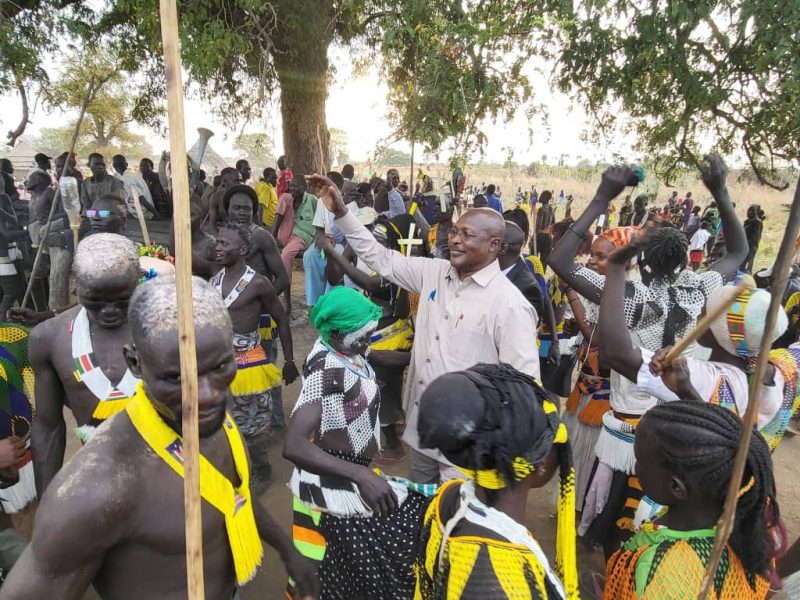
Eastern Equatoria State Governor Louis Lobong Lojore on Tuesday used the annual Allam Festival in Obule Village to urge communities to uphold peace, unity, and abandon harmful traditional practices that undermine human dignity.
The Governor joined hundreds of residents while traveling from Juba to Torit, making a stopover in Western Torit County after concluding official engagements in the national capital.
His presence drew traditional leaders, youth groups known as Monyemiji, women, elders, and community members attending the Otuho cultural celebration.
The Allam Festival marks the beginning of traditional preparations for cultivation and is deeply rooted in Otuho heritage.
Beyond its cultural importance, Governor Lobong said the gathering provided a vital platform for strengthening social cohesion and reinforcing shared identity.
Addressing the crowd, Lobong commended the people of Western Torit for maintaining peaceful coexistence, describing the area as a model of stability within Eastern Equatoria State.
“Peace is the foundation upon which we build schools, health facilities, and roads,” he said. “Without unity and stability, there can be no meaningful progress.”
He urged communities across the state to protect peace as a prerequisite for development, warning that insecurity and internal divisions continue to delay service delivery and economic growth.
The Governor encouraged organizers to expand future Allam celebrations by inviting state officials, neighboring communities, and residents from urban centers, saying inclusive cultural events help bridge divides between rural and urban populations.
“Our government fully supports the promotion and preservation of our rich cultural heritage,” Lobong said. “These festivals must unite us, not divide us.”
However, the Governor also addressed sensitive issues, strongly condemning the customary practice of compensating murder cases through the payment of a girl child a tradition still reported in some parts of the region.
He described the practice as outdated, unjust, and incompatible with national laws and international human rights standards.
“No human being should be used as compensation,” Lobong said emphatically. “If compensation must be made, it should be through cattle or monetary payment never through a child.”
His remarks were met with applause from sections of the crowd, reflecting growing public debate over the balance between cultural traditions, justice, and human rights in South Sudan’s communities.
As songs, dances, and traditional rituals continued in Obule Village, the message from the state’s top official was clear: culture must evolve to protect dignity, and peace remains non-negotiable in Eastern Equatoria State.