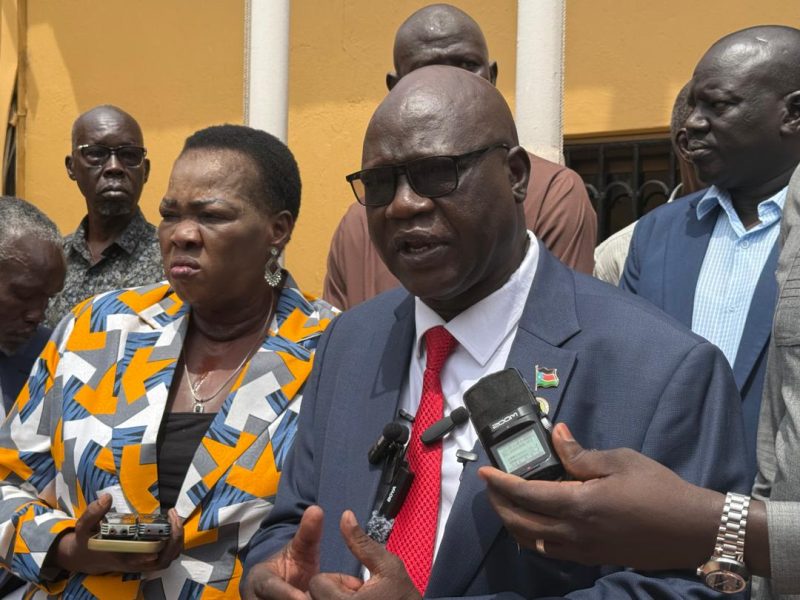
The Ministries of Justice and Trade have upheld the SSNCCIA leadership under Losidik Lukak Legge, rejecting a rival faction’s claim to power.
In a letter dated 13 February 2026, Justice Minister Michael Makuei Lueth declared that an Extraordinary General Assembly meeting held on 30 January 2026 which dissolved Lukak’s executive and installed an interim leadership led by Bona Bol Bol Areech was unconstitutional and legally void.
“The Extraordinary meeting of 30/01/2026 whose resolutions were endorsed by the Registrar of Workers Trade Unions is unconstitutional and thereby null and void,” the Minister ruled in the letter addressed to the SSNCCIA leadership.
The Justice Ministry further dissolved the 13-member Interim Executive Committee formed during the disputed meeting, stating that it was an illegal body constituted in violation of the Chamber’s Constitution and existing labour laws.
“The Interim Executive Committee of 13 members chaired by Mr. Bona Bol Bol Areech is hereby dissolved being an unconstitutional body,” the letter stated.
The dispute traces back to October 2024, when the SSNCCIA Board of Directors resolved to extend the term of its leadership for three years, from 22 October 2024 to 21 October 2027, a decision witnessed and endorsed by the Registrar of Workers Trade Unions at the time.
However, in January 2026, an Organizing Committee chaired by Joseph Makur Lueth convened an Extraordinary General Assembly without the consent of the sitting leadership.
That meeting rejected amendments to the Chamber’s constitution, dissolved Lukak’s executive, and installed an interim leadership moves the Justice Ministry has now categorically rejected.
According to the Justice Minister, the meeting violated multiple provisions of the SSNCCIA Constitution, including those governing who may convene meetings, how delegates are constituted, and the requirement for arbitration in cases of internal disputes.
“Calling a meeting is the sole responsibility of the Chairperson and not any other person,” the letter emphasized, citing Article 24 of the Chamber’s Constitution.
The Justice Ministry also placed responsibility on the Registrar of Workers Trade Unions for endorsing contradictory resolutions first recognizing the 2024 leadership extension and later approving the January 2026 Extraordinary Meeting.
“His task is not endorsement of whatever is brought before him, but to give necessary legal advice and guidance,” the Minister noted, describing the situation as a “constitutional and legal crisis” within the Chamber.
In a parallel move, the Minister of Trade and Industry, Atong Kuol Manyang, issued a similar letter aligning his Ministry with the Justice Ministry’s position.
The Trade Ministry letter rejected the interim leadership formed on 30 January 2026, affirmed the legality of the existing SSNCCIA leadership under Lukak, and instructed all business stakeholders and institutions to recognize only the constitutionally elected leadership of the Chamber.
The dual-ministry stance effectively shuts the door on the rival faction’s claims and restores Lukak’s authority with full government backing.
While upholding Lukak’s leadership, the Justice Ministry also directed the SSNCCIA to address internal governance weaknesses by reviewing and amending its Constitution before the next elections.
“The Constitution of the SSNCCIA needs to be corrected, reviewed, amended and updated,”
the letter stated, citing ambiguity and inconsistency in several provisions.
The Minister further instructed the Registrar of Workers Trade Unions to invoke the arbitration clause under Article 41 of the SSNCCIA Constitution to resolve disputes amicably and prevent future unilateral actions.
For now, Lukak emerges politically and legally intact, having survived what government authorities have now labeled an unconstitutional coup attempt—one decisively neutralized by coordinated state intervention.