Malaria accounts for nearly half of all deaths in South Sudan, officials said, warning that urgent action is needed to strengthen prevention, diagnosis, and treatment of one of the country’s deadliest diseases.
The warning came during the national World Malaria Day commemoration and the launch of a nationwide mosquito net campaign held Saturday in Gurei, outside Juba. Government officials and international partners used the event to highlight the scale of the crisis.
According to the National Bureau of Statistics, malaria is responsible for 64% of outpatient visits, 30% of hospital admissions, and nearly 50% of deaths nationwide.
Officials said data also shows that between 18% and 53% of children aged 6 to 59 months test positive for malaria, depending on testing methods, while only 25% of children with fever receive timely treatment.
Central Equatoria State Health Minister Joyce Bakwa said the disease continues to affect households and the economy, reducing productivity by as much as 40% to 50% among workers.
“The impact is so huge that we even lose them in the process,” she said, describing malaria as a preventable disease that still claims lives due to delayed treatment and poor use of available tools.
Undersecretary in the Ministry of Health, Dr. Oromo Francis, acknowledged the seriousness of the situation but said progress is being made through science and partnerships.
“Malaria is a problem. Everyone knows malaria. But together, we can, together we must,” he said.
Francis noted that newer tools such as improved mosquito nets, vaccines, and better medicines are strengthening the response, while future innovations could further reduce transmission.
He also urged communities to take greater responsibility for prevention efforts by ensuring all family members sleep under mosquito nets every night.
“By the time anyone wants to sleep, the nets should already be fixed,” he said.
At the same event, officials launched a campaign to distribute 9.5 million long-lasting insecticide-treated mosquito nets across the country.
The campaign in Central and Eastern Equatoria states is being implemented by Health Link South Sudan.
Dr. Ojok Agustin Alex Obadiah, Juba County health coordinator for Health Link, said the distribution will use digital registration, barcode scanning, and GPS tracking to improve accountability and verify delivery to households.
He said teams will also educate residents on proper use after previous distributions found some nets were diverted for gardens, livestock shelters, and household repairs.
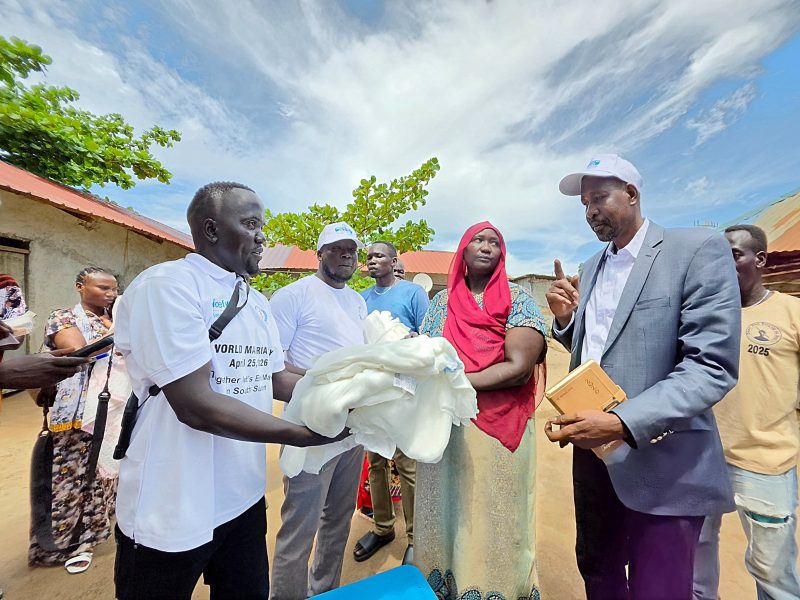
At the first household reached during the launch in Gurei’s Muraba Saba area, a resident identified as Mama Mary received five mosquito nets.
“I’m very happy. It’s the first-time people came to my house,” she said.
The campaign is supported by UNICEF, the World Health Organization, and the United Nations Development Programme. Officials say progress against malaria will depend on whether prevention tools, timely treatment, and public awareness reach every household.