The Nile Basin Initiative (NBI) has renewed calls for Nile riparian states to embrace cooperation over confrontation as longstanding disputes over water governance remain unresolved.
Speaking during the 20th Regional Nile Day celebrations in Juba on Saturday, NBI Executive Director Dr. Eng. Nestor Niyonzima said collaboration among member states is essential for sustainable and peaceful management of the river.
“Nile cooperation is not optional,” Niyonzima said. “It is the only path to sustainable and peaceful management of our shared river.”
His remarks come at a time when the basin is grappling with the legal complexities surrounding the Cooperative Framework Agreement (CFA), alongside mounting pressures from climate change and growing water demands.
Since its establishment in 1999, the NBI has served as the only inclusive regional platform that brings together Nile Basin countries to promote dialogue, technical collaboration, and joint planning.
Over the years, it has supported the development of shared hydrological data systems, flood forecasting mechanisms, and cross-border infrastructure projects.
However, longstanding political and legal disagreements persist over how the Nile should be governed, particularly regarding the Cooperative Framework Agreement (CFA).
The CFA, negotiated under the NBI process, seeks to establish a permanent Nile River Basin Commission to replace colonial-era treaties that allocated most of the river’s waters to downstream countries, mainly Egypt and Sudan.
Several upstream countries, including Ethiopia, Uganda, Tanzania, Rwanda, Kenya and Burundi, have signed and ratified the agreement, stating that it reflects principles of equitable and reasonable utilization under international water law.
Egypt and Sudan, however, have not joined the CFA, citing concerns over water security and historical usage rights.
Egypt’s Minister of Water Resources and Irrigation, Hani Sewilam, argued that broader consensus is needed before establishing a permanent commission.
Sewilam said Cairo remains committed to working through the NBI as “the only inclusive framework capable of bringing our Nile Basin countries together.”
He emphasized that the ongoing consultative process led by Nile-COM should continue addressing outstanding issues.
“The CFA is not a rigid document,” Sewilam said, noting provisions that allow amendments. “No one should be left behind. We cannot leave more than 50 percent of the basin behind us.”
Ethiopia, a key upstream state and host of the Grand Ethiopian Renaissance Dam (GERD), also stressed the need for cooperation.
Ethiopia’s Minister of Water and Energy, Habtamu Itefa, described the CFA as a legal framework that provides a fair basis for collaboration beyond colonial-era treaties.
“Cooperation is not an option. It is a must,” Itefa said. “The Nile is like an umbrella for our nations. We are tied together by this vital resource.”
He stated that embracing the agreement could unlock hydropower potential and accelerate economic integration across the basin.
For South Sudan, which sits at the heart of the White Nile and the vast Sudd wetlands, officials urged states that have not joined the CFA to prioritize citizens’ needs over political differences.
South Sudan’s Minister of Cabinet Affairs, Martin Elia Lomuro, warned that blocking water resource development in any basin country would directly harm vulnerable communities.
“If you are sabotaging or prohibiting development of water resources in any of the countries, you are directly impacting the youth, the women and the communities on the ground,” Lomuro said.
“These communities may be ethnically diverse, but their need for water is the same.”
He called on ministers to act “morally and humanely,” emphasizing that decisions on water management affect livelihoods, food security and regional stability.
The Nile supports more than 300 million people across 11 countries, sustaining ecosystems, agriculture and energy production. Yet it faces mounting pressure from climate change, rapid population growth and rising energy demands.
Flooding has intensified in countries such as South Sudan and Sudan, while drought conditions have affected parts of the Horn of Africa. Large infrastructure projects, including dams and irrigation schemes, have further heightened tensions between upstream and downstream states.
Despite these challenges, leaders maintained that dialogue remains the only viable path forward.
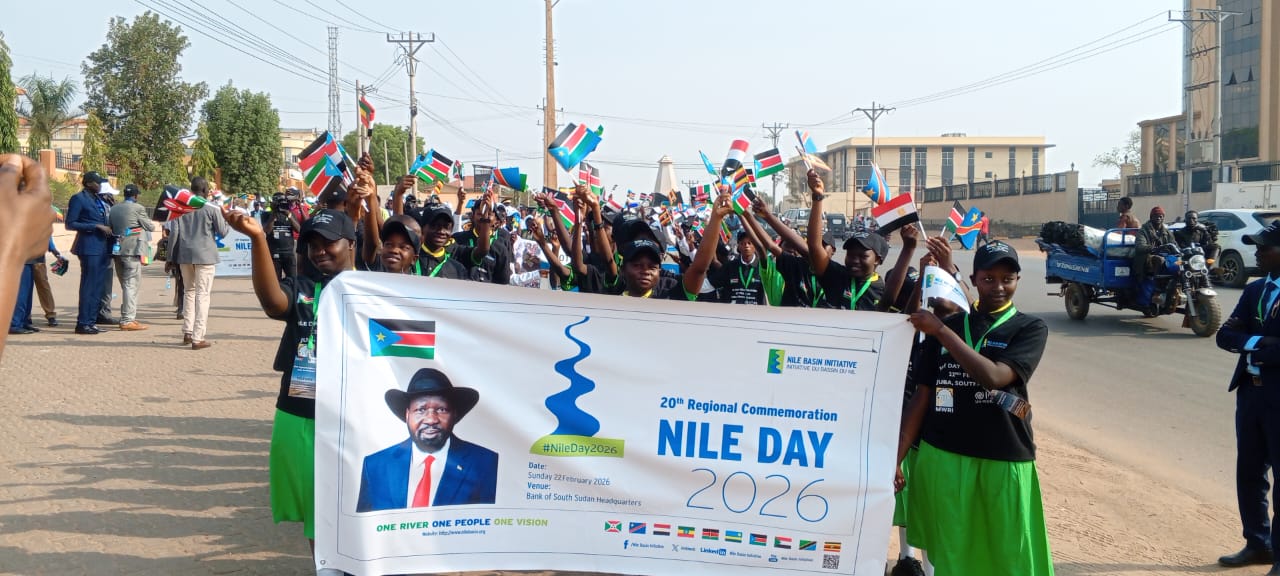
Under the theme “Voices of the Nile: Community, Youth and Women Engagement in Water Governance,” marks the first time the country has hosted the celebration since joining the Nile Basin Initiative (NBI) in 2012.
Celebrated annually on February 22, member states used the day to highlight the importance of cooperation in managing and developing the Nile as a shared resource in a sustainable manner.
This year’s celebrations featured feature cultural displays, music, and traditional dances reflecting South Sudan’s rich diversity, alongside policy dialogues among ministers, experts, and regional stakeholders.