
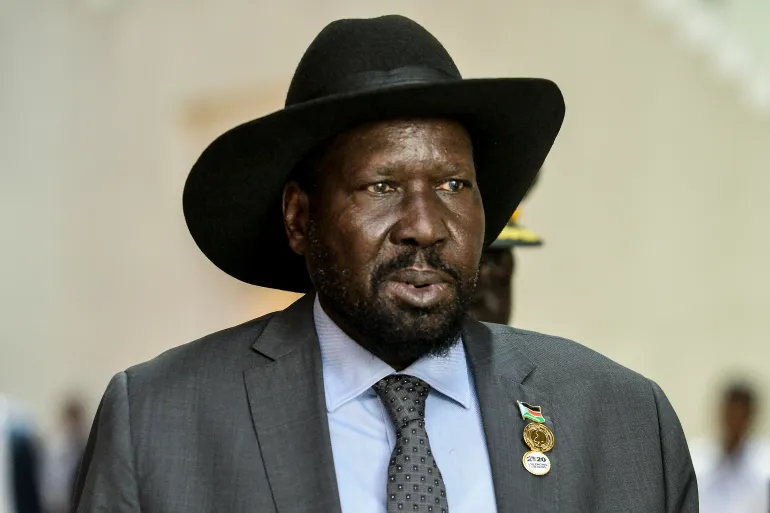
President Salva Kiir Mayardit on Thursday evening issued a fresh series of presidential decrees that triggered significant changes across South Sudan’s security, academic, and civil service institutions, once again keeping the public and political observers guessing about the direction of governance and power dynamics in the country.
The most notable change came within the powerful National Security Service (NSS), where President Kiir relieved Gen. Charles Chiech Mayor of his position as Director General of the Internal Security Bureau.
In his place, the president appointed Gen. Mawien Mawien Ariik, who was first promoted to the rank of General before assuming the new role an indication of the strategic importance attached to the security sector.
Beyond security, the decrees extended into the education sector. Prof. Robert Mayom Kuoirot was removed as Vice Chancellor of the University of Juba, South Sudan’s oldest and most prominent public university.
He was replaced by Prof. John Apuruot Akec, who returns to the position after previously serving as vice chancellor, a move that has sparked debate within academic circles about continuity, reform, and leadership stability in higher education.
Several changes were also announced within the civil service. Dr. Matiok Santino Akuei was dismissed from his role as undersecretary and replaced by Deng Makuok Duyak, while Caesar Oliha Marko was similarly relieved of his duties as undersecretary, with Paul Dhel Gum appointed as his successor.
The presidency further removed John Woja from his position as Director General, appointing Ayiei Deng Ayiei in his place.
At the local administration level, Daniel John was dismissed as commissioner, with Bona Gong Deng named as his replacement, continuing a pattern of frequent leadership changes at sub-national levels of government.
As with previous decrees, no official explanations were provided for the dismissals or appointments.
The lack of clarity has fueled speculation among citizens, analysts, and political actors, many of whom view the reshuffles as a reflection of President Kiir’s firm grip on executive authority and his preference for swift, unilateral decision-making.
Supporters of the president argue that such moves are necessary to improve efficiency, discipline, and loyalty within state institutions, particularly as the country navigates security challenges and prepares for a sensitive political transition.
Critics, however, contend that the frequent changes undermine institutional stability, weaken professionalism, and contribute to uncertainty within government structures.
The decrees come at a time when South Sudan is facing mounting pressure to implement key reforms under the Revitalized Peace Agreement and prepare for long-delayed elections.
Against this backdrop, President Kiir’s continued reshaping of leadership positions signals that power remains tightly centralized in the presidency leaving many South Sudanese to watch closely and wonder who might be next.