
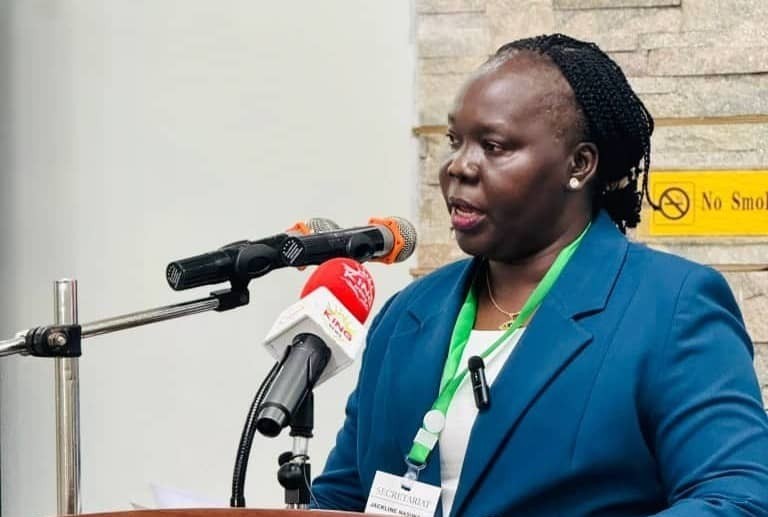
A Civil society activist has called out the transitional government for failing to meet the 35% affirmative action quota for women, labeling the inclusion of women in governance as “non-negotiable” for the country’s stability.
Speaking at the opening session of a three days National Stakeholders’ Dialogue in Juba, Jackline Nasiwa the Executive Director of Centre for Inclusive Governance, Peace and Justice (CIGPJ) highlighted that there is critical gap in the implementation of the 2018 Peace Agreement.
She noted that women continued to be marginalized in decision-making processes, a contrast to international commitments.
“This year marks the 25th anniversary of the UN Security Council Resolution 1325 and 30 years since the Beijing Platform for Action,” Nasiwa stated. “Yet, women’s participation in South Sudan remains below the affirmative action 35% quota.”
Nasiwa warned that women’s exclusion is a security risk, noting that the country stands at a crucial juncture where civilians, particularly women, face escalating risks of sexual and gender-based violence (SGBV) and displacement.
The dialogue, convened by the Centre for Inclusive Governance, Peace and Justice (CIGPJ) in collaboration with UN-Women and the South Sudan Civil Society Forum, aims to accelerate peace initiatives.
Supported by the Government of Norway and the UN Peacebuilding Fund, the dialogue comes at a time of ‘fragile and sluggish’ progress. According to the High-Level Standing Committee for the Peace Agreement report, only 10% of the Revitalised Agreement being implemented to date.
Nasiwa argued that this stagnation is linked to the lack of inclusive voices at the table.
“We must strive to shape a promising future for them. Our women are the pillars of resilience and the foundation of lasting peace. Strengthening their leadership is not negotiable. It is an essential and fundamental right,” Nasiwa declared.
With elections postponed to 2026, a move Nasiwa noted has ‘eroded public trust’, the dialogue seeks to unify messages in a nationwide ‘no return to war’ campaign.
The Executive Director further emphasized that enduring peace requires more than just halting combat; it requires a change of heart and the genuine engagement of marginalized communities.
“We believe that enduring peace will only be achieved when every voice, women, youth, and marginalized communities, is genuinely heard, respected, and engaged in peace and democratic processes,” she said.
Nasiwa expressed gratitude to UN Women for standing with the women of South Sudan, while calling on the diplomatic community, including representatives from the UK, the African Union, and IGAD, to apply pressure for a more inclusive transition.
The dialogue, which gathers over 80 participants, will continue through November 21st, focusing on mitigating risks and countering hate speech as the nation attempts to navigate its extended transition period.
It is being attended by diplomats, faith leaders, and government officials, including the Minister of Youth and Sports, Mary Nawai.
