
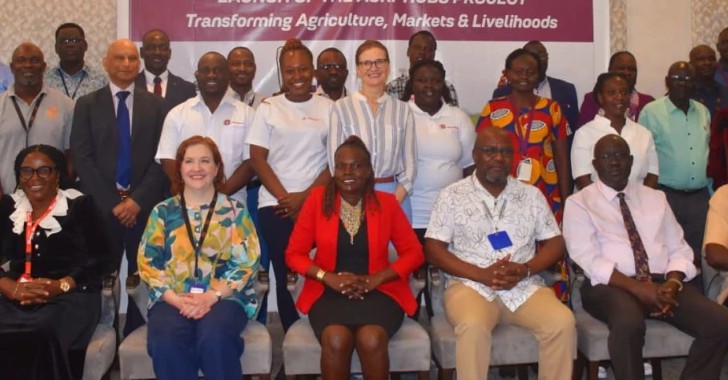
Norwegian Church Aid (NCA) has launched a new 2.9 million US dollar agriculture programme aimed at strengthening food production, market access and rural incomes as South Sudan grapples with widespread food insecurity.
The Agri Hub programme, which will run until November 2026, is funded by the Royal Norwegian Embassy and will be implemented by a consortium led by NCA together with Catholic Relief Services (CRS), CARE, Johanniter and IWIN.
At the launch, incoming NCA Country Director Cathrin Seland said the programme draws on decades of experience working alongside South Sudanese communities and responds to long-standing structural weaknesses in the country’s food system.
“Experience has shown us that farmers do better when production, markets and finance are addressed together,” Seland said, noting that fragmented support has often limited long-term impact.
She said the initiative is designed to move farming communities beyond subsistence by linking climate-adapted production with storage, aggregation centres and quality standards that can unlock access to markets.
South Sudan continues to face severe food insecurity, with more than seven million people affected, while rural households remain constrained by limited access to credit and long distances to functional markets.
Under the programme, 125 producer groups and five cooperatives in Lakes, Jonglei and Western Bahr el Ghazal states will receive technical support, improved inputs and training, reaching more than 6,100 women, men and youth.
Catholic Relief Services Country Director Dr. Tapfuma Murove said the project aligns with efforts to transition from short-term food assistance to sustainable livelihoods.
“There is an urgent need to shift from food aid to long-term solutions that strengthen farmers’ ability to withstand climate shocks,” Murove said.
He thanked the Norwegian Ministry of Foreign Affairs for supporting the initiative, saying the partnership reflects confidence in market-based approaches to improving food security.
The Ministry of Agriculture and Food Security welcomed the programme, describing cooperative farming as central to the country’s agricultural transformation.
Director for Cooperatives Peter Anyieth Mayen said thousands of registered cooperatives still lack basic capacity in financial management and production planning.
“A lot of smallholder farmers are still weak in record-keeping and organisation,” Mayen said, calling on development partners to strengthen cooperatives so they can drive poverty reduction and self-reliance.
NCA said women and youth will receive targeted support, including leadership training and access to finance, while conflict-sensitivity measures will be applied to reduce tensions and promote social cohesion within participating communities.
The organisation added that the Agri Hub model aims to establish sustainable, community-owned structures that will continue supporting production and trade beyond the project’s lifespan.