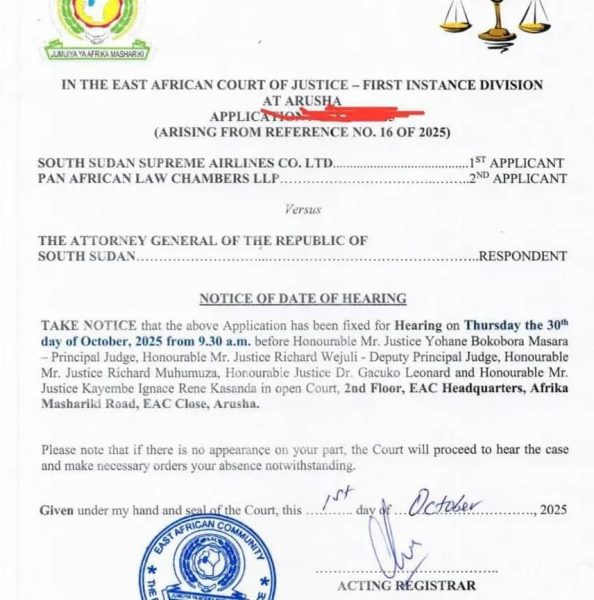
The East African Court of Justice (EACJ) will on October 30 begin hearing a $1.05 billion lawsuit against the government of South Sudan, accused of breaching a binding payment agreement with a local airline company.
The case, Reference No. 16 of 2025, pits South Sudan Supreme Airlines Co. Ltd. and Pan African Law Chambers LLP against the government in what could become one of the largest commercial disputes ever heard before the regional tribunal.
A five-judge panel will preside over the proceedings at the EACJ headquarters in Arusha, Tanzania.
According to court documents, the airline, owned by prominent businessman Ayii Duang Ayii and its legal counsel filed the suit on April 8, alleging that the government failed to honor a settlement agreement signed on February 13.
The agreement acknowledged a debt of $1,053,936,749.85, which was to be repaid in 24 monthly installments of $4.4 million each, beginning February 28.
An additional 10% legal fee was also due to the law firm representing the company.
However, despite repeated demands, the plaintiffs say the Ministry of Finance and Planning has not made any payments to date.
They argue that the government’s conduct amounts to a violation of fundamental principles of the Treaty for the Establishment of the East African Community, including the rule of law and good governance.
The lawsuit names South Sudan’s Attorney General as the respondent. Court filings indicate that the Ministry of Justice received the legal notice in April but failed to submit a response within the mandated 45-day period.
A notice from the EACJ’s acting registrar confirmed the hearing date, warning that if the government fails to appear, the court will proceed in absentia and issue binding orders.
Inside source reveals that the debt stems from services the airline provided to the South Sudanese army, though details of the contract including the timeline and nature of those services remain undisclosed.
The lawsuit comes as South Sudan grapples with a deepening debt crisis. The country, which began its independence in 2011 with virtually no external debt, has since accumulated significant financial obligations due to years of civil conflict, oil-backed loans, and economic instability.
A recent United Nations report warned that the government has “largely stopped repaying” its debts since 2018, with lawsuits from international banks and commodity traders piling up in various jurisdictions.
A judgment in favor of the airline could open the door for other creditors to pursue similar actions through the EACJ or other international tribunals.
For now, all eyes will be on Arusha on October 30, where the five-judge bench will determine whether South Sudan must pay more than a billion dollars — a sum equal to a significant portion of the country’s annual budget — or face further legal and diplomatic fallout.